2026 Kimono Storage Preservation: Archival Care Guide
The Evolution of Kimono Preservation in 2026
As we navigate the environmental realities of 2026, preserving vintage and antique silk kimonos requires far more than traditional folding methods and cedar chests. Global climate shifts have led to increasingly erratic indoor humidity patterns, making passive storage solutions largely obsolete for serious collectors and museum curators alike. The kimono is not merely a garment; it is a complex architectural assembly of delicate protein fibers, natural dyes, and metallic threads that demand rigorous, science-backed collection management. Whether you are safeguarding a single family heirloom or managing a sprawling archive of Edo-period kosode, understanding the intersection of traditional Japanese textile arts and modern archival science is critical for ensuring these masterpieces survive for future generations.
The Science of Silk Degradation
To properly store a kimono, one must first understand the vulnerabilities of its primary material. Silk is a natural protein fiber composed of fibroin and sericin. While incredibly strong in terms of tensile strength, silk is highly susceptible to environmental degradation. Prolonged exposure to ultraviolet light causes photo-oxidation, leading to irreversible yellowing and fiber shattering. However, the most insidious threat in a domestic setting is improper relative humidity (RH). According to guidelines published by the Victoria and Albert Museum, high humidity levels (above 65% RH) create an ideal breeding ground for mold spores, which can digest silk proteins and leave permanent, dark staining. Conversely, excessively dry environments (below 40% RH) strip the fiber of its natural moisture, rendering the silk brittle and prone to cracking along fold lines.
Traditional vs. Modern Storage Solutions
Historically, kimonos were stored in tansu (traditional Japanese wooden chests) made of Paulownia or Cedar wood. While these woods possess natural pest-repellent properties and can buffer minor humidity fluctuations, they are entirely inadequate for the strict climate control required in 2026. Below is a comparison of traditional and modern archival storage methods currently utilized by top conservation labs.
| Storage Method | Humidity Control | Pest Protection | 2026 Cost Estimate |
|---|---|---|---|
| Traditional Kiri Tansu | Poor (Fluctuates with room) | Moderate (Natural wood oils) | $3,500 - $8,000 |
| Gaylord Archival Textile Boxes | Moderate (Requires silica) | High (Sealed micro-environment) | $45 - $120 per box |
| Totech Electronic Dry Cabinet | Excellent (Active electronic) | High (Sealed, monitored) | $800 - $2,400 |
Gaylord Archival Textile Boxes: The Flat Storage Standard
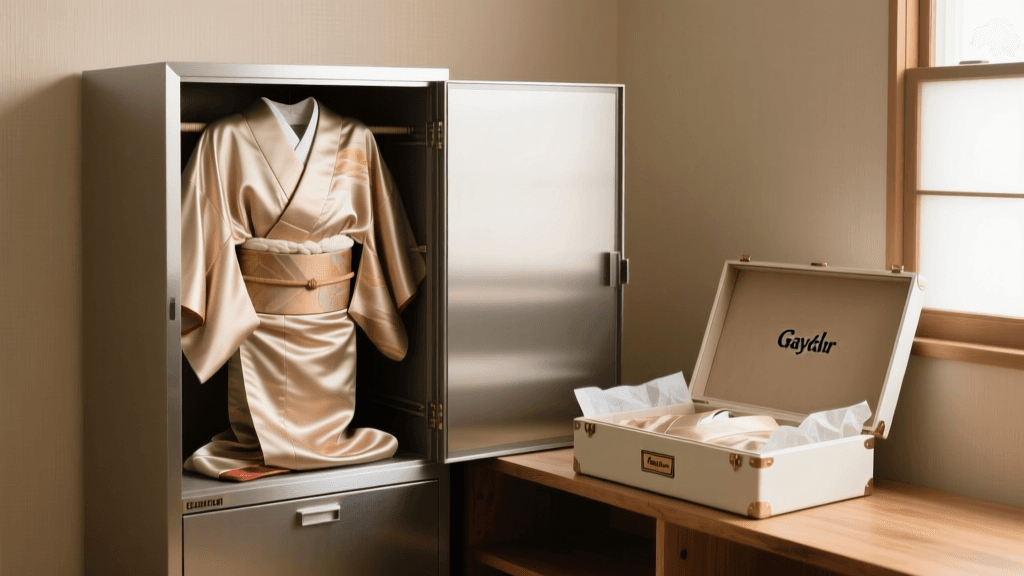
For collectors who lack the space or budget for electronic cabinetry, flat storage in archival boxes remains the gold standard. In 2026, the industry leader for this application is Gaylord Archival. Their unbuffered, acid-free textile boxes are specifically engineered for protein-based fibers like silk and wool. It is a common and devastating mistake for amateur collectors to use buffered acid-free boxes; the alkaline reserve (calcium carbonate) used in buffered paper can cause chemical reactions that degrade silk and alter the hues of natural dyes over time. When utilizing Gaylord boxes, the kimono must be layered with unbuffered, pH-neutral tissue paper to cushion the folds and prevent hard creases. These boxes should be stored on metal shelving units in a dark, climate-stable interior room, far away from exterior walls, attics, or basements.
Totech Electronic Dry Cabinets: Active Climate Control
For high-value collections, active humidity control is non-negotiable. The 2026 lineup of Totech Super Dry Cabinets represents the pinnacle of textile preservation technology. Unlike passive desiccants like silica gel—which require frequent monitoring, baking, and recharging—Totech cabinets utilize an electronic dehumidification system that actively monitors and adjusts the internal microclimate. For silk kimonos, the ideal target is a stable 45% to 55% RH. Totech's latest smart-sensor models feature Wi-Fi integration, allowing collection managers to receive real-time alerts on their mobile devices if the ambient room humidity spikes and threatens the cabinet's internal seal. Furthermore, these cabinets feature UV-blocking tempered glass and adjustable, powder-coated steel shelves that prevent off-gassing, ensuring that the garments are protected from both atmospheric moisture and light damage.
The Art of Folding: The Tato-shi Technique
How a kimono is folded is just as critical as the environment it is stored in. The traditional Japanese folding method, known as tato-shi, is specifically designed to align the seams and distribute the bulk of the fabric evenly, minimizing stress on the silk. However, even the perfect tato-shi fold will cause damage if left undisturbed for years. The weight of the garment will eventually compress the fibers at the fold line, leading to 'silk shattering'—a phenomenon where the fabric splits along the crease.
To mitigate this in 2026, conservators employ a technique called 'padding the folds.' Before executing the final folds of the tato-shi method, archivists roll unbuffered acid-free tissue paper into loose cylinders and place them inside the creases. This creates a soft, rounded curve rather than a sharp, hard edge, drastically reducing mechanical stress on the fibroin structure. Additionally, collection managers must adhere to a strict rotation schedule. Every six months, garments should be removed, gently shaken out, and refolded along slightly different lines to ensure that no single area of the textile bears prolonged compression.
Integrated Pest Management (IPM) in 2026
The days of tossing toxic camphor blocks or naphthalene mothballs into a storage chest are long gone. These volatile organic compounds (VOCs) off-gas aggressively, reacting with metallic threads and causing the tarnishing of gold and silver leaf, while simultaneously accelerating the deterioration of the silk itself. Modern preservation relies on Integrated Pest Management (IPM). The Canadian Conservation Institute strongly advocates for preventive monitoring over chemical intervention.
In a modern collection, this involves placing non-toxic pheromone sticky traps in the corners of the storage room to monitor for the presence of webbing clothes moths and carpet beetles. If an infestation is detected in a specific kimono, the garment is not sprayed with chemicals. Instead, it undergoes anoxic treatment or controlled freezing. The garment is sealed in an oxygen-barrier film with an oxygen scavenger, effectively suffocating any larvae or eggs without introducing harmful residues to the delicate textile.
Digital Collection Management and Tracking
Preservation is not just about physical storage; it is about meticulous documentation. As collections grow, relying on memory or physical index cards becomes a liability. In 2026, serious collectors and institutions utilize specialized collection management software such as CollectionSpace or PastPerfect to track the lifecycle of each garment. A comprehensive digital record should include high-resolution macro photography of the weave and dye condition, detailed provenance, and a condition report noting any existing areas of weakness, staining, or shattering.
Crucially, the software is used to schedule the aforementioned six-month rotation and inspection cycles. Automated alerts remind the collection manager when a specific Totech cabinet needs its desiccant backup checked, or when a specific Edo-period kosode is due to be gently unfolded and refolded to prevent permanent crease setting. According to the American Institute for Conservation, consistent documentation and condition reporting are the bedrock of preventive conservation, allowing curators to track the rate of degradation over time and adjust environmental controls before irreversible damage occurs.
Conclusion: Safeguarding the Future of Asian Traditions
The kimono is a profound expression of Japanese aesthetics, history, and craftsmanship. Preserving these garments in 2026 requires a departure from romanticized, outdated storage methods in favor of rigorous, scientifically validated archival practices. By investing in unbuffered Gaylord archival boxes, utilizing the active climate control of Totech electronic dry cabinets, mastering the padded tato-shi folding technique, and embracing digital collection management, collectors can ensure that these magnificent silk textiles remain vibrant, intact, and structurally sound for centuries to come. The preservation of Asian traditional garments is an active, ongoing stewardship—a bridge connecting the master weavers of the past with the admirers of the future.