Vintage Silk Kimono & Hanbok Archival Preservation 2026
Introduction to Asian Garment Preservation in 2026
Preserving vintage Asian garments, particularly the intricate Japanese kimono and the voluminous Korean hanbok, requires a meticulous approach to textile conservation. As we navigate 2026, the field of archival preservation has evolved significantly, moving away from harsh chemical treatments and toward sustainable, non-toxic, and highly controlled environmental management. For collectors, museum curators, and families holding onto precious heirlooms, understanding the specific vulnerabilities of traditional Asian garments is the first step toward ensuring their survival for future generations.
Silk, the foundational fabric for many high-status kimonos and hanboks, is a delicate protein fiber. Unlike plant-based cellulose fibers such as cotton or linen, silk is highly susceptible to environmental fluctuations, light damage, and specific biological threats. According to the American Institute for Conservation's Textile Wiki, protein fibers require specialized microclimates to prevent irreversible degradation. This comprehensive guide outlines the most current, museum-grade preservation techniques available in 2026 for safeguarding your vintage Asian textile collection.
The Science of Silk Degradation
To properly care for vintage silk, one must understand its chemical structure. Silk is composed primarily of fibroin, a protein that is inherently sensitive to alkaline environments and ultraviolet (UV) radiation. When exposed to direct sunlight or even high-intensity ambient indoor lighting, the amino acid chains within the silk begin to break down, leading to photo-oxidation. This manifests as severe yellowing, loss of tensile strength, and eventual 'shattering,' where the fabric literally crumbles along fold lines.
Furthermore, many vintage kimonos from the late 19th and early 20th centuries were treated with metallic salts—a process known as 'weighting'—to give the silk a heavier, more luxurious drape. Over time, these metallic salts accelerate the deterioration of the silk, causing it to become brittle. The heavily pleated skirts of traditional hanboks (chima) and the long, sweeping sleeves of kimonos (furisode) create natural stress points where this shattering is most likely to occur if the garments are stored improperly.
2026 Standards for Archival Storage Materials
The cornerstone of any preservation strategy is the use of chemically stable, archival-quality storage materials. In 2026, the conservation community strictly enforces the 'unbuffered' rule for protein fibers. While acid-free buffered tissue paper (which contains an alkaline reserve, usually calcium carbonate, to neutralize acids) is excellent for cotton and linen, it is highly detrimental to silk. The alkaline reserve in buffered tissue will actively degrade silk fibroin over time.
The Unbuffered Tissue Rule
Always use unbuffered, acid-free, lignin-free tissue paper when wrapping or padding vintage kimonos and hanboks. This neutral-pH material provides a safe physical barrier without introducing harmful alkaline chemicals. When folding a kimono, every single fold must be padded with rolls of unbuffered tissue to prevent hard creases. Crease memory in vintage silk leads to micro-fractures in the fibers, which eventually result in tearing.
Enclosures and Boxes
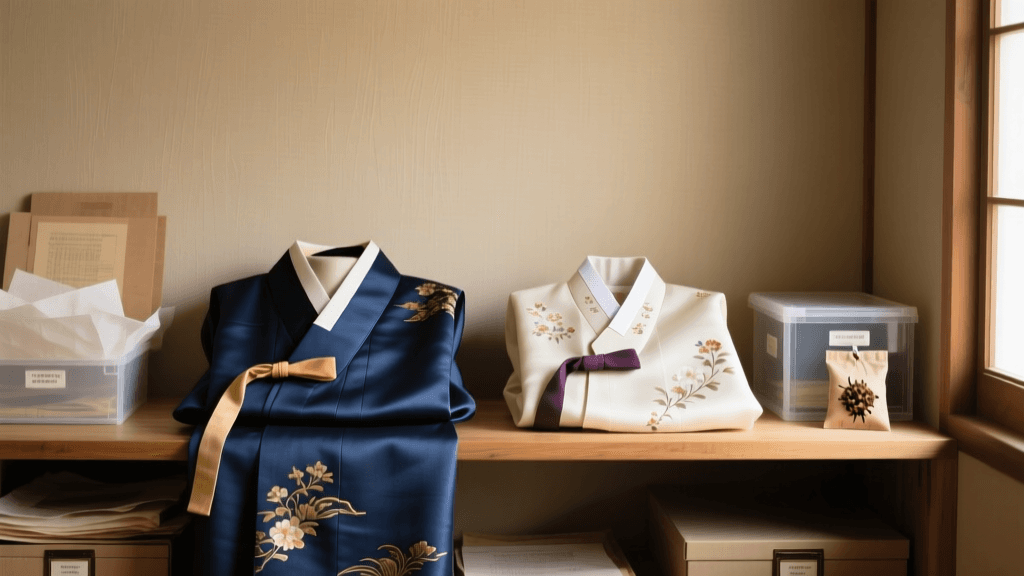
For long-term storage, garments should be placed in custom-fitted archival boxes made from corrugated polypropylene or acid-free cardboard. In 2026, many institutions have transitioned to washed, unbleached muslin cotton bags for garments that require breathability but are kept in climate-controlled, dust-free environments. Never store silk in standard plastic dry-cleaning bags or polyvinyl chloride (PVC) containers, as these plastics off-gas harmful plasticizers and trap moisture, creating a breeding ground for mold.
Specialized Folding and Padding Techniques
The physical manipulation of the garment during storage is just as critical as the materials used. The Japanese have long utilized the hondatami (traditional folding) method for kimonos, which is designed to align seams and distribute the weight of the fabric evenly. However, for archival storage, the traditional fold must be modified with extensive padding.
For the Korean hanbok, the jeogori (jacket) can be folded similarly to a kimono, but the chima (skirt) presents a unique challenge due to its dense, radial pleating. Folding a vintage silk chima will crush the pleats and cause severe stress at the waistband. In 2026, the recommended protocol for heavily pleated hanbok skirts is to either roll them gently around an acid-free honeycomb cardboard tube, interleaved with unbuffered tissue, or to store them flat in oversized archival drawers where the pleats can be supported by custom-cut Ethafoam wedges.
Climate Control and Smart Environmental Monitoring
Environmental stability is the most critical factor in preventing mold growth and fiber desiccation. Silk requires a relative humidity (RH) level between 45% and 55%. If the RH drops below 40%, the silk becomes brittle; if it rises above 60%, the risk of mold spores germinating increases exponentially. Temperature should be kept consistently cool, ideally around 65°F (18°C), as higher temperatures accelerate chemical degradation.
In 2026, maintaining these parameters is easier than ever thanks to the proliferation of affordable, mesh-networked smart hygrometers. These devices utilize e-ink displays (which emit zero UV light or heat) and can send real-time alerts to your smartphone if the microclimate inside an archival box or storage room fluctuates outside the safe parameters. Following the Canadian Conservation Institute guidelines, it is recommended to place at least one data logger inside every major storage enclosure to monitor the actual environment surrounding the textile, rather than relying solely on room-level HVAC sensors.
Advanced Pest Management for Protein Fibers
Webbing clothes moths (Tineola bisselliella) and carpet beetles are the natural enemies of silk, as these insects feed on keratin and protein-based fibers. Historically, collectors relied on naphthalene mothballs or paradichlorobenzene (PDB) crystals. Today, these volatile organic compounds (VOCs) are recognized as highly toxic to both humans and the textiles themselves, causing chemical staining and accelerating fiber degradation.
Pheromone Monitoring and Anoxic Treatment
Modern 2026 pest management relies on prevention, monitoring, and anoxic (oxygen-deprived) treatments. Sticky pheromone traps should be placed strategically around the storage area to monitor for male moth activity. These traps do not eliminate an infestation but serve as an early warning system. If an infestation is detected, or if a newly acquired vintage kimono is being quarantined, the garment should undergo anoxic treatment. This involves sealing the garment in a specialized, oxygen-impermeable barrier film (such as Escal film) along with oxygen scavengers. By reducing the oxygen level below 0.1% for a period of 21 days, all life stages of the pest—including eggs, larvae, pupae, and adults—are safely eradicated without the use of any toxic chemicals.
Handling and Display Best Practices
When handling vintage Asian garments, the natural oils, salts, and acids present on human skin can easily transfer to the silk, causing permanent staining and localized degradation. While older guidelines often recommended white cotton gloves, the 2026 consensus among textile conservators—supported by the Victoria and Albert Museum's textile care protocols—favors freshly washed, bare hands for handling delicate, brittle silks. Cotton gloves can reduce tactile sensitivity, increasing the risk of snagging fragile embroidery or tearing brittle fabric. However, if the garment features metallic threads or heavy beading, clean, powder-free nitrile gloves should be worn to prevent tarnishing the metal elements.
For display, garments should never be hung on standard wire or wooden hangers. The weight of a heavy, embroidered kimono or a multi-layered hanbok will cause severe stress on the shoulder seams, leading to tearing. Display should be done using custom-padded, sloped hangers wrapped in washed muslin, or ideally, the garment should be displayed flat on a slanted, fabric-covered conservation board to eliminate gravitational stress entirely.
Material Comparison Chart for 2026 Archival Storage
| Storage Material | Best Use Case | Why It Works | 2026 Avg. Cost Estimate |
|---|---|---|---|
| Unbuffered Acid-Free Tissue | Wrapping, padding folds, and interleaving pleats | Neutral pH prevents protein fiber breakdown and chemical burns | $18 per 100 sheets |
| Corrugated Polypropylene Boxes | Long-term, light-proof enclosure for folded garments | Chemically inert, waterproof, and provides rigid structural support | $45 - $85 per box |
| Washed Unbleached Muslin | Dust covers and breathable garment bags | Allows moisture vapor transmission while blocking dust and light | $12 per yard |
| Ethafoam Planks | Custom carving for supporting hanbok chima pleats | Closed-cell polyethylene that does not off-gas or absorb moisture | $35 per plank |
| Escal Barrier Film | Anoxic pest treatment and extreme isolation | Impermeable to oxygen and moisture, allowing safe pest eradication | $25 per linear foot |
Conclusion
The preservation of vintage silk kimonos and hanboks is a profound responsibility that bridges the gap between historical artistry and future appreciation. By adopting the 2026 standards for archival storage, utilizing unbuffered materials, implementing smart climate monitoring, and embracing non-toxic pest management, collectors can halt the degradation of these magnificent garments. Proper care ensures that the intricate weaving, vibrant dyeing, and masterful tailoring of traditional Asian textiles remain intact, allowing the stories woven into their silk threads to endure for centuries to come.