Vintage Silk Kimono & Hanbok Preservation Guide 2026
The Rising Importance of Asian Garment Preservation in 2026
As the global appreciation for traditional Asian garments continues to surge in 2026, the demand for vintage and antique silk kimonos, hanboks, and cheongsams has reached unprecedented levels. Collectors, cultural institutions, and families holding onto heirloom pieces are increasingly aware that these garments are not merely clothing, but woven artifacts of immense historical and artistic value. However, the very nature of the materials used in these garments—primarily silk, metallic threads, and natural dyes—makes them highly susceptible to environmental degradation. Proper preservation and restoration are no longer optional; they are essential practices for anyone looking to protect these cultural treasures for future generations.
Unlike modern synthetic textiles, traditional Asian garments require highly specific care protocols. The intersection of traditional wisdom and modern conservation science has led to updated best practices for 2026, focusing on non-invasive storage, precise climate control, and safe restoration techniques. This comprehensive guide explores the latest museum-grade standards for preserving your valuable silk kimonos and hanboks.
The Science of Silk Degradation in Protein Fibers
To understand how to preserve a kimono or hanbok, one must first understand the chemistry of silk. Silk is a natural protein fiber composed primarily of fibroin. While it possesses remarkable tensile strength, it is inherently vulnerable to three major threats: hydrolysis (breakdown by water and humidity), photo-oxidation (damage from ultraviolet and visible light), and biological attacks from mold and insects.
In 2026, conservationists emphasize that the greatest enemy of stored silk is fluctuating humidity. When silk absorbs moisture, the fibers swell; when they dry, they contract. Over decades, this microscopic expanding and contracting causes the fibers to snap, leading to the phenomenon known as 'shattering,' where vintage silk literally crumbles to the touch. Furthermore, the natural dyes used in traditional Japanese and Korean garments, such as indigo, safflower, and gromwell, are highly fugitive and can fade or bleed if exposed to improper pH levels or excessive light.
2026 Archival Storage Standards for Kimono and Hanbok
The foundation of garment preservation is the creation of a stable, chemically inert microenvironment. According to guidelines maintained by the Canadian Conservation Institute (CCI), protein-based fibers require strictly unbuffered, acid-free materials for storage. Many consumers mistakenly purchase 'acid-free' tissue paper that is actually buffered with calcium carbonate to protect plant-based fibers like cotton and linen. This alkaline buffer is highly destructive to silk and will cause irreversible yellowing and fiber weakening over time.
Material Comparison: Choosing the Right Archival Supplies
Selecting the correct archival materials is critical. The table below outlines the 2026 standards for materials interacting directly or indirectly with vintage Asian garments.
| Material | Safe for Silk (Kimono/Hanbok)? | Safe for Cotton/Linen? | 2026 Conservation Recommendation |
|---|---|---|---|
| Unbuffered Acid-Free Tissue | Yes | Yes | Essential for direct silk contact and interleaving folds. |
| Buffered Acid-Free Tissue | No | Yes | Strictly avoid; alkaline buffer degrades protein fibers. |
| Polyethylene (PE) Plastic | Yes (with caution) | Yes | Acceptable for secondary dust barriers; ensure ventilation. |
| Polyvinyl Chloride (PVC) | No | No | Never use; off-gasses hydrochloric acid and plasticizers. |
| Raw Cedar Wood Chests | No (direct contact) | No | Traditional, but raw cedar oils stain silk. Must be fully lined. |
| Washed Cotton Muslin | Yes | Yes | Excellent for wrapping garments before boxing. |
The Traditional Tato Wrapping and Hanbok Rolling Methods
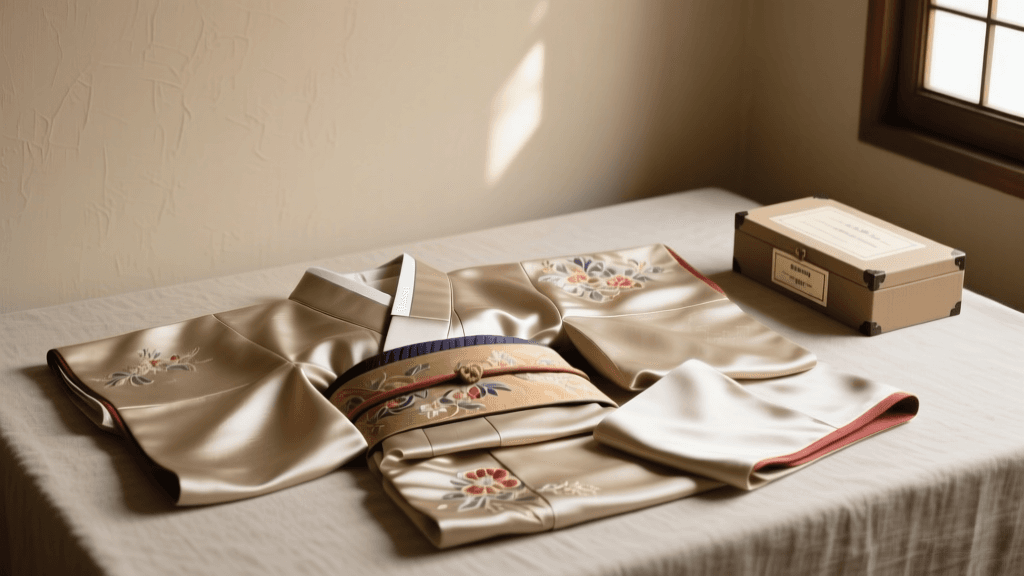
How a garment is folded dictates where permanent creases and subsequent fiber breaks will occur. In Japan, the traditional method of storing a kimono is known as the tato (or tatou) method. This involves a precise folding technique that aligns the seams, minimizing stress on the fabric, followed by wrapping the garment in a large sheet of unbuffered tissue or traditional tatogami paper. In 2026, conservators recommend padding the folds with crumpled unbuffered tissue to prevent sharp creases, which act as focal points for fiber degradation and dust accumulation.
Conversely, the traditional Korean hanbok presents unique storage challenges, particularly the chima (the voluminous wrap-around skirt). Folding a silk chima creates harsh, unnatural creases that can shatter the fabric over time. Modern preservationists recommend rolling the chima around acid-free archival tubes padded with unbuffered tissue. The jeogori (jacket) can be folded gently, but the intricate geumbak (gold leaf stamping) often found on hanboks requires interleaving with smooth, unbuffered tissue to prevent the gold leaf from abrading and transferring onto the opposite side of the fabric.
Climate Control and Mold Prevention in 2026
Mold is a catastrophic threat to vintage silk. Once mold spores colonize a protein fiber, they consume it, leaving permanent staining and structural weakness. The American Institute for Conservation (AIC) emphasizes that mold growth is virtually guaranteed when relative humidity (RH) exceeds 65% for prolonged periods, especially in warm environments.
In 2026, maintaining a stable microclimate is easier than ever thanks to advanced smart-home integration. Conservators recommend utilizing Wi-Fi-enabled hygrometers, such as the Govee H5179 or SwitchBot Sensor, placed directly inside archival storage boxes or cedar chests. The ideal target for silk preservation is a stable 50% RH (with a strict variance of no more than ±5%) and a temperature of 65°F (18°C). If you live in a high-humidity region, investing in a dedicated, climate-controlled storage closet with a commercial-grade desiccant dehumidifier is highly recommended over relying on standard residential HVAC systems, which often fail to maintain precise humidity levels in localized spaces.
Pest Management Without Hazardous Chemicals
Silverfish, carpet beetles, and clothes moths view silk as a prime food source. Historically, collectors relied on camphor, naphthalene, or paradichlorobenzene (mothballs) to deter pests. Today, these chemicals are recognized as highly toxic to both humans and textiles; they can react with metallic threads and synthetic dyes, causing severe discoloration and accelerating fiber decay.
Modern 2026 pest management relies on Integrated Pest Management (IPM) strategies. This includes the use of non-toxic pheromone traps to monitor insect activity, rigorous vacuuming of storage areas, and the use of oxygen-deprivation (anoxia) treatments for garments that show signs of active infestation. Freezing garments to kill pests is a known museum technique, but it carries high risks for vintage Asian garments due to the potential for condensation and thermal shock to delicate metallic threads and lacquered elements. Therefore, prevention through sealed, pest-proof archival boxes is the preferred methodology.
Cleaning and Restoration: Arai-Hari vs. Modern Methods
When a vintage kimono or hanbok becomes soiled, traditional dry cleaning is often a death sentence for the garment. The harsh solvents and mechanical tumbling used in commercial dry cleaning can strip the silk of its natural sericin, dissolve traditional paste-resist dyes, and destroy the structural integrity of the hand-stitching.
The gold standard for kimono restoration remains the traditional Japanese art of arai-hari (洗い張り). This meticulous process involves carefully unpicking every seam of the kimono until it returns to its original, flat, rectangular fabric panels. These panels are then gently washed using specialized, pH-neutral soap and water, stretched on a bamboo frame (shinshi) to dry and realign the fibers, and finally re-sewn by a master artisan. In 2026, finding skilled arai-hari artisans outside of Kyoto and Tokyo is challenging, leading to the rise of specialized international restoration services that partner directly with Japanese workshops.
For hanboks, spot cleaning with specialized conservation-grade sponges and deionized water is preferred for minor blemishes. If a full clean is necessary, the garment must be disassembled by a specialist familiar with Korean traditional sewing techniques (chimseon), as the curved seams and hidden stitches require highly specific handling to maintain the garment's distinctive silhouette upon reassembly.
Conclusion
Preserving vintage silk kimonos and hanboks is a profound responsibility that bridges the gap between historical reverence and modern science. By adhering to 2026's strict archival standards—utilizing unbuffered tissues, employing the correct folding and rolling techniques, maintaining rigorous climate control, and seeking out traditional restoration methods like arai-hari—collectors and families can ensure these magnificent Asian garments survive to tell their stories for centuries to come. Treat your garments not merely as clothing, but as the fragile, irreplaceable works of art they truly are.