Vintage Silk Kimono Storage & Preservation Collection Guide 2026
The Evolving Standards of Kimono Preservation in 2026
As we navigate the shifting climate patterns of 2026, the preservation of vintage silk kimonos has become more complex and critical than ever before. Collectors, archivists, and enthusiasts recognize that extreme humidity fluctuations and rising global temperatures pose severe threats to delicate protein-based fibers. The days of simply folding a prized Meiji or Taisho-era garment and placing it in a standard cedar chest are over. Today, comprehensive collection management requires a synthesis of traditional Japanese wisdom and cutting-edge archival science. This guide outlines the definitive 2026 protocols for storing, monitoring, and preserving vintage silk kimonos, ensuring these masterpieces of Asian textile heritage survive for future generations.
The Anatomy of Silk Degradation
To properly store a kimono, one must first understand the vulnerabilities of its primary material. Silk is a natural protein fiber composed mainly of fibroin and sericin. While incredibly strong in its pristine state, vintage silk is highly susceptible to environmental stressors. The most catastrophic form of silk degradation is known as 'shattering,' where the fibers become brittle and split along fold lines or areas of mechanical stress. This is often exacerbated by historical dyeing processes that used heavy metallic mordants, particularly in black or dark purple garments from the early 20th century.
Furthermore, environmental pollutants, ultraviolet light, and improper humidity levels accelerate the breakdown of the amino acid chains within the silk. According to the Victoria and Albert Museum's textile conservation guidelines, maintaining a stable environment is the single most effective way to halt the chemical degradation of historic silk textiles. In 2026, museum-grade preservation focuses on neutralizing acidic off-gassing and maintaining strict microclimate stability.
The Ultimate 2026 Archival Storage Stack
Building the correct physical barrier between your kimono and the external environment is the foundation of collection management. The modern archival stack combines traditional Japanese materials with contemporary conservation-grade products.
Tatou (畳紙) and Acid-Free Interleaving
Traditionally, kimonos are wrapped in tatou, a specialized multi-layered paper designed to allow the silk to breathe while protecting it from dust and light. In 2026, authentic acid-free, lignin-free Japanese tatou remains the gold standard for wrapping. If traditional tatou is unavailable, conservators recommend using unbuffered, acid-free tissue paper to interleave the folds. Never use standard tissue paper or plastic dry-cleaning bags, as these trap moisture and emit volatile organic compounds (VOCs) that yellow and weaken silk.
Kiri (Paulownia) Wood Tansu vs. Archival Boxes
The traditional kiri (paulownia) wood tansu (chest) has been used in Japan for centuries. Paulownia is uniquely suited for textile storage because its cellular structure naturally expands in high humidity to seal out moisture, and contracts in dry conditions to allow airflow. However, not all modern tansu are created equal. When sourcing a chest in 2026, ensure the wood is untreated and finished only with natural oils or left raw. For collectors lacking space for a tansu, museum-grade corrugated polypropylene archival boxes (such as those manufactured by Blue Box or Gaylord Archival) offer excellent, chemically inert alternatives that stack securely in climate-controlled rooms.
Climate Control: Temperature and Relative Humidity (RH)
The invisible enemies of the kimono collection are temperature spikes and relative humidity (RH) fluctuations. The ideal storage environment for vintage silk is a steady 65°F (18°C) with an RH of 45% to 50%. High humidity encourages mold growth and attracts pests, while low humidity desiccates the fibers, leading to shattering.
In 2026, smart home integration has revolutionized microclimate monitoring. Collectors are increasingly relying on Wi-Fi-enabled thermohygrometers, such as the latest SwitchBot Meter Pro or Govee H5179 sensors, placed directly inside the tansu drawers or archival boxes. These devices log data to the cloud, sending instant smartphone alerts if the RH deviates from the 45-50% safe zone. This proactive approach allows collectors to deploy localized silica gel cassettes (like Art-Sorb or Pro-Sorb) to buffer sudden humidity spikes before damage occurs. The Canadian Conservation Institute emphasizes that stability is often more important than hitting the exact ideal number; avoiding rapid swings in RH is paramount for preventing mechanical stress on the silk fibers.
Pest Management Without Chemicals
Webbing clothes moths and carpet beetles are the bane of protein-based textile collections. Historically, collectors relied on chemical mothballs (naphthalene or paradichlorobenzene), but these are now recognized as highly toxic to both human health and the textiles themselves, leaving residual crystals that degrade silk dyes.
The 2026 standard for pest management is strictly non-toxic and preventive. Pheromone traps should be deployed in the perimeter of the storage room to monitor for adult male moths. If an infestation is suspected, the safest eradication method is the freezing protocol. The affected kimono is sealed in a polyethylene bag with minimal air, placed in a standard chest freezer at -20°C (-4°F) for 72 hours, and then thawed slowly over 24 hours while still sealed to prevent condensation from forming on the silk. This process effectively kills all life stages of the pest without introducing chemicals to the garment.
Material Comparison Chart for Kimono Storage
Selecting the right materials for wrapping and boxing is critical. Below is a comparison of common storage materials evaluated for 2026 archival standards:
| Material | Archival Rating | Breathability | Pros & Cons for Silk Kimonos |
|---|---|---|---|
| Traditional Tatou Paper | Excellent | High | Pros: Authentic, breathable, pH neutral. Cons: Expensive, requires periodic replacement. |
| Unbuffered Acid-Free Tissue | Excellent | High | Pros: Readily available, safe for protein fibers. Cons: Tears easily, requires multiple sheets. |
| Unbleached Cotton Muslin | Good | Very High | Pros: Reusable, washable, excellent dust barrier. Cons: Must be pre-washed to remove sizing. |
| Polyethylene Plastic (Archival) | Fair | None | Pros: Water-proof, good for freezing pests. Cons: Traps moisture, risks mold if not monitored. |
| PVC / Standard Vinyl | Poor (Avoid) | None | Pros: Cheap. Cons: Off-gasses toxic plasticizers that permanently stain and shatter silk. |
Step-by-Step Folding and Storing Protocol
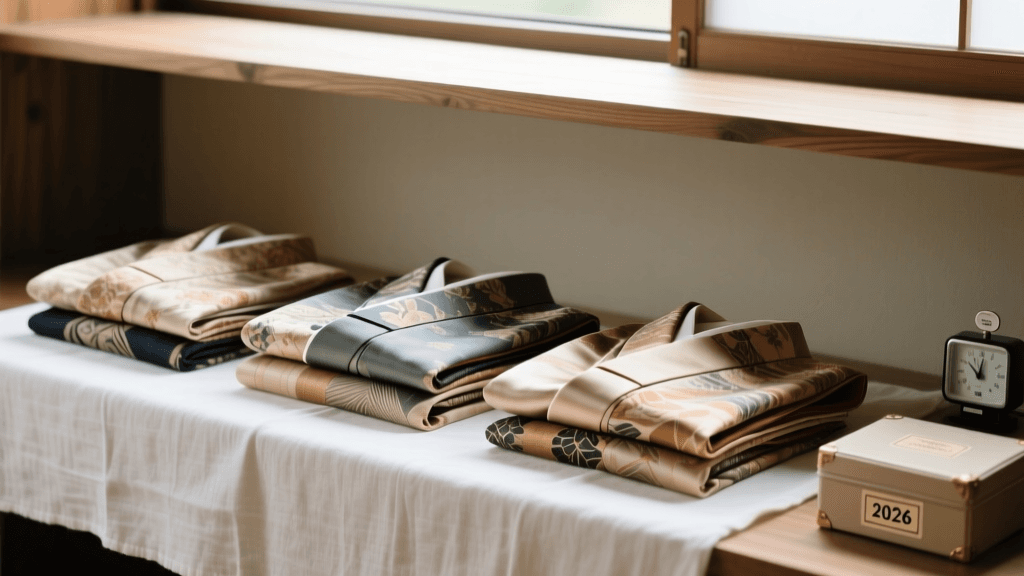
Improper folding creates permanent creases that weaken the silk over time. The traditional Japanese folding method, hon-datami, is specifically designed to align the seams and distribute stress evenly across the garment. Always fold the kimono on a clean, smooth surface covered with a fresh sheet of unbleached muslin or a large piece of tatou paper.
- Lay the kimono face down, smoothing out any wrinkles from the center back seam outward.
- Fold the left front panel back along its natural seam line, then fold the right front panel over it, creating a long, narrow rectangle.
- Fold the sleeves back so they align with the edges of the body, ensuring the intricate sleeve patterns are not sharply creased.
- Fold the garment in half lengthwise, bringing the hem up to the collar. Use acid-free tissue paper rolls or padded 'snakes' inside the major folds to create soft, rounded curves rather than hard, sharp creases.
- Wrap the folded kimono securely in the tatou paper, tying it with a flat, undyed cotton cord or a strip of clean silk. Never use adhesive tape or tight synthetic strings.
The Modern Mushiboshi (Airing Out) Routine
In Japan, the tradition of mushiboshi involves airing out kimonos during the dry, crisp days of late autumn. In 2026, with many collections stored in climate-controlled urban apartments, this practice must be adapted. Once a year, preferably during a period of low outdoor humidity, open the tansu drawers or archival boxes. Unwrap the kimonos and let them breathe in a shaded, well-ventilated room for 24 hours. This allows any trapped micro-moisture to dissipate and gives the collector an opportunity to inspect the garments for early signs of mold, pest activity, or dye transfer. By combining the time-honored rituals of Japanese garment care with the precision of modern environmental monitoring, your vintage silk kimono collection will remain vibrant, structurally sound, and historically intact for decades to come.