Miao Ethnic Clothing: Guide to Traditional Silver & Silk
Introduction to Miao Clothing Traditions
The Miao people, widely known outside of China as the Hmong, represent one of the most culturally vibrant and historically resilient ethnic minority groups in Asia. Primarily concentrated in the mountainous regions of China's Guizhou, Hunan, and Yunnan provinces, the Miao have cultivated a sartorial heritage that is globally recognized for its breathtaking complexity. According to Encyclopedia Britannica, the Miao historically lacked a formalized written language. As a result, their clothing serves as a 'wearable history book,' with every stitch, motif, and silver adornment encoding myths, migration routes, and clan identities.
For textile collectors, cultural historians, and sustainable fashion enthusiasts, understanding Miao garments requires looking beyond their visual splendor. It demands an appreciation of the immense technical skill, the specific regional variations, and the socio-economic structures that sustain these crafts today. This guide provides an in-depth exploration of Miao embroidery, indigo dyeing, and silversmithing, alongside actionable advice for sourcing authentic pieces.
The Art of Miao Embroidery (Xiu)
Miao embroidery is not a single technique but a diverse collection of over a dozen distinct stitching methods. The most revered is Shuangkou Xiu (double-needle lock stitch), which creates a raised, braided effect that is incredibly durable. Another highly prized method is Zhouxiu (wrapping stitch), where silk threads are wrapped around a core of horsehair or cotton to create three-dimensional, sculptural motifs.
Mythological Motifs and Storytelling
The motifs found on a traditional Miao jacket, particularly the famous Baiyi (hundred-bird jacket), are deeply symbolic. The most prominent figure is the 'Butterfly Mother' (Mai Bang), the mythical progenitor of the Miao people who is said to have hatched the first humans from twelve eggs. Other common motifs include the water buffalo (a symbol of agricultural wealth and ancestral spirits), the five-clawed dragon (adapted from Han Chinese imperial iconography but reimagined as a benevolent, protective water spirit), and geometric representations of the Yellow River and the Yangtze River, mapping the ancestral migration of the Miao people.
Indigo Dyeing and Batik (Ladao)
Before embroidery begins, the foundation fabric must be prepared. Miao artisans are masters of indigo fermentation and beeswax batik. The indigo plant (Strobilanthes cusia) is fermented in wooden vats with rice wine, ash, and limestone to create a living dye bath. Cotton or hemp fabric is dipped repeatedly over several weeks to achieve a deep, midnight blue.
For batik, artisans use a specialized brass knife called a ladao to draw intricate geometric patterns with melted beeswax. The fabric is then dyed in indigo, and the wax is boiled off, revealing crisp white patterns against the dark blue background. In regions like Danzhai, the finished indigo cloth is beaten with wooden mallets and coated in a mixture of buffalo hide glue and egg white, resulting in a stiff, metallic-looking fabric known as 'shiny cloth' (liangbu).
The Weight of Tradition: Miao Silver Jewelry
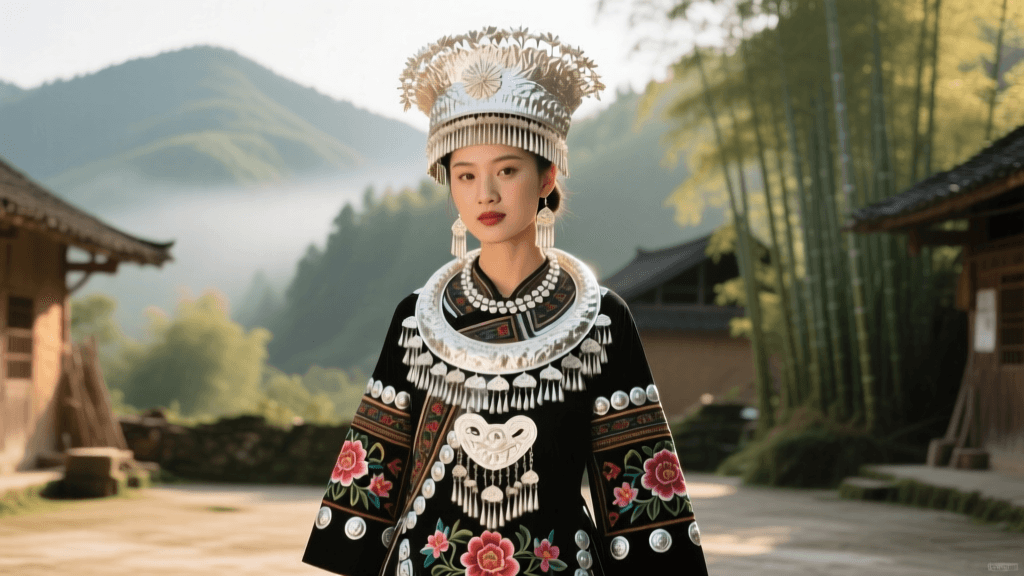
No Miao festival garment is complete without an overwhelming display of silver. Silver is believed to possess spiritual properties that ward off evil spirits, illuminate the path to the afterlife, and display the wealth and status of a family. According to the Metropolitan Museum of Art's Asian Art Department, the sheer volume of silver worn by Miao women during festivals is a testament to the community's dedication to preserving ancestral wealth in a portable, wearable form.
Understanding Miao Silver Craftsmanship
Miao silversmiths, traditionally men who inherit their craft from their fathers, utilize complex techniques such as filigree, repoussé, and granulation. A full festival silver set can weigh anywhere from 5 to 10 kilograms. The most iconic piece is the Sheng (silver horn headdress), which can span up to 80 centimeters in width and mimic the horns of the revered water buffalo.
Actionable Advice for Buying Silver
- Purity Verification: Traditional Miao silver is often stamped with '990' or '999' to denote purity. However, structural pieces like large hairpins may be alloyed with copper (around 70-80% silver) to prevent bending. Always ask the artisan about the structural integrity versus surface purity.
- Pricing Structure: Authentic artisan silver is priced by weight plus a craftsmanship fee. Expect to pay between $15 to $25 USD per gram for the silver, plus a 20% to 50% markup for the labor, depending on the complexity of the filigree work.
- Weight Considerations: If purchasing for wear rather than display, opt for a silver neck torc (xiangquan) which typically weighs 200-400 grams, rather than a full headdress which can cause neck strain during prolonged wear.
Comparative Guide to Miao Garments and Accessories
| Item Name | Average Weight / Size | Estimated Cost (USD) | Best Occasion to Buy / Wear |
|---|---|---|---|
| Baiyi (Hundred-Bird Jacket) | Wingspan 110-120 cm | $800 - $3,500+ | Museum display, high-end collection |
| Sheng (Silver Horn Headdress) | 60-80 cm wide; 1-2 kg | $600 - $1,500 | Festival wear, cultural exhibitions |
| Baidie (Pleated Indigo Skirt) | Up to 20m of fabric, 1-2 kg | $300 - $800 | Daily traditional wear, dance performances |
| Xiangquan (Silver Neck Torc) | 200 - 400 grams | $150 - $350 | Everyday elegant wear, gifting |
Practical Sourcing: Where and When to Buy
Sourcing authentic Miao textiles requires navigating the delicate balance between commercialized tourist markets and genuine artisan cooperatives. The UNESCO Intangible Cultural Heritage lists recognize several traditional crafts in this region, highlighting the importance of supporting verified artisan communities to keep these practices alive.
Timing Your Visit
To see the garments in their full context and to meet artisans who are actively creating festival wear, time your visit to Guizhou province around major lunar festivals. The Sisters' Meal Festival (usually in April or May) in Taijiang County is arguably the best time to witness the most elaborate silver and embroidery. The Lusheng Festival (often in October or November) in Kaili and surrounding villages is another prime opportunity. During these times, village cooperatives often open their doors to serious buyers and collectors.
Navigating Costs and Authenticity
When buying in markets like the Xijiang Thousand Households Miao Village, be highly skeptical of 'antique' jackets priced under $200. True vintage pieces from the mid-20th century are rare and command prices upward of $2,000. Most affordable 'vintage' items are actually modern pieces that have been artificially distressed or chemically faded.
To verify hand-embroidery over machine-embroidery, examine the reverse side of the fabric. Hand-stitched Miao embroidery will show nearly identical neatness on both the front and back, with no long, loose jump-threads. Machine embroidery will feature a messy back with visible bobbin threads and synthetic, overly shiny rayon threads. Authentic pieces use locally spun silk and cotton, which have a softer, more matte luster.
Caring for Your Miao Textiles and Silver
Proper maintenance is crucial for preserving the integrity of these culturally significant items.
- Indigo Textiles: Never wash authentic indigo-dyed Miao garments in modern chemical detergents, as the alkalinity will strip the natural dye. If cleaning is necessary, spot clean with cold water and a pH-neutral soap. Store them flat in a cool, dark place, as prolonged exposure to direct sunlight will cause the indigo to oxidize and fade to a pale gray.
- Silver Jewelry: Miao silver naturally develops a dark patina over time, which many collectors prefer as it highlights the intricate repoussé details. If you wish to restore the shine, avoid harsh commercial silver dips. Instead, use a soft jeweler's cloth and gently polish only the raised surfaces, leaving the crevices dark to maintain the three-dimensional contrast of the design.
By understanding the profound mythology, the rigorous craftsmanship, and the practical realities of sourcing, collectors and enthusiasts can engage with Miao clothing traditions in a way that is both respectful and deeply informed.