A Collector's Guide to Vintage Meiji and Taisho Kimono
The Allure of Meiji and Taisho Era Textiles
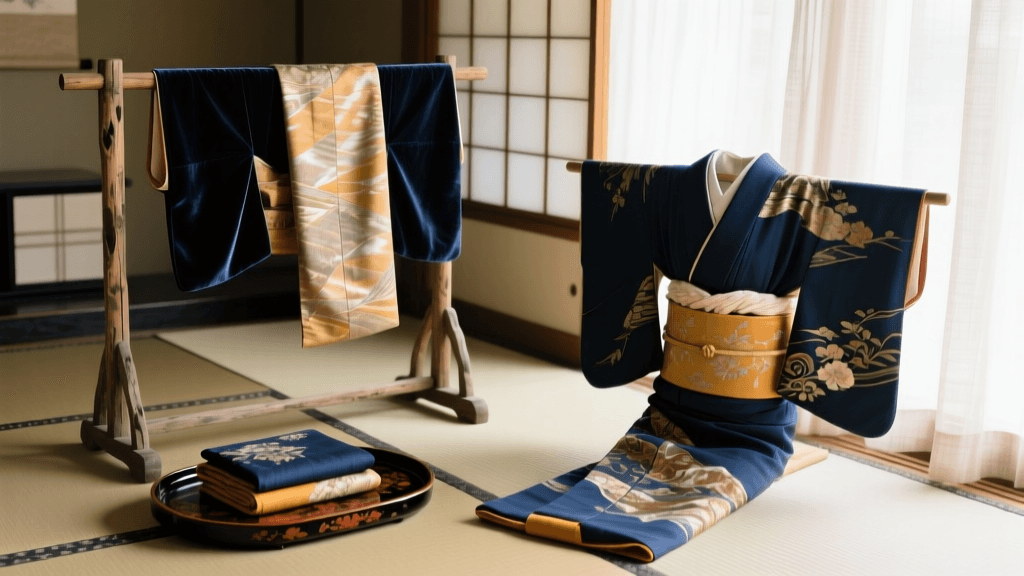
For serious collectors of Japanese traditional garments, the Meiji (1868–1912) and Taisho (1912–1926) eras represent a golden age of textile innovation. Following centuries of strict Edo-period sumptuary laws that limited commoners to subdued colors and subtle patterns, the Meiji Restoration opened Japan to global trade. This influx of Western technology introduced synthetic aniline dyes, allowing artisans to create breathtakingly vivid magentas, purples, and emerald greens. As noted by The Metropolitan Museum of Art's Heilbrunn Timeline of Art History, this era marked a profound transformation in Japanese dress, blending indigenous yuzen dyeing techniques with newly imported chemical dyes and Western aesthetic influences.
The subsequent Taisho era birthed the 'Taisho Roman' movement, a romantic and avant-garde cultural shift characterized by Art Nouveau and Art Deco influences. Taisho kimono feature bold, surreal, and geometric motifs—often depicting modern cityscapes, abstract florals, or stylized animals. Collecting these specific eras offers a tangible connection to Japan's rapid modernization, but it also requires a deep understanding of authentication, specialized sourcing, and meticulous conservation.
Sourcing Authentic Vintage Kimono
Acquiring genuine Meiji and Taisho pieces requires looking beyond standard tourist shops in Kyoto. The most prolific sourcing channels for international collectors include:
- Yahoo! Auctions Japan: The largest domestic marketplace for vintage textiles. Because it requires a Japanese bank account and address, international collectors must use proxy bidding services like Buyee or ZenMarket. Search terms such as Meiji jidai kimono (明治時代着物), Taisho roman (大正ロマン), and antique yuzen (アンティーク友禅) yield the best results.
- Specialized Online Dealers: Retailers like Ichiroya (based in Osaka) curate high-quality antique pieces and ship globally. While prices are higher than raw auctions, the garments are professionally inspected, photographed, and accurately described.
- Domestic Flea Markets: If you are traveling to Japan, the Oedo Antique Market in Tokyo (held on the 1st and 3rd Sundays) and the To-ji Temple Flea Market in Kyoto (held on the 21st of each month) are premier hunting grounds. Arrive at dawn to sift through dealer boxes before the best silk chirimen (crepe) and rinzu (satin damask) pieces are claimed.
Authentication and Era Identification
Distinguishing between a genuine antique and a mid-century reproduction requires examining the dye, lining, and motifs. According to the Victoria and Albert Museum's Asian Kimono Collection, the evolution of the kimono's interior and exterior design provides vital clues to its age. Use the comparison chart below to evaluate potential acquisitions.
| Feature | Meiji Era (1868–1912) | Taisho Era (1912–1926) | Early/Mid Showa (1926–1950s) |
|---|---|---|---|
| Dyes & Colors | Introduction of vivid aniline dyes (magenta, deep purple); heavy use of indigo and safflower. | Pastels mixed with bold, contrasting accent colors; emergence of soft, muted 'modern' palettes. | Wartime restrictions led to duller, utilitarian colors; post-war saw a return to bright, synthetic hues. |
| Motifs | Traditional flora, fauna, and courtly scenes, occasionally incorporating subtle Western elements. | 'Taisho Roman' geometrics, Art Deco patterns, surrealism, and modern architecture. | Highly stylized, repetitive patterns (komon); later, mass-produced woven designs. |
| Lining (Uraji) | Often lined with solid red silk (beni-iro) or intricately dyed silk featuring hidden patterns. | Cream, white, or pale pastel linings; occasional use of patterned silk for the lower half. | Standardized white or unbleached cotton/silk blends; less focus on hidden luxury. |
| Sleeve Length | Generally shorter sleeves for unmarried women compared to modern furisode. | Sleeves began to lengthen slightly, reflecting changing social norms for young women. | Standardized modern lengths established for both tomesode and furisode. |
Understanding Vintage Measurements
One of the most significant hurdles for modern collectors is sizing. Vintage Japanese women were notably shorter and narrower than the contemporary global average. A genuine Meiji or Taisho kimono was typically tailored for a woman standing around 4'10" to 5'2" (147–157 cm).
Key Measurements to Check
- Yuki (Sleeve Span): Measured from the center back of the neck to the wrist. Vintage yuki rarely exceeds 62 cm (24.5 inches). Modern standard is 64–68 cm.
- Mitake (Back Length): Measured from the base of the collar to the hem. Vintage mitake is usually 150–155 cm (59–61 inches).
Collector's Tip: If you are taller than 5'4" (162 cm), you will not have enough fabric to create the traditional ohashori (the waist fold that allows the kimono to be adjusted to the wearer's height). To wear a true antique, you must either wear it without the fold (like a Western dress), use a faux-ohashori belt, or accept that the piece is strictly for display and study.
Preservation, Storage, and Conservation
Antique silk is a delicate protein fiber highly susceptible to light, humidity, and acidic environments. Proper storage is non-negotiable for preserving the structural integrity and vibrant dyes of Meiji and Taisho textiles.
'Silk degrades rapidly when exposed to fluctuating humidity and acidic off-gassing. Archival storage is not an option; it is a requirement for any textile over fifty years old.'
Best Practices for Archival Storage
The Canadian Conservation Institute guidelines on storing textiles emphasize the importance of a stable environment. Follow these actionable steps to protect your collection:
- Avoid Cedar and Plastic: Never store antique silk in cedar chests. The natural oils and acidic off-gassing from cedar will cause the silk to yellow and become brittle. Similarly, avoid plastic garment bags, which trap moisture and promote mold growth.
- Use Paulownia Wood (Kiribako): Traditional Japanese paulownia wood boxes are ideal. Paulownia is naturally moisture-regulating, fire-resistant, and low in acidic resins. If using modern archival boxes, ensure they are made of acid-free, buffered cardboard.
- Acid-Free Tissue Paper: Fold the kimono as minimally as possible to prevent permanent creasing and fiber breakage. Pad the folds with unbuffered, acid-free tissue paper. Refold the garment along different lines every six months to distribute stress on the fibers.
- Climate Control: Maintain a stable relative humidity (RH) of 50–55% and a temperature of around 65°F (18°C). Keep the storage area completely dark, as UV light will rapidly fade the aniline dyes used in the Meiji era.
Professional Cleaning: Arai-Hari
If you acquire a vintage piece with stains or structural fatigue, do not attempt to dry clean or hand wash it. Traditional Japanese laundering, known as arai-hari, involves carefully unpicking every seam of the kimono, washing the flat panels of silk with specialized mild detergents, stretching them on bamboo frames to dry and realign the fibers, and then hand-sewing the garment back together. In the US or Europe, specialized Japanese textile conservators charge between $150 and $350 USD for this meticulous service. It is a worthy investment for museum-quality Taisho Roman pieces.
Building and Cataloging Your Collection
As your collection grows, maintaining a detailed digital catalog is essential. Use a database tool like Airtable or Notion to track each acquisition. Record the acquisition date, purchase price, proxy fees, era, specific motifs, lining color, and condition notes (e.g., 'minor foxing on left sleeve', 'hemline wear'). Photographing the garment flat, alongside close-ups of the family crests (kamon) and the lining, will aid in insurance valuation and future authentication. By focusing on the rich historical narrative and strict conservation of Meiji and Taisho garments, collectors do more than hoard beautiful fabrics; they act as custodians of Japan's most dynamic era of textile art.