Identifying Vintage Japanese Textiles: Shibori, Yuzen, Kasuri
The Resurgence of Vintage Japanese Textiles
The global appreciation for traditional Japanese garments has sparked a massive resurgence in the collecting and wearing of vintage kimono, haori, and juban. For collectors, fashion historians, and enthusiasts, understanding the foundational dyeing techniques is paramount. The 'big three' of Japanese surface design—Shibori, Yuzen, and Kasuri—each represent centuries of regional mastery, distinct chemical processes, and unique aesthetic philosophies. Whether you are sourcing pieces for a personal archive, upcycling textiles for modern fashion, or simply seeking to appreciate the craftsmanship of your current wardrobe, knowing how to identify and care for these specific dyeing methods is essential.
Shibori: The Art of Shaped Resist Dyeing
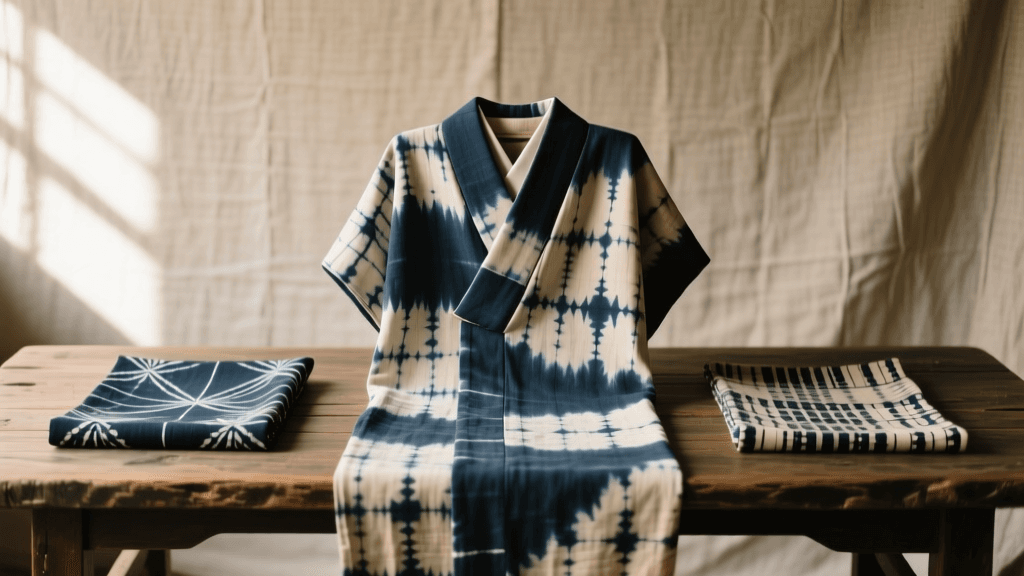
Shibori is often mistakenly reduced to simple tie-dye in Western contexts, but it is actually a highly complex family of shaped-resist dyeing techniques. According to the World Shibori Network, the term encompasses any method of manipulating fabric—through binding, stitching, folding, twisting, or compressing—before dyeing to create intricate, often three-dimensional patterns.
Key Variations and Identification Markers
- Kanoko Shibori: Resembling fawn spots, this technique involves pinching and binding tiny tufts of fabric with thread. Identification: Look for distinct, un-dyed circles with a slightly raised, textured center. Authentic vintage Kanoko feels bumpy to the touch.
- Arashi Shibori: Pole-wrapping technique where fabric is wrapped diagonally around a cylindrical pole and tightly bound. Identification: Creates striking, diagonal, rain-like striations. The texture is distinctly ribbed.
- Itajime Shibori: Shape-resist using carved wooden blocks or acrylic plates clamped onto folded fabric. Identification: Yields crisp, repeating geometric patterns (like grids or triangles) with sharp, un-dyed margins.
Practical Collecting Advice
When shopping for vintage Shibori (typically found on silk crepe or lightweight cotton), always run your fingers over the pattern. True Shibori retains a structural memory; the resist areas will feel slightly raised or puckered compared to the dyed areas. Be wary of modern, mass-produced 'faux-shibori' which prints the pattern flat onto the fabric. Authentic vintage silk Shibori haori jackets typically range from $80 to $350, while fully hand-stitched Kanoko kimono can command prices upwards of $1,200 due to the hundreds of hours of labor required.
Yuzen: Paste-Resist Painting on Silk
Developed in the late 17th century by Miyazaki Yuzensai, Yuzen revolutionized Japanese textile design by allowing artisans to paint directly onto fabric with the precision of a canvas artist. The Metropolitan Museum of Art highlights Yuzen as the pivotal technique that shifted kimono decoration from woven patterns to expansive, pictorial surface designs.
Kyo-Yuzen vs. Kaga-Yuzen
Collectors must distinguish between the two primary regional styles of Yuzen:
- Kyo-Yuzen (Kyoto): Characterized by bold, stylized, and often surreal motifs. Artisans frequently use gold leaf, silver leaf, and heavy embroidery to embellish the paste-resisted areas. The color palette is vast and vibrant.
- Kaga-Yuzen (Kanazawa): Renowned for hyper-realistic, botanical, and nature-inspired motifs. Kaga-Yuzen strictly adheres to the Kaga Gosai (five traditional colors): deep indigo, crimson, ochre, grass green, and a muted purple. A defining marker of Kaga-Yuzen is mushi-kui, a design element where leaves are depicted with realistic insect bite marks, and the absence of gold leaf or embroidery.
The 'Ito-Me' Test
The most actionable way to authenticate hand-painted Yuzen is to look for the ito-me (thread line). Before painting, the artisan applies a thick rice-paste resist along the outlines of the design. When the fabric is dyed and the paste is washed away, it leaves a razor-thin, crisp white outline around every motif. If the edges of the floral or avian motifs are blurry, bleeding, or lack this distinct white border, the piece is likely a modern digital print or a lower-quality stencil dye, significantly lowering its collector value.
Kasuri: The Japanese Ikat
Kasuri is the Japanese iteration of ikat, a technique where the threads are resist-dyed before they are woven together. The word 'kasuri' translates roughly to 'blurred' or 'hazy,' referring to the characteristic soft, feathered edges of the resulting patterns. The Victoria and Albert Museum notes that while ikat exists globally, Japanese Kasuri is unique in its reliance on indigo and its evolution from rural workwear to highly prized folk art.
Regional Kasuri Variations
- Kurume Kasuri (Fukuoka): Woven from cotton and dyed with natural indigo. Famous for its intricate, small-scale geometric and pictorial patterns (like turtles or cranes). It is highly durable and was historically used for farming garments.
- Bingo Kasuri (Hiroshima): Known for its softer, slightly slubbier cotton texture and larger, more abstract geometric motifs.
- Oshima Tsumugi (Amami Oshima): While technically a mud-dyed silk pongee, it utilizes a highly complex kasuri technique. It is one of the most expensive and labor-intensive textiles in the world, requiring up to a year to produce a single bolt of fabric.
Authentication and Sourcing
To verify authentic Kasuri, examine the reverse side of the fabric. Because the threads are dyed before weaving, the pattern should be nearly as vibrant on the back as it is on the front. Furthermore, look closely at the intersections of the warp and weft threads; the 'blur' should occur naturally at the edges of the pattern blocks. Vintage cotton Kasuri is highly accessible, with yardage or unlined yukata often available for $40 to $150.
Comparative Identification Chart
Use this quick-reference table when evaluating vintage Japanese textiles at estate sales, antique markets, or online auctions.
| Technique | Base Fabric | Visual Marker | Tactile Marker | Avg. Vintage Cost |
|---|---|---|---|---|
| Shibori | Silk Crepe, Cotton | Geometric or organic un-dyed spots/stripes | Raised, puckered, or ribbed texture | $80 - $400 |
| Yuzen | Silk (Rinzu, Chirimen) | Pictorial motifs with crisp white outlines (ito-me) | Smooth, flat surface (unless embroidered) | $150 - $1,500+ |
| Kasuri | Cotton, Silk Pongee | Blurred, hazy edges on geometric/folk patterns | Flat, woven texture; reversible pattern | $40 - $250 |
Actionable Care and Storage Guide
Proper preservation of these textiles requires an understanding of their specific dye and fiber vulnerabilities. Follow these precise protocols to maintain the integrity of your collection.
Washing Protocols for Kasuri and Cotton Shibori
Never machine wash vintage Kasuri or cotton Shibori. The indigo dye, even decades old, can continue to bleed.
- Preparation: Fill a clean basin with exactly 68°F (20°C) water. Hot water will shock the fibers and release indigo.
- Detergent: Add 1 tablespoon of a pH-neutral, archival-grade textile wash like Orvus WA Paste or Synthrapol. Do not use standard laundry detergents, which contain optical brighteners and enzymes that degrade natural dyes.
- Soaking: Submerge the garment and gently agitate for exactly 10 to 12 minutes. Do not scrub or wring the fabric.
- Rinsing: Drain and refill with cool water until the water runs completely clear (usually 3-4 rinses).
- Drying: Roll the garment in a clean, white cotton towel to press out excess moisture. Lay flat on a mesh drying rack away from direct sunlight, which will rapidly fade natural indigo.
Storing Yuzen Silk and Delicate Shibori
Silk requires strict environmental controls to prevent dry rot, mold, and permanent creasing.
- The Archival Box Method: Store high-value Yuzen kimono in acid-free, lignin-free archival boxes measuring at least 36 x 24 x 12 inches. Standard kimono panels are roughly 14 inches wide; a larger box allows you to fold the garment along its original seam lines with minimal stress.
- Padding the Folds: Roll unbuffered, acid-free tissue paper into loose tubes and place them inside every fold of the garment. This prevents sharp creases that can eventually snap fragile silk fibers.
- Humidity Control: Maintain your storage environment at a stable 50% relative humidity and 65°F (18°C). Fluctuations in humidity cause silk to expand and contract, weakening the rice-paste resist areas in Yuzen.
- Avoid Cedar Contact: While cedar chests are traditional, the natural oils and acidic off-gassing from raw cedar can stain and yellow silk over time. Always line cedar storage areas with washed, unbleached muslin or use acid-free boxes inside the chest.
Conclusion
Mastering the identification and care of Shibori, Yuzen, and Kasuri transforms the act of collecting from mere acquisition into active cultural preservation. By understanding the tactile cues of shaped-resist dyeing, the crisp white lines of paste-resist painting, and the hazy intersections of pre-dyed threads, you equip yourself to navigate the vintage market with confidence. Treat these garments not just as clothing, but as historical documents of Japanese artistry, and they will endure for generations to come.