Authentic Viking Smokkr Apron Dress Guide 2026: Textiles & Brooches
The Resurgence of Archaeological Accuracy in 2026
As we navigate the 2026 historical reenactment and heritage festival season, the landscape of Nordic and Viking traditional garments has undergone a profound transformation. The era of the 'Hollywood Viking' - characterized by excessive leather armor, impractical fur trim, and brass-studded bracers - has been decisively replaced by a rigorous commitment to archaeological accuracy. At the forefront of this movement is the reconstruction of the smokkr, the iconic Viking Age apron dress worn by women across Scandinavia, the British Isles, and Celtic-Nordic frontier settlements. Today, heritage weavers, natural dyers, and metalworkers are collaborating to recreate these garments with unprecedented precision, utilizing data from recent bog finds and advanced spectral analysis of burial textiles.
Whether you are preparing for the 2026 Moesgaard Viking Moot in Denmark or simply wish to integrate authentic Nordic heritage wear into your daily wardrobe, understanding the precise construction, textile choices, and hardware of the smokkr is essential. This comprehensive guide explores the anatomy of the apron dress, the specific wool breeds required for historical accuracy, the chemistry of natural woad dyeing, and the proper use of oval tortoise brooches.
Anatomy of the Smokkr: Tubular vs. Wrapped Designs
The exact cut of the Viking smokkr has been a subject of intense debate among textile archaeologists for decades. However, consensus in 2026 leans heavily toward two primary styles, dictated by the specific archaeological site and the wealth of the wearer. The first is the tubular dress, a closed cylinder of fabric gathered at the top and held up by shoulder straps. The second is the wrapped or open-front dress, which overlaps at the front and is secured by the brooches.
According to extensive research documented by the National Museum of Denmark, the smokkr was rarely worn alone. It was the middle layer of a sophisticated three-part ensemble. The base layer consisted of a fine linen underdress (often pleated at the neckline and dyed with saffron or weld for a brilliant yellow), while the smokkr provided warmth and displayed the family's wealth through intricate tablet-woven trims. A third layer, such as a woolen shawl or a tailored caftan, was added for outdoor wear.
When drafting your pattern in 2026, avoid the modern temptation to add darts or tailored waistlines. The Viking aesthetic relied on the natural drape of the fabric and the gathering of excess material beneath the brooches. The hemline should fall between the mid-calf and the ankle, allowing for ease of movement during daily labor and festival activities.
Sourcing Authentic Nordic Textiles
The soul of any Celtic or Nordic garment lies in its textile. Modern commercial wools are heavily processed and lack the structural integrity and visual texture of Viking Age fabrics. To achieve an authentic smokkr, you must seek out specific heritage sheep breeds and historical weave structures. The most prized weave for high-status apron dresses is the diamond twill, a complex pattern that requires a multi-shaft loom and demonstrates immense weaving skill. For everyday garments, a herringbone twill or a balanced plain tabby weave is historically appropriate.
Thread count is another vital metric. Archaeological fragments from Hedeby and Birka frequently show thread counts ranging from 10 to 20 threads per centimeter in the warp, and slightly fewer in the weft. Furthermore, the spinning direction matters immensely. The most common combination in the Viking Age was Z-spun warp and S-spun weft, which creates a subtle, beautiful texture that catches the light differently than modern uniformly spun yarns.
Heritage Wool Breed Comparison for 2026
| Wool Breed | Historical Region | Micron Count | Drape & Texture | Best Use in Smokkr |
|---|---|---|---|---|
| Spælsau (Old Norwegian) | Western Norway | 28-32 (Outercoat) | Crisp, durable, water-resistant | Outer layers, heavy winter apron dresses |
| Gotland | Eastern Sweden / Baltics | 24-28 | Soft, lustrous, excellent drape | High-status diamond twill dresses |
| Icelandic (Thel) | Iceland / North Atlantic | 18-22 (Innercoat) | Exceptionally soft, warm, lightweight | Finer weaves, blended with linen |
| Shetland | Scottish Isles / Celtic-Nordic | 20-25 | Versatile, takes natural dyes brilliantly | Everyday tabby weave smokkrs |
The Chemistry of Color: Woad and Madder Dyeing
Viking Age Scandinavians were master dyers, utilizing complex chemical processes to extract vibrant colors from local flora. The two most prominent colors for the smokkr were deep blue, derived from woad (Isatis tinctoria), and rich red, derived from madder (Rubia tinctorum). In 2026, eco-conscious reenactors and textile artists have moved away from harsh chemical mordants, reviving ancient fermentation vats and organic reduction methods.
Woad dyeing is particularly fascinating because the blue pigment (indigotin) is not present in the leaf in a usable form. It must be extracted, oxidized, and then reduced in an alkaline vat. While historical vats often relied on stale urine for alkalinity and reduction, modern heritage dyers utilize a fructose-lye vat, which is both historically sympathetic and environmentally safe.
Step-by-Step Fructose Woad Vat Preparation
- Step 1: Extraction. Steep dried woad leaves in water heated to exactly 50°C (122°F) for one hour. Strain the liquid, which will appear yellowish-brown.
- Step 2: Alkalinity. Add calcium hydroxide (slaked lime) to raise the pH to between 9 and 10. The liquid will turn a deep amber.
- Step 3: Reduction. Stir in fructose powder. The fructose consumes the oxygen in the liquid, reducing the indigotin into a water-soluble, yellowish-green leuco state.
- Step 4: Dyeing. Submerge your pre-scoured wool smokkr fabric into the vat for 20 minutes. Avoid introducing air bubbles.
- Step 5: Oxidation. Remove the fabric. As it meets the oxygen in the 2026 air, it will magically shift from yellow to green, and finally to a brilliant, colorfast Nordic blue.
For reds, madder root requires a different approach. It must be mordanted with aluminum potassium sulfate (alum) and cream of tartar. The dye bath must never exceed 70°C, as higher temperatures extract the brown and yellow compounds in the root, resulting in a muddy orange rather than the prized deep crimson seen in elite Birka graves.
Metalwork: Fastening with Oval Tortoise Brooches
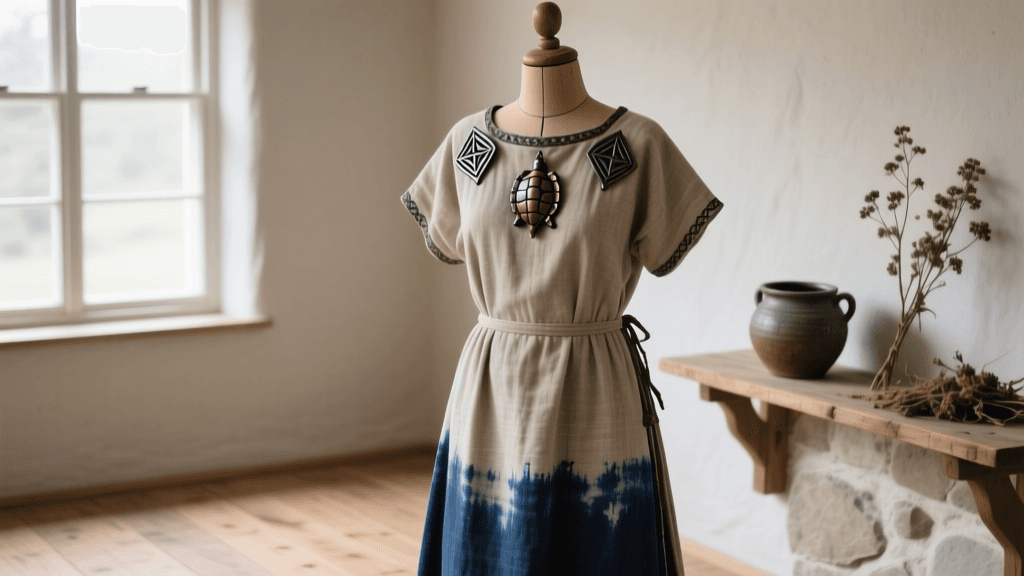
The smokkr is structurally dependent on its hardware. The garment is suspended from the shoulders by loops of woven wool or linen tape, which are pinned to the underlying linen dress by a pair of large, ornate oval brooches, commonly known as 'tortoise brooches' due to their domed, shell-like shape. These brooches are not merely decorative; they are the structural anchors of the entire ensemble.
When sourcing brooches for your 2026 kit, pay close attention to the Rygh typology, the standard classification system for Viking Age artifacts. The Rygh P51 and Rygh P37 are among the most common and widely accepted designs for the late 9th and 10th centuries. Authentic replicas should be cast in bronze or brass, featuring intricate interlacing Urnes or Borre-style animal motifs. Avoid cheap, mass-produced zinc alloys or silver-plated base metals, as these lack the historical weight and patina of genuine heritage pieces.
To wear them correctly, the linen underdress should have reinforced loops at the collarbone. The smokkr straps are then laid over these loops, and the brooch pin is passed through all layers. According to festival guidelines published by the Moesgaard Museum, proper brooch placement is crucial for both historical authenticity and physical comfort, ensuring the weight of the heavy wool is distributed evenly across the upper chest rather than pulling on the neck.
Styling the Complete Ensemble for Modern Festivals
Completing the Viking smokkr ensemble requires attention to the extremities and accessories. Footwear in 2026 has seen a shift toward the highly accurate Hedeby-type leather turnshoes, featuring a distinct seam placement that differs from later medieval footwear. Legwear should consist of woolen hose or wrap-around leg bindings (winingas), secured with simple bone or bronze clasps.
Jewelry played a massive role in Nordic culture, serving as portable wealth and social signaling. Alongside the tortoise brooches, consider adding a string of glass and amber beads draped between the brooches, a silver penannular brooch for your outer shawl, and a simple bronze ring. Hair should be styled in practical, historically supported manners, such as the knotted low bun or intricate braids, avoiding the modern misconception of elaborate, heavily accessorized up-dos.
By embracing the meticulous textile standards, natural dyeing chemistry, and precise metalwork of the Viking Age, you do more than just wear a costume. You participate in a living, breathing revival of Celtic and Nordic heritage. The 2026 reenactment community demands excellence, and a properly constructed, naturally dyed smokkr stands as a testament to the ingenuity, artistry, and enduring legacy of Northern European traditional garments.