Viking Smokkr Apron Dress: 2026 Wool Sourcing & Weaving Guide
The Anatomy of the Viking Smokkr
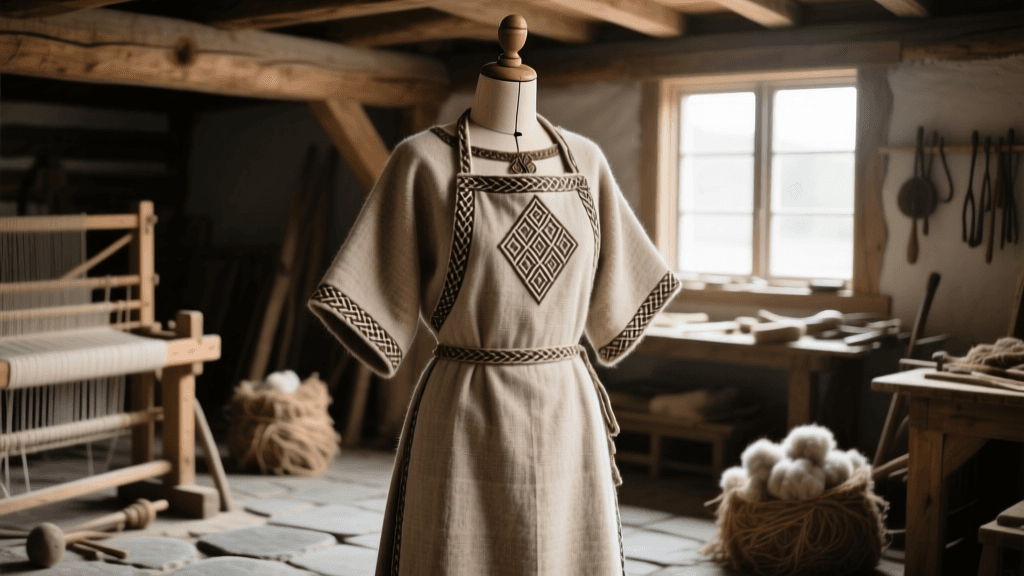
The Viking smokkr, commonly referred to as the apron dress, remains one of the most iconic and widely reconstructed garments of the Norse world. Worn over a long-sleeved linen or wool underdress (the serk), the smokkr was a staple of Scandinavian women's fashion from the 8th to the 11th centuries. As we navigate the historical reenactment and heritage textile landscape in 2026, the demand for absolute archaeological accuracy has never been higher. Modern enthusiasts and professional weavers are moving beyond simplified commercial patterns, focusing instead on period-accurate textile structures, botanical dyes, and authentic metallurgy.
According to extensive archaeological textile archives maintained by the National Museum of Denmark, fragments found in high-status burials at Hedeby, Birka, and Køstrup reveal a garment that was meticulously tailored, heavily decorated, and woven from specialized wools. This comprehensive guide will walk you through the exact processes required to source, spin, weave, and assemble an authentic diamond twill smokkr using the best heritage materials and techniques available in 2026.
Sourcing Period-Accurate Heritage Wool in 2026
The foundation of any authentic Norse garment is the fleece. Modern commercial merino wool is entirely inappropriate for Viking reconstruction; it is too fine, too soft, and lacks the structural integrity required for a warp-weighted loom. In 2026, the heritage sheep breeding community has made incredible strides in preserving ancient landrace breeds that closely mimic the fleece of the Viking Age.
When sourcing raw fleece or prepared roving, you must look for breeds that possess a dual-coated structure or a long, hairy staple that provides natural water resistance and durability. The outer coat (tog) provides strength for the warp, while the softer inner coat (thel) can be used for the weft or for garments worn closer to the skin.
Top Heritage Breeds for Norse Garments
| Breed | Origin | Staple Length | Micron Count | Historical Accuracy |
|---|---|---|---|---|
| Old Norwegian Spelsau | Norway | 15-30 cm (outer) | 28-40 (outer) | Exceptional; closest living relative to Viking Age sheep. |
| Gotland | Sweden | 10-15 cm | 29-34 | High; excellent for lustrous, drapey weft yarns. |
| Shetland | Scotland | 5-12 cm | 20-30 | Moderate; great for softer underdresses and fine trims. |
| Hebridean | Scotland | 10-20 cm | 30-35 | High; naturally dark, perfect for undyed contrast weaves. |
For the main body of the smokkr, sourcing a high-quality Spelsau or Gotland fleece from specialized 2026 heritage flocks in Scandinavia or the UK is highly recommended. Many artisan mills now offer custom carding services that keep the outer and inner coats blended, replicating the rustic, haloed texture of historical Norse yarns.
Mastering the Diamond Twill Weave
The most prestigious wool fabrics of the Viking Age were woven in a 2/2 broken twill structure, commonly known today as diamond twill. This weave creates a beautiful, geometric light-reflecting pattern that elevates the garment from a simple peasant wrap to a piece of high-status clothing.
Loom Setup and Threading
While purists may opt for a traditional warp-weighted loom, many weavers in 2026 successfully replicate diamond twill on modern four-shaft floor looms or rigid heddle looms equipped with pick-up sticks. The critical factor is not the loom itself, but the yarn structure and the sett (ends per inch).
- Yarn Structure: Historical Norse textiles were almost exclusively woven using singles yarn (unplied) for both warp and weft. The warp should be Z-spun with a high twist angle (around 25-30 degrees) to withstand the tension of the loom, while the weft can be Z-spun with a softer twist (15 degrees) to allow for a gentle bloom and fulling after weaving.
- Warp Sett: Aim for a sett of 10 to 12 ends per inch (EPI). Viking textiles were not overly dense; they relied on post-loom fulling (washing and agitating in hot water) to shrink the fabric, close the gaps, and create a wind-resistant, water-shedding cloth.
- Threading Draft: Use a standard 2/2 broken twill point draft. The threading sequence on four shafts typically follows a 1-2-3-4, 3-2-1 pattern, creating the characteristic diamond motifs.
"The true magic of a Viking diamond twill does not happen on the loom, but in the finishing. The cloth must be aggressively fulled in warm water with a pH-neutral soap until the weave structure becomes a cohesive, felted fabric that can be cut without fraying." — Master Weaver Guild Guidelines, 2026.
Botanical Dyeing: Madder, Woad, and Weld
Color was a profound indicator of wealth and status in Norse society. The chemical analysis of textiles from the Oseberg ship burial and the Birka garrison reveals a sophisticated palette derived from complex dye vats. In 2026, heritage dyers have perfected the cultivation and extraction of these ancient botanicals.
The Big Three Norse Dyes
- Madder (Rubia tinctorum): Used to achieve deep reds, rusts, and oranges. For a historically accurate Viking red, mordant your wool with alum and cream of tartar, then slowly heat the madder root bath to exactly 60°C (140°F). Boiling madder will extract the brown alizarin compounds, resulting in a muddy brick color rather than a vibrant red.
- Woad (Isatis tinctoria): The primary source of blue. Unlike indigo, woad requires a delicate, alkaline fermentation vat. Maintaining a pH of 9.0 and a temperature of 50°C is crucial for a successful reduction. Multiple dips are required to build a deep, colorfast Norse blue.
- Weld (Reseda luteola): Provides brilliant, lightfast yellows. Weld is highly sensitive to heat; simmer the leaves gently for an hour, strain, and dye the alum-mordanted wool at a low temperature to preserve the neon-like vibrancy of the luteolin pigment.
Tablet Weaving for Trims and Straps
The straps of the smokkr were rarely plain cloth; they were often intricately patterned bands created through tablet weaving (or card weaving). The Oseberg ship burial yielded some of the most complex tablet-woven bands in archaeological history, featuring intricate animal motifs and geometric interlacing.
Materials and Pattern Drafting
For the straps, use a tightly spun, high-twist wool or a blend of wool and linen. Linen provides incredible tensile strength, which is necessary for straps that will bear the weight of heavy bronze brooches and suspended tools. In 2026, laser-cut wooden tablets and 3D-printed warp tensioners have made the setup process significantly more precise, though the actual weaving remains entirely manual.
Draft your pattern using a standard 4-hole tablet threading. For a classic Norse knotwork design, alternate S-threaded and Z-threaded tablets. This technique, known as "double-faced" tablet weaving, allows you to create sharp, contrasting patterns on both sides of the band by simply turning the tablets forward or backward in specific sequences.
Assembly and Bronze Tortoise Brooches
The smokkr is defined by its suspension system. The garment is held at the shoulders by a pair of oval, domed brooches—often colloquially called "tortoise brooches" due to their shape and textured exterior. These brooches were not merely functional; they were potent symbols of a woman's household authority and social standing.
Sourcing Authentic Cast Bronze in 2026
Avoid cheap, mass-produced pewter replicas from commercial costume shops. The 2026 artisan metallurgy market is rich with independent smiths who use traditional lost-wax casting methods to recreate brooches based directly on 10th-century Birka and Gotland molds. Look for castings made in high-tin bronze, which gives the metal a beautiful golden hue that was highly prized by the Norse. The pins must be forged from high-carbon steel or spring-tempered bronze to ensure they can pierce thick, fulled wool without bending.
When assembling the dress, the top edge of the smokkr is folded over the tablet-woven strap and secured with a sturdy backstitch. The loop that passes through the brooch pin should be reinforced with a small piece of leather or a secondary layer of wool to prevent the heavy bronze from tearing through the textile over time.
Sewing Techniques and Final Assembly
Machine sewing has no place in a high-level historical reconstruction. All seams on your smokkr must be sewn by hand using period-accurate stitches. Historical context and extensive sewing guides provided by the Viking Society for Northern Research emphasize the importance of seam finishes that prevent fraying in single-layer woven wools.
The Essential Norse Stitches
- Running Stitch: Used for basic seam construction. Use a heavy, waxed linen thread or a thick, Z-spun wool thread. Keep your stitches small (about 3-4 mm) and evenly spaced.
- Backstitch: Employed in high-stress areas, such as the armholes of the underdress or the strap attachment points on the smokkr. It provides a continuous, unbreakable line of thread.
- Flat-Felled Seam: The gold standard for Norse garments. After sewing the initial running stitch, trim one side of the seam allowance, fold the other side over it, and whipstitch it flat to the fabric. This encloses the raw edges completely, creating a clean, durable interior that is comfortable against the skin.
Conclusion
Recreating a Viking smokkr in 2026 is a profound exercise in experimental archaeology. It requires patience, a willingness to learn archaic skills, and a deep respect for the artisans of the past. By sourcing authentic Spelsau or Gotland wool, mastering the diamond twill weave, utilizing historical botanical dyes, and finishing the garment with hand-forged bronze and tablet-woven straps, you are not just making a costume. You are resurrecting a tangible piece of European folk history, weaving the legacy of the Norse world into the fabric of the modern day.