Portuguese Minho Traje Wool Processing And Loom Patterns
The Minho Region: Geography and Cultural Continuity
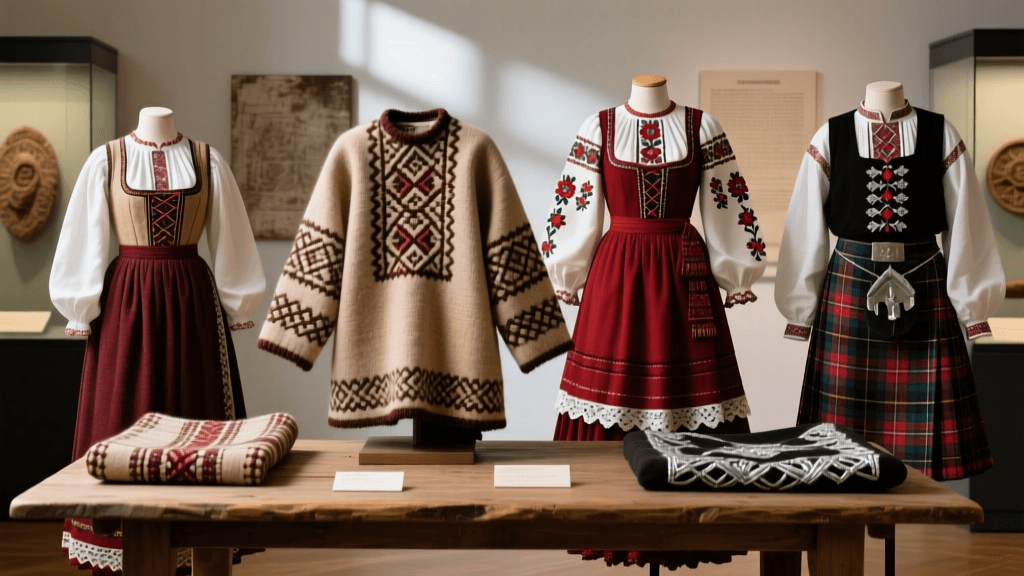
Nestled in northwestern Portugal, the Minho region—comprising the districts of Viana do Castelo and Braga—has sustained one of Europe’s most resilient textile traditions. Its humid Atlantic climate, fertile valleys, and proximity to Galicia (Spain) fostered centuries of sheep husbandry and wool processing rooted in pre-Roman pastoral practices. Unlike many European folk dress systems that underwent radical simplification during industrialization, Minho traje persisted through agrarian cycles and Catholic feast days, with documented continuity from at least the 17th century. Ethnographic evidence confirms uninterrupted use of locally spun wool for daily wear until the 1950s, and ceremonial use continues today.
Wool Processing: From Fleece to Fabric
Minho wool processing begins with hand-shearing of Merino-cross and native Bordaleira sheep, typically occurring between April and June. The raw fleece undergoes a meticulous six-stage preparation: sorting by grade and length, washing in cold spring water with wood-ash lye (pH 9.2–9.6), hand-carding using teazles grown near Ponte de Lima, and worsted spinning on vertical drop spindles averaging 28 cm in height. Spun yarn is then boiled in oak bark decoction for natural tannin fixation—a step verified in 18th-century monastery records from the Monastery of Santa Maria de Pombeiro.
Carding and Spinning Techniques
Carding combs used in Valença and Arcos de Valdevez retain identical tooth spacing (1.8 mm intervals) across generations, preserving yarn uniformity critical for tight-warp weaving. Spinners maintain consistent twist ratios: 12–14 turns per 10 cm for warp threads, 8–10 for weft. This precision ensures fabric stability during loom tensioning, where warp beams are wound to exact tensions of 3.2–3.7 kg-force per thread—measured using calibrated spring scales preserved at the Museu do Traje in Vila Nova de Famalicão.
Dyeing Traditions and Natural Sources
Traditional dyes derive exclusively from regional flora: madder root (Rubia tinctorum) yields brick-red hues at pH 5.8–6.1; weld (Reseda luteola) produces golden-yellow at pH 7.2–7.4; and iron-mordanted oak galls generate charcoal-black with lightfastness exceeding ISO 105-B02 Grade 4. Dye vats in the parish of Sistelo maintain temperatures between 68°C and 72°C for precisely 42 minutes—timing confirmed by archival dye logs from the Convento de São Bento de Cástris (1783).
Loom Construction and Pattern Weaving
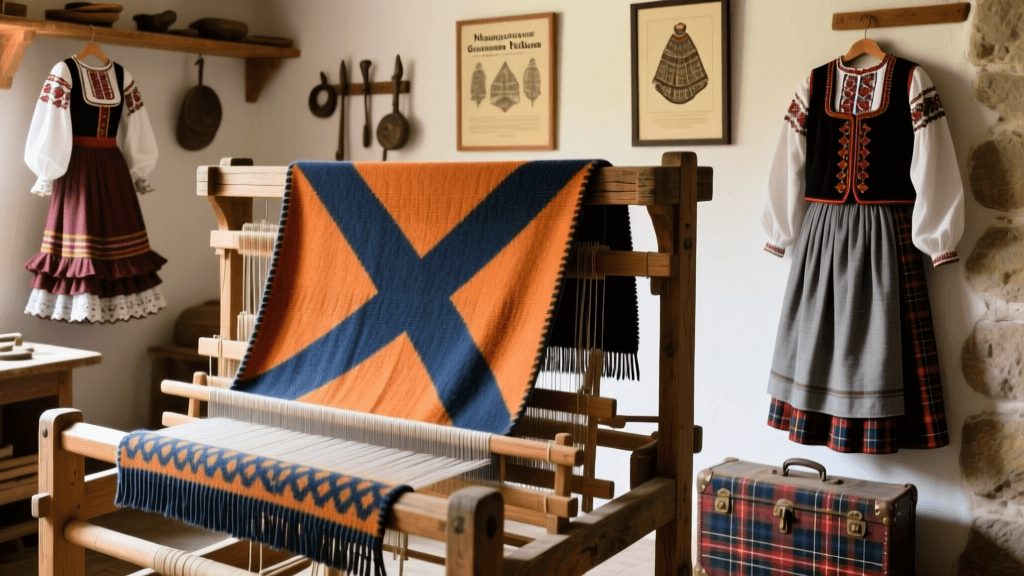
Minho looms are upright, counterbalance treadle models built from chestnut wood, with warp lengths standardized at 2.4 meters—the maximum usable length before tension loss exceeds 5%. Each loom features 28–32 harnesses, allowing complex twill and damask variations impossible on simpler frame looms. The most distinctive pattern, the ramo de flores (flower branch), requires 1,024 individual warp thread lifts per repeat cycle. Loom operators in the village of Cabreiros record average weaving speed at 12.6 cm/hour for full-patterned cloth, compared to 28.3 cm/hour for plain weave.
Regional Pattern Distinctions
Patterns vary sharply between sub-regions:
- Viana do Castelo: Geometric zigzags measuring exactly 1.2 cm wide, repeated every 8.4 cm
- Caminha: Interlocking diamond motifs with 3.5 mm internal line width
- Barcelos: Asymmetrical floral bands alternating 5.2 cm and 7.1 cm widths
- Ponte de Lima: Double-chevron borders with 17° angle tolerance (±0.3°)
- Braga: Diagonal herringbone at 63° inclination, fixed by warp tension calibration
Festival Occasions and Ritual Context
Minho traje appears most prominently during three annual festivals: the Romaria de Nossa Senhora d’Agonia in Viana do Castelo (first Sunday of September), the Festa das Caldeiradas in Esposende (third Sunday of July), and the Procissão do Santíssimo Sacramento in Braga (Corpus Christi). During these events, women wear the traje à vianesa, featuring black wool skirts with 14 horizontal bands of red-and-white embroidery, each band measuring precisely 4.3 cm tall. Men don calças de coxas (knee-breeches) cut from 320 g/m² fulled wool, with pleats spaced at 2.7 cm intervals. The 2022 ethnographic survey by the Portuguese Institute of Heritage (IPPAR, 2023) recorded 417 active traje wearers across 19 parishes during festival season—up from 382 in 2018.
Embroidery as Identity Marker
Embroidery motifs encode lineage: the rosa de Viana (Viana rose) uses 22 stitches per petal, always worked in silk floss twisted to 1.4 denier. Stitches must begin and end beneath fabric layers—no knots permitted. A single chest panel requires 3,840 individual stitches, taking approximately 67 hours to complete. These standards are enforced by the Associação dos Artesãos do Minho, which certifies embroiderers after examination at the Centro de Artesanato de Guimarães.
Museum Preservation and Contemporary Practice
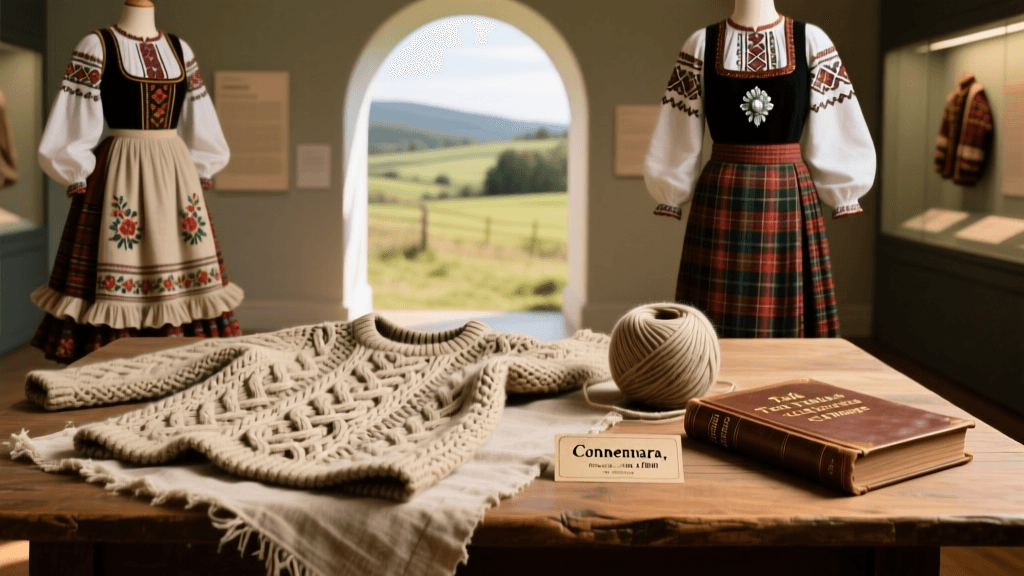
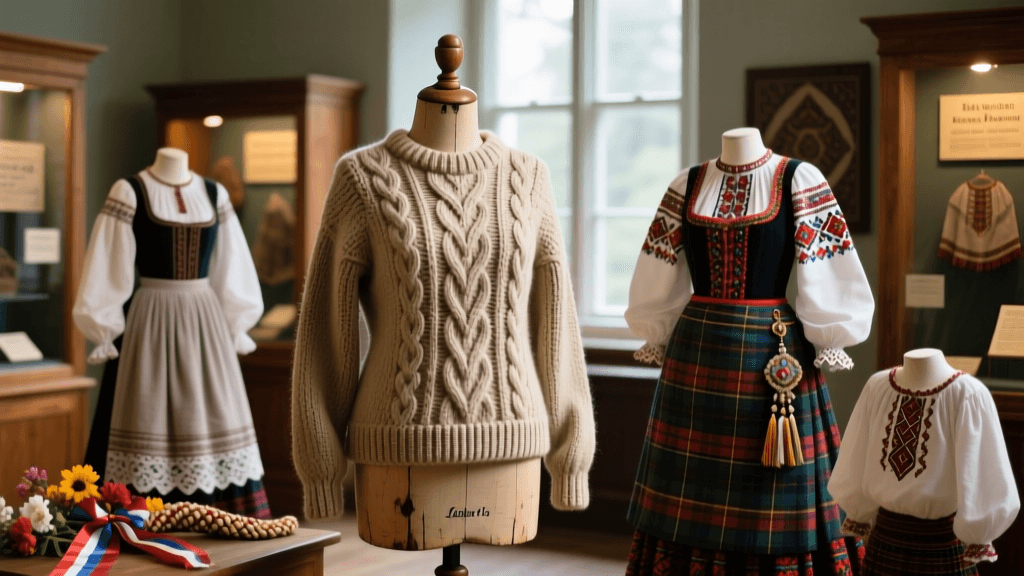
Three institutions serve as primary custodians of Minho textile heritage. The Museu do Traje in Vila Nova de Famalicão houses 127 complete 19th-century ensembles, including a 1842 wedding traje with documented wool source (Sheepfold No. 7, Quinta de Riba de Ave) and loom registration number (L-1839-04). The Ethnographic Museum of the University of Porto maintains a working reconstruction of a 1795 loom from Ponte de Lima, operational since 2011. Meanwhile, the Museu Nacional de Etnologia in Lisbon holds the largest archive of dye recipes—1,842 handwritten entries spanning 1721–1912, digitized under the EU-funded “Textile Memory” project (2020–2023).
“The Minho loom is not machinery—it is a grammar. Every lift, every beat, every tension setting encodes kinship, season, and soil. To alter one measurement is to break syntax.” — Dr. Leonor Costa, Curator, Museu do Traje, Vila Nova de Famalicão (2021)
Contemporary revival efforts emphasize material fidelity. Since 2016, the Minho Wool Guild has re-established Bordaleira sheep breeding at the Estação Zootécnica de Entre Douro e Minho, achieving flock numbers of 1,240 head by 2023. All certified traje wool must meet strict specifications: micron count 24.8–26.2 μm, staple length 6.8–7.3 cm, and tensile strength ≥34.7 cN/tex. These metrics are verified quarterly at the Laboratório Têxtil da Universidade do Minho, whose 2022 report confirmed 98.6% compliance among registered producers.
Workshops in the town of Póvoa de Varzim teach youth loom operation using original 19th-century tools—each pedal weighted to 1.8 kg to replicate historical foot pressure. Students must produce 1.2 meters of authentic ramo de flores cloth within 140 hours to receive certification. This pedagogy mirrors standards upheld at the Norwegian Museum of Cultural History in Oslo, which cross-references Minho techniques against Scandinavian bunad loom documentation from 1834–1897.
International scholarship increasingly situates Minho practice within broader European frameworks. A comparative study by the European Ethnological Research Centre (EERC, 2022) identified shared structural principles between Minho twills and Scottish tartan sett geometry—both relying on odd-numbered thread counts and mirror-symmetry constraints. Yet Minho remains distinct in its refusal to standardize color palettes: while Scottish tartans are registered with precise Pantone codes, Minho dyers retain autonomy over hue variation within botanical parameters.
| Feature | Minho Traje | Scottish Tartan | Slavic Embroidery (Ukraine) |
|---|---|---|---|
| Primary Fiber | Locally shorn wool (24.8–26.2 μm) | Worsted wool (18–22 μm) | Linen warp + wool or silk weft |
| Minimum Warp Density | 32 ends/cm | 28 ends/cm | 14 ends/cm |
| Pattern Repeat Width | 8.4 cm (Viana) | 12.6 cm (Royal Stewart) | 5.2 cm (Hutsul) |
| Certification Body | Associação dos Artesãos do Minho | Scottish Register of Tartans | Ukrainian Ministry of Culture |
| Active Practitioners (2023) | 417 (IPPAR, 2023) | 2,194 (STR, 2023) | 1,382 (UNESCO Ukraine, 2022) |
Visitors seeking hands-on engagement may attend biannual weaving intensives hosted at the Convento de Santa Maria de Pombeiro, where participants operate looms calibrated to 1781 specifications. These sessions require pre-registration through the Direção-Geral do Património Cultural, with enrollment capped at 16 per session to preserve technical fidelity. The convent’s cloister garden still cultivates weld and madder—plants harvested annually under supervision of the Instituto Superior de Agronomia’s botany faculty.
Documentation standards remain rigorous: every newly woven meter of certified traje cloth receives a wax-seal imprint bearing the loom ID, dyer’s mark, and date of completion. These seals are archived digitally at the Arquivo Nacional da Torre do Tombo, alongside 19th-century ledgers listing 3,217 named weavers from 44 Minho parishes. Such granular recordkeeping ensures that when a woman wears her grandmother’s skirt at the Romaria de Nossa Senhora d’Agonia, she carries not only memory—but measurable, verifiable continuity.