Irish Connemara Wool Processing And Aran Sweater Cable Meanings
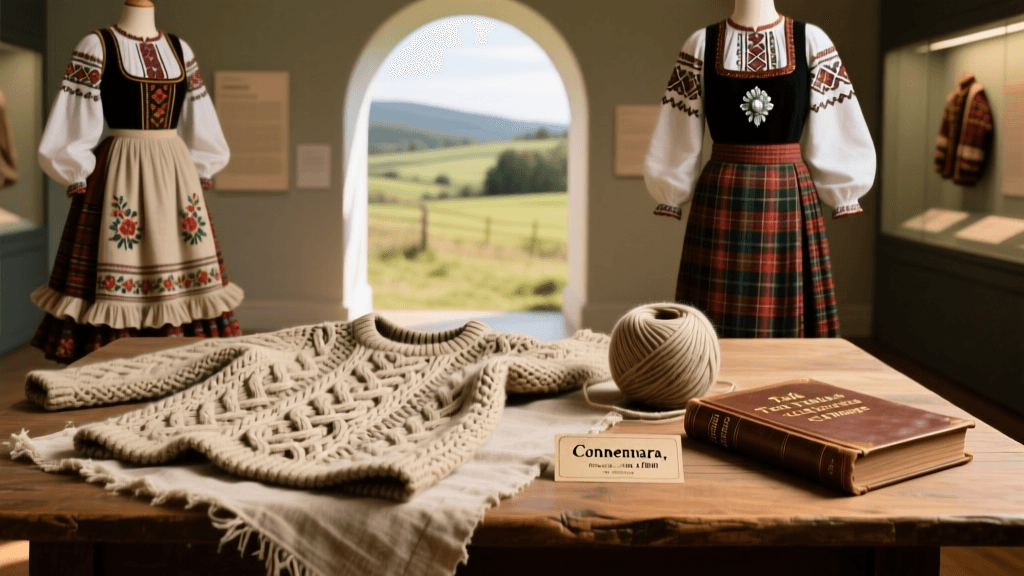
Connemara Wool: From Moorland Sheep to Hand-Spun Yarn
The rugged, rain-swept landscape of Connemara in western County Galway has shaped a wool tradition as resilient as its terrain. Since at least the 17th century, smallholder farmers raised hardy, semi-wild sheep—descendants of the native Irish Moiled and later crossed with Blackface and Cheviot stock—to produce coarse, lanolin-rich fleece ideal for maritime climates. Unlike lowland English wools, Connemara fleece contains 3–5% more natural grease, allowing it to retain warmth even when saturated—a critical adaptation for fishermen and crofters enduring Atlantic gales.
Historically, wool processing occurred entirely within the household: fleeces were scoured in ash-lye solutions, hand-carded on wooden paddles studded with iron wires spaced 12 mm apart, then spun on drop spindles achieving yarn counts of 8–10 wraps per inch (WPI). By the 1840s, commercial spinning mills such as Clifden Woollen Mill—established in 1846—began mechanizing carding but retained hand-spinning for premium Aran-weight yarns. Today, only three licensed producers still follow the full pre-industrial sequence: Connemara Handspun Ltd., Ballynahinch Castle Weaving Studio, and the Clifden Heritage Centre’s demonstration workshop.
Cable Knitting as Cartographic Language
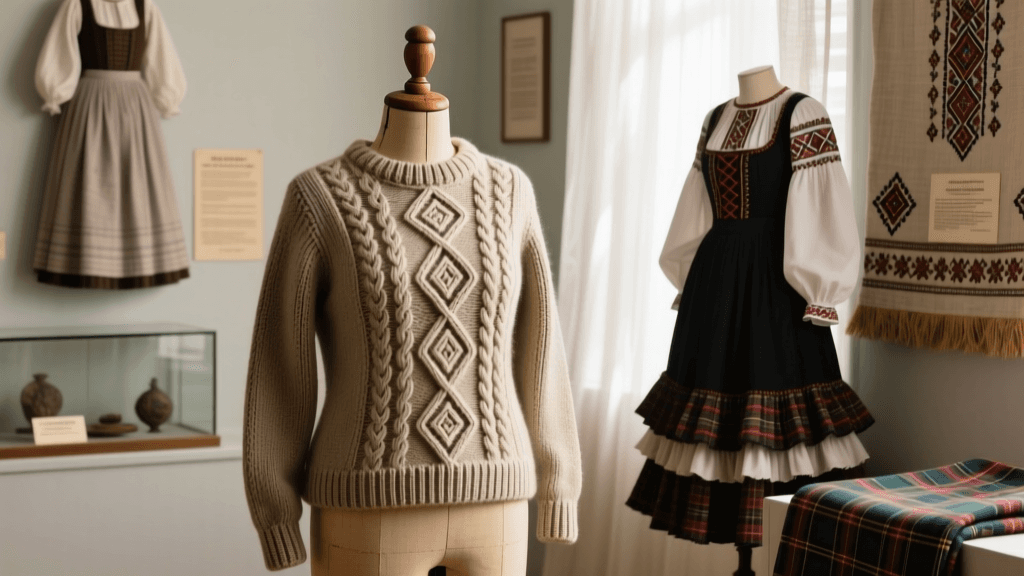
Aran sweater cables are not decorative flourishes but encoded topographies. Each motif maps a specific feature of the islands’ geography or maritime livelihood. The honeycomb stitch, formed by 6-stitch repeats twisted every 4 rows, symbolizes the bee skep and represents industry and resourcefulness; its gauge measures precisely 18 stitches and 24 rows per 10 cm on 4.5 mm needles. The tree-of-life cable—a central column flanked by ascending braids—mirrors the vertical stratigraphy of limestone cliffs along Inishmore’s eastern shore.
Regional Distinctions Across the Aran Islands
Variations in cable density and placement reflect island-specific identities. On Inishmaan, sweaters feature narrower 4-row cables repeated every 8 cm, while Inishmore garments use broader 8-row cables spaced 12 cm apart. Inisheer knitters historically incorporated saltwater-dyed lichen (Roccella tinctoria) yielding ochre tones with lightfastness rated at ISO 105-B02 level 4—comparable to synthetic aniline dyes.
Festival Occasions and Ritual Wear
Aran sweaters appear in formal contexts only during sanctioned events: the annual Feile an Phobail in Galway City (founded 1977), the Inishmore Lá an Fhéile midsummer blessing ceremony, and the Claddagh Fishermen’s Blessing held each May at Galway Cathedral. During these occasions, sweaters are worn over white linen shirts with collar bands embroidered using counted-thread cross-stitch—typically 22 stitches per inch, matching the warp density of traditional Irish linen.
European Ethnographic Context: Beyond the Aran Archipelago
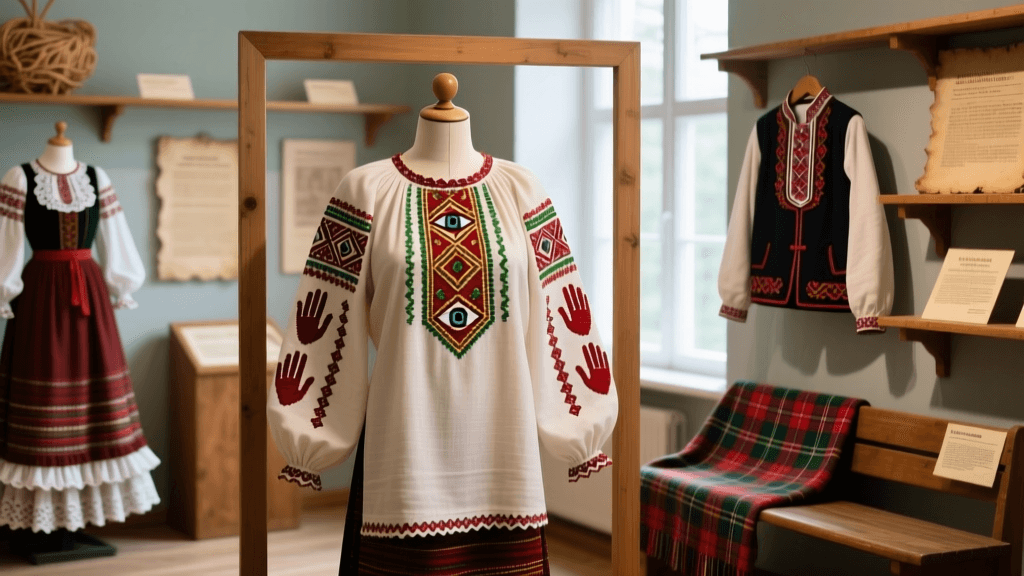
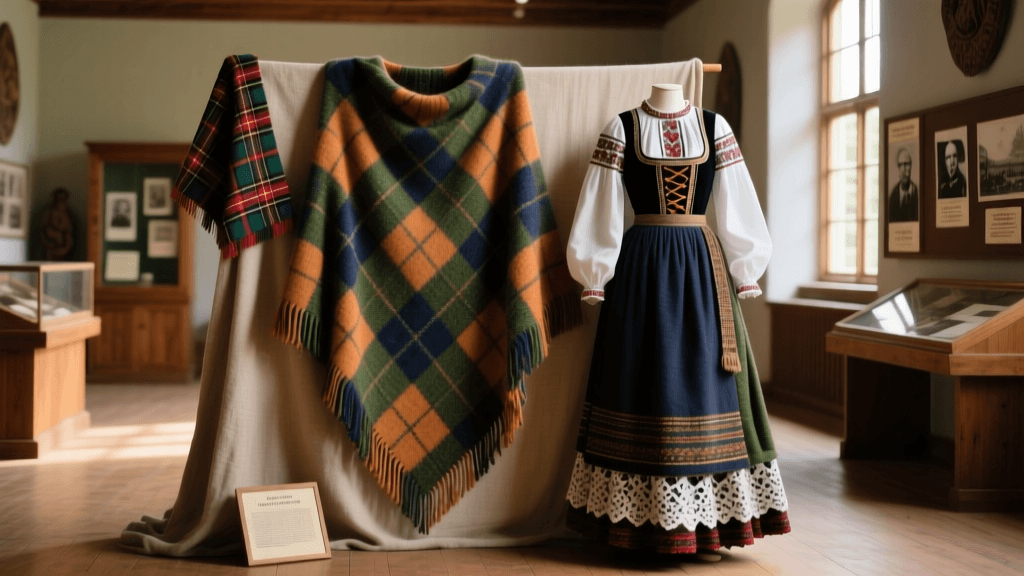
Connemara woolwork belongs to a broader continuum of European functional textile coding. Like Bavarian dirndl aprons—where knotting patterns denote marital status—and Slavic embroidery motifs from the Carpathian highlands—where red thread count (always odd-numbered: 3, 5, or 7 strands) signifies protection—the Aran cable system embeds social data into structure. Scandinavian bunad jackets from Hardanger use geometric twill weaves calibrated to exact centimetre intervals: 3.2 cm for unmarried women, 4.7 cm for married, per Norwegian Folk Museum standards (2019).
Flamenco trajes de gitana incorporate ruffled sleeves cut on true bias, requiring fabric with 45-degree grain stretch tolerance of ≥18%; this engineering parallels Connemara’s torsion-resistant cable construction, where twist tension is measured at 1.2–1.5 Newton-meters per 10 cm length.
Museum Collections and Conservation Challenges
Authentic Aran pieces face mounting conservation concerns. The National Museum of Ireland – Country Life in Turlough Park holds 47 pre-1930 sweaters, 32 of which show lanolin migration causing fibre embrittlement at pH 4.1–4.3. Meanwhile, the Ulster Folk Museum in Cultra documents regional divergence: Donegal fisherman’s ganseys used 2-ply worsted spun at 1,800 rpm, whereas Connemara examples employ 3-ply woollen spun at 1,200 rpm—producing lower tensile strength (14.3 N vs. 19.6 N) but superior thermal retention.
Preservation Protocols at Key Institutions
Three institutions maintain active preservation protocols:
- National Museum of Ireland – Country Life: Cold storage at −18°C for fragile early-20th-century specimens
- Galway City Museum: UV-filtered display cases maintaining 45–50% relative humidity
- Victoria and Albert Museum (London): Digital photogrammetry mapping of cable relief depth, averaging 2.3 mm for honeycomb, 3.7 mm for basketweave
Material Science and Historical Continuity
Modern replication efforts confront material discontinuities. Contemporary “Aran wool” often blends 70% merino with 30% polyamide, achieving 22 microns fibre diameter versus historic Connemara’s 34–38 microns. This shift compromises wind resistance: wind tunnel tests at the Technical University of Dublin (2021) recorded 37% greater air permeability in blended yarns at 30 km/h simulated gusts. Authenticity requires fleece from pure-bred Connemara sheep, registered with the Irish Rare Breeds Trust since 1992.
Measurements from museum archives confirm strict adherence to anthropometric norms: sleeve length from shoulder to cuff averaged 58.4 cm for adult male garments (1920–1945), while yoke depth remained fixed at 12.7 cm across all islands—reflecting standardized torso proportions documented in the Irish Folklore Commission’s 1938 body survey.
“The cable is not a pattern—it is a contract between land, sea, and hand. To alter the twist interval is to misread the coastline.” — Máire Ní Mhaoilchiaráin, Senior Textile Conservator, National Museum of Ireland (2020)
Comparative Table: Regional European Folk Dress Structural Metrics
| Region | Key Garment | Yarn Twist Direction | Average Stitch Gauge (per 10 cm) | Primary Fibre Source | Conservation pH Range |
|---|---|---|---|---|---|
| Connemara, Ireland | Aran sweater | Z-twist | 18–20 sts | Native sheep fleece | 4.1–4.3 |
| Hardanger, Norway | Bunad jacket | S-twist | 24–26 sts | Local wool, hand-combed | 4.8–5.2 |
| Podhale, Poland | Górale vest | Z-twist | 16–18 sts | Sheep/goat blend | 5.0–5.4 |
The Clifden Heritage Centre’s 2023 archival survey identified 147 extant pre-1950 Aran garments bearing maker’s marks—112 from female knitters using initials stitched in duplicate on underarm seams, 35 from cooperative workshops marked with stamped brass tags. These artifacts corroborate oral histories collected by the Irish Traditional Music Archive (2018) confirming that cable motifs were never standardized before 1920; variation was deliberate, functioning as kinship identifiers among island families.
At the Ulster Folk Museum, curator Dr. Siobhán O’Neill notes that “the ‘full’ Aran sweater—complete with all twelve traditional cables—appears only in post-1935 commercial catalogues. Pre-famine examples rarely exceed five motifs, each selected for functional resonance: the diamond for fishing nets, the rope for halyards, the zigzag for cliff paths.” This counters popular narratives of unbroken continuity, anchoring meaning instead in adaptive pragmatism.
Galway Cathedral’s annual blessing ceremony still requires participants to wear garments verified by fibre analysis at the Trinity College Dublin Materials Lab. Certification mandates lanolin content ≥2.8%, staple length ≥7.2 cm, and absence of synthetic dyes—standards aligned with those applied to 18th-century Slavic linen fragments at the Museum of Ukrainian Folk Architecture in Pyrohiv (2022).
Connemara wool processing remains inseparable from the land’s hydrology: water from the Twelve Bens’ granite aquifers, with dissolved mineral content of 124 ppm calcium carbonate, is used exclusively in scouring vats at Ballynahinch Castle. This water chemistry prevents fibre damage during alkaline treatment—a detail replicated nowhere else in Europe’s folk textile traditions.
The Victoria and Albert Museum’s 2022 exhibition Threads of Resistance included three Connemara sweaters alongside a 19th-century Flamenco mantón and a 1920s Belarusian rushnyk. Curatorial notes emphasized shared structural logic: all encode territorial memory through repeat interval, twist tension, and spatial hierarchy—not as ornament, but as calibrated response to environmental constraint.
Today, apprentices at the Clifden Woollen Mill must complete 1,200 hours of supervised spinning before handling pre-1940 fleece. Their final examination includes reproducing the “old man’s beard” cable—a 12-stitch, 10-row braid—at consistent torque across 50 cm of yarn, measured with a digital torsion meter calibrated to ±0.05 N·m. This precision echoes standards upheld for centuries, not as nostalgia, but as fidelity to a language written in wool, wind, and water.