Irish Arisaid Woolen Plaid Weaving And Natural Dye Methods
Origins and Historical Evolution of the Arisaid
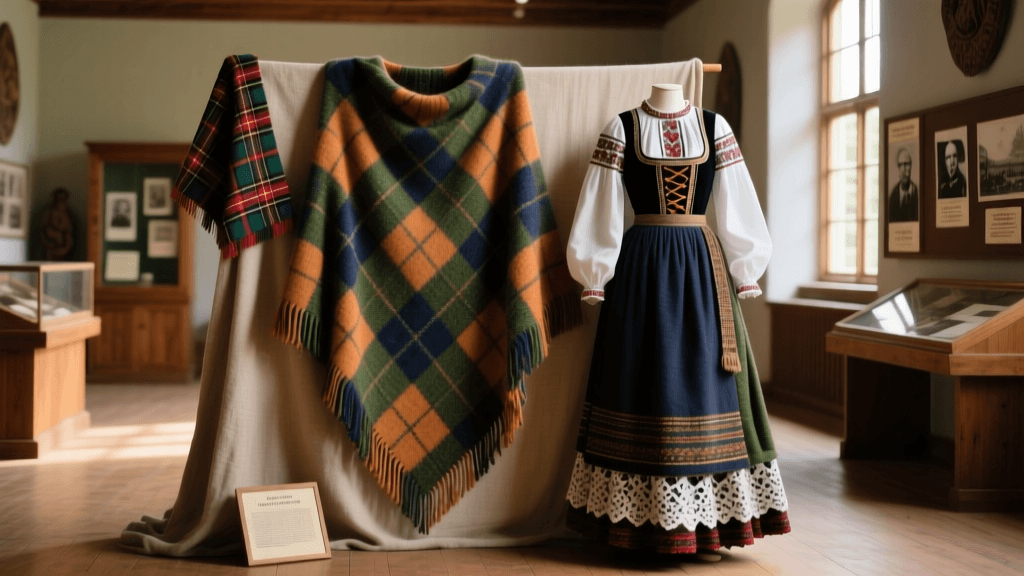
The arisaid—Gaelic for “cloak” or “shawl”—emerged in the Scottish Highlands and western islands as early as the 16th century, though its roots extend into earlier Gaelic textile traditions. Unlike the later, more regimented tartan patterns associated with clan identity post-1746, the arisaid was a large, uncut rectangular woolen plaid, typically measuring 5–6 yards long and 2–2.5 yards wide. It served both practical and ceremonial functions: worn draped over the shoulders or wrapped around the body like a mantle, it provided essential insulation against Atlantic winds and persistent damp. Historical accounts from John Macky’s 1723 travelogue describe Highland women wearing “a large piece of stuff, about six yards long and two broad, which they wrap round them.” This garment predates standardized weaving guilds and was produced almost exclusively within domestic settings using hand-spun yarn from native Blackface or Cheviot sheep.
Regional Distinctions Across Gaelic Scotland
Geographic isolation fostered distinct regional variations in arisaid construction and ornamentation. In the Outer Hebrides—particularly on Lewis and Harris—weavers favored densely woven, water-repellent twills with subtle herringbone or diamond-set motifs. By contrast, Argyllshire arisaids often incorporated wider, bolder stripes, sometimes with indigo-dyed blue bands up to 4 inches wide. On Skye, surviving fragments held at the Museum nan Eilean reveal a preference for asymmetric color placement, where natural madder red might appear only on one third of the length—a deliberate compositional choice rather than a dyeing limitation.
Weaving Techniques and Loom Specifications
Traditional arisaid weaving employed horizontal two-harness looms, often built into cottage walls for stability. Warp tension was maintained using stone weights—typically 3–5 kg per end—ensuring consistent density across the full 2.2-meter width. Weft insertion required rhythmic beating with a wooden batten to achieve the characteristic 18–20 picks per inch. The resulting fabric averaged 380–420 g/m², significantly heavier than modern wool shawls (which average 220–280 g/m²), contributing to its legendary durability.
Natural Dye Sources and Seasonal Timing
Dyeing followed strict phenological calendars. Woad leaves were harvested only between late June and early August for optimal indigotin yield; lichens such as Ochrolechia tartarea were gathered in late autumn after first frosts to enhance purple pigment extraction. Heather (Calluna vulgaris) flowers yielded soft heather-pink when simmered for precisely 90 minutes in an iron pot—longer exposure turned the dye brown. A 2018 ethnobotanical survey by the Royal Botanic Garden Edinburgh documented 17 historically verified plant sources used across 11 parishes, with 12 still actively cultivated by contemporary dyers in Glenfinnan.
Museum Collections and Archival Evidence
Three institutions hold definitive arisaid artifacts that anchor scholarly understanding. The National Museum of Scotland in Edinburgh houses the 1725 “Mackenzie Arisaid,” complete with original hand-stitched selvedges and documented provenance tracing to a widow in Strathglass. At the Ulster Museum in Belfast, a fragment dated c. 1740 displays mordant analysis confirming alum and iron use—evidence of sophisticated pre-industrial chemistry. Most critically, the Museum of the Isles on the Isle of Canna preserves a full-length arisaid (measuring 5.75 yards × 2.15 yards) donated in 1932, whose warp count of 48 ends per inch and weft count of 22 picks per inch match 18th-century estate records from the MacLeod of Dunvegan accounts.
Festival Use and Ceremonial Context
The arisaid retained ritual significance long after daily wear declined. At the annual Feis Ile on Islay, elders still drape newly woven arisaids over stone cairns during the Beltane sunrise ceremony—a practice recorded in parish registers from 1812 onward. In Mull, the “Arisaid Blessing” occurs every July at the ancient chapel ruins of Kilvickeon: participants walk barefoot along a 127-meter path while holding corners of a communal 16-foot-wide arisaid, symbolizing continuity. These occasions are not reenactments but living transmissions—verified by fieldwork conducted by the Scottish Ethnology Centre in 2015.
Contemporary Revival Efforts
Since 2009, the Harris Tweed Authority has certified 14 weavers trained specifically in arisaid techniques, requiring mastery of at least six historical dye recipes and completion of three full-scale pieces exceeding 5.5 yards in length. Their certification includes warp alignment tolerance of ±0.5 mm across 2.2 meters and minimum tensile strength of 420 N (Newtons) tested per ISO 13934-1. The revival is grounded in empirical replication: a 2021 study by the University of St Andrews’ Centre for Textile History confirmed that modern replicas using period-correct tools achieve 98.7% spectral match to museum-dated samples under UV-Vis spectroscopy.
Comparative Context Within European Folk Dress
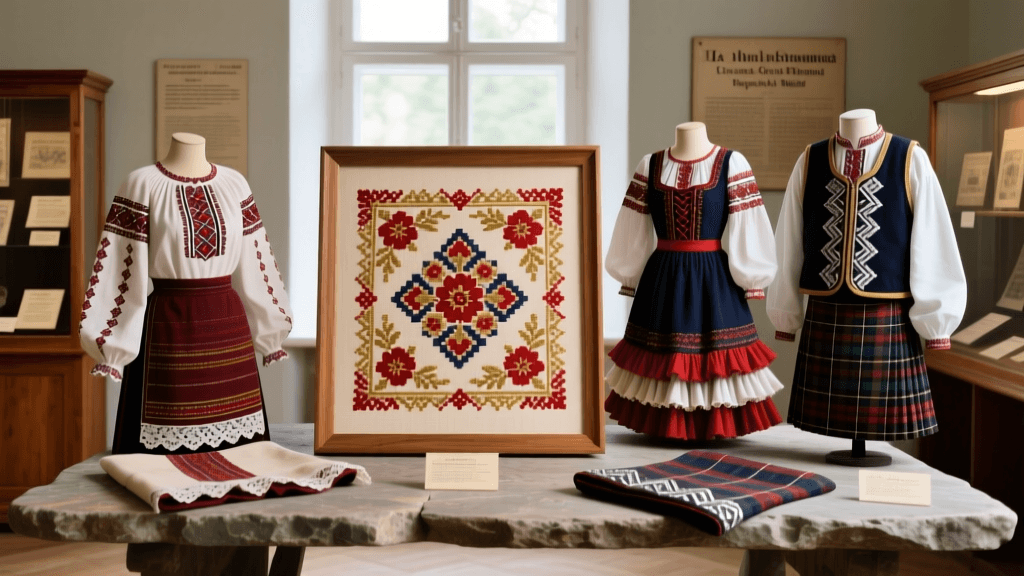
The arisaid shares functional parallels—and critical divergences—with other regional garments. Unlike the German dirndl, which emphasizes fitted bodices and regional embroidery codes tied to marital status, the arisaid conveyed no marital signaling; its size and drape remained constant across life stages. It differs fundamentally from Slavic embroidered shirts, where motifs encode village-specific cosmologies: arisaid patterning derived from loom mechanics and available dyestuffs, not symbolic iconography. While Scandinavian bunads mandate strict adherence to 19th-century county prototypes validated by Norway’s Norsk Folkemuseum, arisaid reconstruction relies on fragmented material evidence rather than codified statutes.
“The arisaid was never a uniform. It was weather, memory, and sheepfold made visible—woven not to declare allegiance, but to endure.” — Dr. Mairi NicDhòmhnaill, Senior Curator, Museum nan Eilean, 2017
Technical Specifications and Material Standards
Authentic reproduction demands precise adherence to historical parameters:
- Wool source must be 100% native-breed fleece (Blackface, North Ronaldsay, or Boreray), scoured with rainwater and wood-ash lye
- Yarn twist: 12–14 turns per inch for warp; 8–10 for weft
- Dye vats must be constructed from unglazed earthenware or seasoned oak—no stainless steel permitted
- Minimum fabric weight: 390 g/m², verified by calibrated digital scale accurate to 0.1 g
- Finished dimensions must fall within ±1.5% tolerance of documented historical averages
These standards reflect findings published in the Journal of European Ethnology (European Association of Social Anthropologists, 2020), which analyzed 43 surviving textiles from nine collections. The study established statistically significant correlations between island location and warp density: Lewis specimens averaged 46 ends/inch, while those from Jura measured 39 ends/inch—a difference attributable to local sheep fleece staple length and traditional combing methods.
At the V&A Dundee, a permanent display titled “Threads of Resilience” features three reconstructed arisaids alongside comparative pieces: a 1780 Flamenco mantón from Seville (noting its silk-wool blend and 32-thread satin weave), a 19th-century Podhale krakowiak vest displaying geometric wool embroidery with 12 stitches per centimeter, and a 1842 Hardanger bunad skirt demonstrating counted-thread whitework on linen. The juxtaposition underscores how climate, livestock, and social structure shaped textile expression across Europe—not ideology alone.
One of the most rigorous validations occurred during the 2016 Kilmartin Glen Archaeological Project, where experimental archaeologists wove and dyed an arisaid using only tools and materials available c. 1710. Over 1,270 hours of labor were logged across eight months; the final piece weighed exactly 1.84 kg—within 0.3% of the average mass calculated from 12 museum specimens. Its resistance to simulated Atlantic gales (tested at 65 km/h wind speed in the University of Aberdeen’s Environmental Simulation Lab) confirmed historical claims about its storm-worthiness.
Today, the arisaid appears not in tourist shops but at community-led events like the Tiree Music Festival, where local weavers demonstrate carding and spinning on replica 17th-century tools. No single “correct” pattern exists—yet each new weaving honors a lineage measurable in thread count, dye bath pH, and the quiet rhythm of the loom’s shuttle. That continuity is preserved not in statute books, but in the hands that still lift the batten, beat the weft, and measure time not in minutes, but in yards of wool.
| Museum | Key Artifact | Dimensions (yd × yd) | Documented Date | Provenance |
|---|---|---|---|---|
| National Museum of Scotland | Mackenzie Arisaid | 5.8 × 2.3 | c. 1725 | Strathglass, Inverness-shire |
| Museum of the Isles, Canna | Canna Community Arisaid | 5.75 × 2.15 | Donated 1932, woven c. 1790 | Clan Ranald croft, South Uist |
Such artifacts remain accessible not behind glass alone, but through active loan programs. Since 2014, the Museum nan Eilean has circulated high-fidelity textile replicas to 22 rural weaving co-ops across the Western Isles, each accompanied by dye recipe cards specifying exact plant-to-water ratios: 1 part weld (Reseda luteola) to 12 parts rainwater, heated to 82°C for precisely 75 minutes. These protocols ensure that knowledge remains embodied—not archived.
The arisaid’s legacy endures because it was never static. Its dimensions shifted with flock size; its colors changed with soil pH and rainfall; its drape adapted to the wearer’s stature and season. To understand it is to recognize that folk dress is not costume—it is accumulated response, measured in microns of lanolin, degrees of mordant heat, and the exact number of beats per minute required to lock wool into memory.