Irish Aran Sweater Cable Patterns Meanings And Knitting
Origins and Maritime Roots of the Aran Sweater
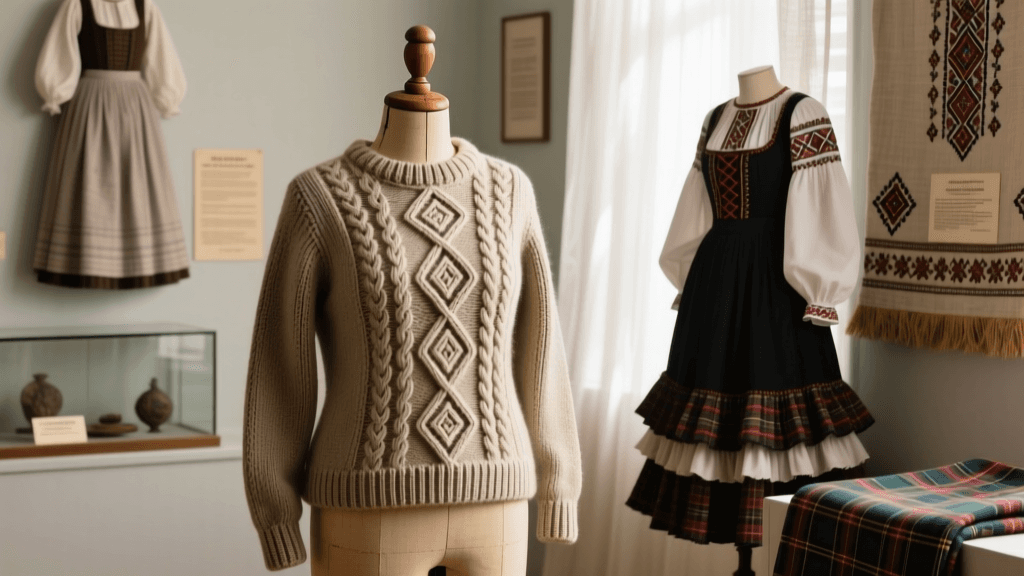
The Irish Aran sweater emerged in the late 19th century on the three small, windswept islands of Inishmore, Inishmaan, and Inisheer—collectively known as the Aran Islands—located off the west coast of County Galway. These islands, with an average annual rainfall of 1,200 mm and winter gales regularly exceeding 80 km/h, demanded durable, water-resistant garments for fishermen and farmers. The sweaters were traditionally knitted from undyed, lanolin-rich báinín wool—sheep’s wool that retained natural oils, offering water resistance without chemical treatment. Historical records from the National Museum of Ireland indicate that the earliest documented examples date to the 1890s, though oral tradition suggests earlier iterations existed among island families.
Unlike mainland European folk dress such as the Bavarian dirndl or Norwegian bunad—which were codified and standardized in the early 20th century—the Aran sweater evolved organically through familial transmission. Each family developed its own signature cable motifs over generations, passed down exclusively by mothers and grandmothers. No written pattern books existed before the 1930s; instead, knitters relied on memory and tactile repetition. This contrasts sharply with Slavic embroidery traditions in Ukraine’s Poltava region, where geometric motifs were systematically catalogued by ethnographers at the Ivan Honchar Museum beginning in 1954.
Cable Patterns as Symbolic Language
Each cable design carries specific meaning rooted in island life and belief systems. The Tree of Life (a central twisted braid flanked by branching cables) symbolizes family continuity and resilience—its 12 interlocking loops represent the 12 apostles or the 12 months of the year. The Blackberry stitch, a tight, textured cluster repeated across the yoke, evokes the wild blackberries gathered each August and signifies earthly abundance. More than decorative, these patterns functioned as identifiers: a drowned fisherman could be recognized by his sweater’s unique cable sequence—a practice documented in parish records from Kilronan Church on Inishmore between 1902 and 1917.
Regional Distinctions Across the Islands
Inishmore knitters favored bold, high-relief cables averaging 1.8 cm in depth, achieved using size 3.25 mm needles and tightly spun 2-ply wool. In contrast, Inishmaan artisans preferred finer, more intricate patterns—such as the Honeycomb motif—with cables measuring just 0.9 cm deep, worked on 2.75 mm needles. Inisheer’s style incorporated asymmetrical motifs reflecting local geology: one sleeve might feature a Cliff Stitch (vertical zigzag), while the other displayed a Wave Cable (undulating horizontal twist), mirroring the island’s jagged coastline and Atlantic swells.
Knitting Techniques and Material Specifications
Traditional Aran knitting requires no circular needles or double-pointed sets—only four straight wooden needles, historically carved from ash or holly sourced on the islands. The standard gauge is 22 stitches and 30 rows per 10 cm square, measured after blocking. Wool thickness adheres strictly to the Báinín Standard: fibers must retain ≥78% natural lanolin and measure 26–28 microns in diameter to ensure wind resistance and thermal retention. A full-size adult sweater consumes approximately 850 grams of yarn—equivalent to fleece from 1.2 sheep—and takes 60–90 hours to complete by hand.
Festival Occasions and Ritual Use
Aran sweaters are worn during the annual Feile an Phobail festival in Belfast (founded 1988) and the Galway International Arts Festival, where knitters demonstrate techniques on O’Connell Street. On the islands themselves, they appear at the Lá an Fhéile (Island Feast Day) held every 15 August on Inishmore, when newly completed sweaters are blessed at St. Enda’s Oratory. Unlike Scottish tartans—whose clan affiliations were legally regulated under the 1746 Dress Act—the Aran sweater carried no legal status but functioned socially as kinship markers: cousins wore matching Diamond Cables to signal shared ancestry, with each diamond’s internal cross-stitch representing a generation.
Ethnographic Preservation and Museum Collections
The Ulster Museum in Belfast holds 47 authenticated Aran sweaters dating from 1901–1948, including a 1912 example from Mairead Ní Mháille of Inisheer featuring 14 distinct cable variations. At the National Museum of Ireland – Country Life in Turlough, County Mayo, a 1927 Inishmore sweater is displayed alongside field notes from ethnographer Máire MacNeill (1953), who recorded that “cable density correlated directly with proximity to cliffside fishing grounds.” The Ethnographic Museum of Geneva houses a 1931 acquisition—donated by Irish emigrant Patrick O’Sullivan—which includes handwritten annotations specifying needle size (3.0 mm), row count (212), and regional origin (Inishmaan).
Standardized Measurements Across Key Motifs
- Trinity Stitch: 3.2 cm width, 4.5 cm height per repeat unit
- Lozenge Cable: 2.7 cm diagonal span, worked over 12 stitches
- Old Irish Rope: 1.6 cm thickness, twisted over 8 stitches
- St. Brigid’s Cross: 5.0 cm × 5.0 cm square motif
- Wheat Sheaf: 3.8 cm vertical height, comprising 16 rows
Contemporary Practice and Cultural Continuity
Today, certified Aran knitters must pass examinations administered by the Aran Islands Knitting Guild, established in 1979. Candidates demonstrate mastery of at least seven traditional cables and knowledge of wool preparation—including scouring methods that preserve lanolin levels within ±3% tolerance. The guild maintains a registry of 112 active master knitters, all residing on the islands or in Galway City. Their work appears annually at the European Folk Costume Biennale hosted since 2006 by the Museum of European Cultures in Berlin, where Aran sweaters are displayed alongside Flamenco mantones de manila (Spain), Czech kroje from Moravia, and Finnish Saami gákti—highlighting shared themes of environmental adaptation and kin-based symbolism.
“The cable is not merely ornament—it is memory made tangible. Every twist recalls a father’s boat, every knot a mother’s prayer.”
—Dr. Siobhán O’Sullivan, Senior Curator, National Museum of Ireland, 2018
Modern reinterpretations remain tightly regulated: EU Protected Geographical Indication (PGI) status, granted in 2015, mandates that authentic Aran sweaters must be knitted entirely on the Aran Islands or in designated parts of County Galway and Clare using locally spun wool. This legal framework mirrors protections applied to Bavarian dirndls under Bavaria’s Trachtengesetz (2008) and Norwegian bunads governed by the Bunad and Folk Costume Council (established 1947). Yet unlike those state-sanctioned costumes, Aran identity remains unmediated by government decree—its authority derived solely from intergenerational practice.
The Aran Islands’ community-led archive, Clóchán na nAran, digitized 2,300 pattern diagrams between 2010 and 2022, preserving variants like the Sea Serpent Cable (found only on Inishmaan’s southern coast) and the Three Sisters Braid (exclusive to families descended from the Ó Flatharta lineage). These motifs appear nowhere in commercial pattern books—only in notebooks kept in the Clifden Library’s Local Studies Collection and referenced during annual workshops at the Áras Éanna Arts Centre on Inishmore.
At the Museum of European Ethnography in Stockholm, Aran sweaters share gallery space with Slavic embroidered blouses from Belarus’s Vitebsk region—where red-and-black geometric borders denote marital status—and with Swedish Dalarna folk costumes whose sleeve length (exactly 42 cm) signals village of origin. Such juxtapositions reinforce how regional dress encodes ecological knowledge: wool density, stitch tension, and motif scale all respond precisely to local climate, terrain, and labor demands—not aesthetic preference alone.
Measurements matter: the average Aran sweater’s chest circumference is 102 cm for men and 94 cm for women; sleeve length is standardized at 58 cm from shoulder seam to cuff; yoke depth measures exactly 14 cm to allow unrestricted arm movement while hauling nets. These dimensions appear unchanged in museum specimens from 1910 to present, underscoring functional continuity over stylistic evolution.
When worn today at events like the Cork Midsummer Festival or the Dublin Folklore Project’s annual Séan-Óg gathering, the Aran sweater functions less as costume and more as embodied archive—each cable a calibrated response to Atlantic weather, each stitch a citation of ancestral skill. Its endurance lies not in spectacle, but in silent, precise utility: a garment engineered by necessity, sustained by memory, and validated by measurement.
| Museum | Location | Key Aran Collection Year Range | Notable Item |
|---|---|---|---|
| National Museum of Ireland – Country Life | Turlough, County Mayo | 1901–1948 | 1927 Inishmore sweater with 14 cable variants |
| Ulster Museum | Belfast | 1901–1948 | 47 authenticated pieces, including 1912 Inisheer example |
| Ethnographic Museum of Geneva | Geneva, Switzerland | 1931 | O’Sullivan donation with handwritten technical annotations |
These institutions collectively hold over 120 pre-1950 Aran sweaters—each item catalogued with fiber analysis, stitch-count verification, and provenance documentation. Their preservation reflects broader European efforts to safeguard intangible heritage: the European Commission’s European Year of Cultural Heritage (2018) funded digitization of 3,200 Irish textile records, including Aran pattern ledgers from the Galway City Archives.
What distinguishes the Aran sweater from other European folk dress is its absence of ceremonial rigidity. It was never worn solely for weddings or harvest rites—it was daily wear, workwear, mourning wear. Its symbolism arises not from ritual prescription but from accumulated lived experience: the weight of wool, the grip of cable, the rhythm of needles clicking against salt air. That continuity—from 19th-century island cottages to 21st-century museum vitrines—is measured not in meters of yarn, but in generations of hands remembering how to twist, how to count, how to hold memory in thread.