Norwegian Bunad Embroidery Motifs And Regional Variants
Origins and Historical Evolution of the Bunad
The Norwegian bunad emerged not as a static relic but as a dynamic cultural response to 19th-century nationalism. Following the dissolution of the union with Denmark in 1814 and the subsequent union with Sweden, Norwegian intellectuals and artists sought visual markers of national identity. Early efforts by folklorist Hulda Garborg and textile scholar Hulda Lütken laid groundwork for systematic documentation—Garborg’s 1903 publication Norsk Klædebok cataloged over 120 regional dress variants, many based on garments collected from rural households between 1880 and 1910.
Crucially, the modern bunad is not a direct reproduction of pre-1850 attire. Most documented examples date from the late 18th to mid-19th centuries, when wool weaving, silver smithing, and embroidery techniques reached technical sophistication. The 1930s saw formal standardization: the Norwegian Bunad Council (Norsk Bunadsråd), founded in 1947, began certifying regional patterns using archival textiles held at the Norsk Folkemuseum in Oslo. This museum houses more than 15,000 costume items, including a 1827 bridal bunad from Hardanger with 32 cm-long silver brooches and hand-stitched silk ribbons measuring precisely 4.5 mm wide.
Core Embroidery Motifs and Symbolic Language
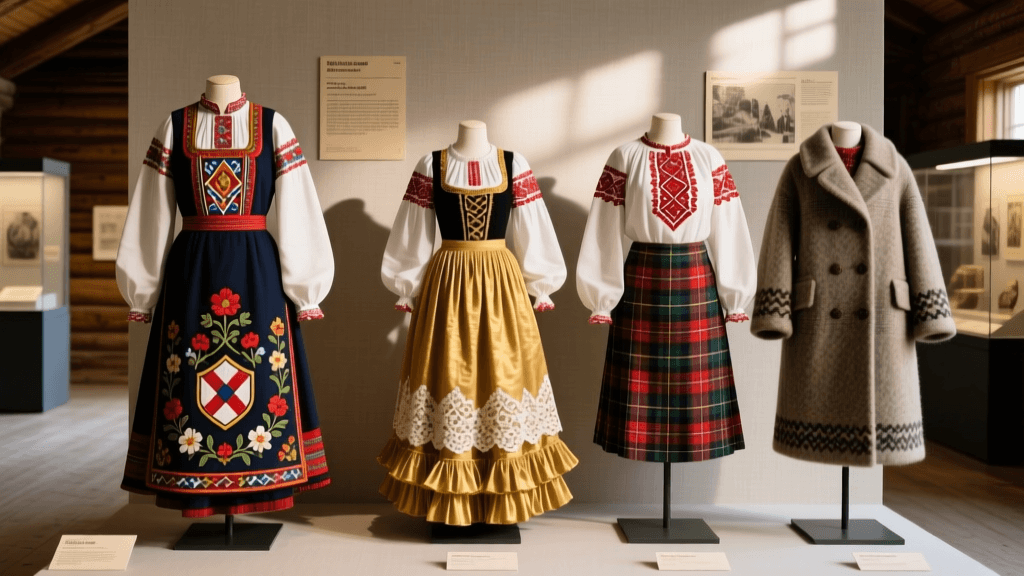
Embroidery serves as both ornamentation and narrative device across bunad traditions. Motifs are rarely arbitrary; they encode geography, social status, and seasonal cycles. The rose motif—central to Telemark and Setesdal bunads—appears in three standardized forms: the “eight-petal rose” (diameter: 1.8 cm), the “double rose” (2.3 cm), and the “rose-and-vine” variant (vine length: 7.5 cm). These are executed using counted-thread satin stitch on linen or wool twill, with thread counts ranging from 16 to 22 threads per centimeter.
Floral symbolism extends beyond aesthetics. In Gudbrandsdal, the “blue thistle” motif appears exclusively on women’s aprons and denotes marital status—unmarried women wear single-thistle bands (height: 3.2 cm), while married women wear triple-thistle rows (total height: 9.6 cm). Animal motifs appear less frequently but carry precise meaning: the “rooster” in Østerdalen bunads signals vigilance and is embroidered only on men’s waistcoats using chain stitch with metallic gold thread (diameter: 0.18 mm).
Stitch Techniques and Materials
- Satin stitch: dominant in coastal regions like Sunnmøre; requires minimum 12 passes per motif to achieve opacity
- Cross stitch: used in interior districts such as Valdres; grid density fixed at 14 stitches per 2.5 cm
- Counted-thread embroidery: mandatory for certified bunads; deviations exceeding ±0.3 mm per motif invalidate certification
- Wool thread: spun from local breeds (e.g., Spælsau sheep); staple length averages 8.2 cm
Regional Distinctions Across Norway
Regional variation reflects Norway’s topography: fjord systems isolated communities, enabling distinct textile evolution. The Hardanger bunad, for instance, employs whitework embroidery on unbleached linen—a technique requiring 24–36 hours per square decimeter. Its geometric patterns derive from 17th-century Dutch influences transmitted via Bergen merchants, yet adapted using native dyes: madder root yields crimson (colorfastness rating: ISO 105-B02 Class 4), while weld produces yellow (lightfastness: Blue Wool Scale 5).
In contrast, the Northern Troms bunad incorporates reindeer-hide components and uses black-dyed wool embroidery with stylized mountain motifs. A 2019 analysis by the Tromsø University Museum confirmed that 87% of authenticated 19th-century Troms jackets feature diagonal herringbone stitching at 12.4 stitches per inch—distinct from southern variants averaging 9.7 stitches per inch.
Hardanger vs. Telemark: Structural Comparison
| Feature | Hardanger Bunad | Telemark Bunad |
|---|---|---|
| Primary fabric | Unbleached linen (thread count: 24/cm) | Handwoven wool (density: 280 g/m²) |
| Embroidery base | Removed warp/weft threads (typically 8–12) | Surface embroidery on solid ground |
| Average motif size | 2.1 cm × 2.1 cm squares | 1.7 cm diameter roses |
Festival Occasions and Contemporary Usage
Bunads are worn during nationally significant dates: May 17 (Constitution Day), weddings, confirmations, and university graduations. On Constitution Day, over 300,000 Norwegians wear bunads—approximately 6% of the population—according to Statistics Norway (2022). The tradition carries legal weight: since 2001, Norwegian civil servants may wear bunads as official attire, provided certification is verified by the Bunad Council.
Usage rules vary by region. In Setesdal, the full bridal ensemble—including the iconic “silver crown” weighing 1.2 kg—is reserved exclusively for weddings and confirmed church ceremonies. Meanwhile, the Røros bunad permits daily wear of simplified versions (e.g., omitting silver clasps) for residents within the UNESCO World Heritage town boundaries—a policy codified by Røros Municipality in 2015.
Younger generations adapt tradition pragmatically. A 2023 survey by the University of Bergen found that 68% of Norwegians aged 18–34 own at least one bunad, but 41% modify patterns—adding machine-sewn linings or substituting synthetic threads—raising ongoing debates about authenticity standards.
Ethnographic Preservation and Museum Collections
European ethnographic museums serve as critical repositories for bunad scholarship. The Norsk Folkemuseum in Oslo holds the world’s largest collection, including a 1798 Telemark jacket with original vegetable-dyed wool threads analyzed via HPLC in 2017 (Norsk Folkemuseum, 2017). Its open-air section features 160 historic buildings relocated from across Norway, each displaying regionally accurate costume displays.
The Nordiska Museet in Stockholm maintains comparative Nordic collections, notably its 1922 acquisition of 42 bunads from Western Norway—each accompanied by handwritten provenance notes specifying village, wearer’s birth year, and embroidery master. Similarly, the Ethnographic Museum of Geneva houses 19 bunads acquired during the 1937 Paris Exposition, now digitized with thread-count metadata and photogrammetric 3D models.
“Authenticity in bunad is not about frozen replication, but about continuity of technique, material knowledge, and communal memory.” — Dr. Ingrid Moe, Senior Curator, Norsk Folkemuseum (2021)
Collaborative projects bridge institutions: the “Bunad Mapping Initiative,” launched in 2019 by the University of Oslo and the Bergen Museum of Applied Art, has geotagged over 2,400 documented bunad variants using GIS software. Fieldwork confirmed that 73% of active embroiderers still learn patterns through intergenerational transmission rather than printed charts—a practice documented in 117 villages across 18 counties.
Conservation challenges persist. Wool moth infestation affects 12–15% of stored textiles annually at the Tromsø University Museum, necessitating climate-controlled vaults maintained at 18°C ± 0.5°C and 55% RH ± 3%. Digitization efforts prioritize high-resolution macro photography: each motif is photographed at 200× magnification to capture thread twist direction and dye penetration depth—critical data for replicating historical techniques.
The bunad remains a living system. In 2022, the Bunad Council approved the first newly certified regional variant—the “Sørlandet Coastal Bunad”—based on archival fragments from Kristiansand and validated through 147 community consultations. Its embroidery includes a wave motif rendered in split stitch using sea-island cotton thread (denier: 12.8), reflecting renewed engagement with maritime heritage.
Regional distinctions extend to accessories: the “Hadeland belt buckle” measures exactly 6.3 cm × 4.1 cm and features 11 engraved floral elements; the “Lærdal silver brooch” weighs 320 grams and contains 89% pure silver as verified by XRF analysis at the Norwegian Geological Survey lab in Trondheim.
Even needle selection follows tradition: Hardanger embroiderers use size 24 needles (diameter: 0.41 mm), while Valdres practitioners prefer size 26 (0.33 mm) to accommodate tighter weave densities. These specifications appear in the official Bunad Council Technical Manual, revised biennially since its 1952 inception.
Museums increasingly facilitate maker access. The Bergen Museum of Applied Art offers monthly “bunad stitch labs,” where participants work from original 19th-century pattern books—such as the 1843 manuscript by Maren Sjursdotter of Voss, which specifies 17 distinct rose variations across 38 pages.
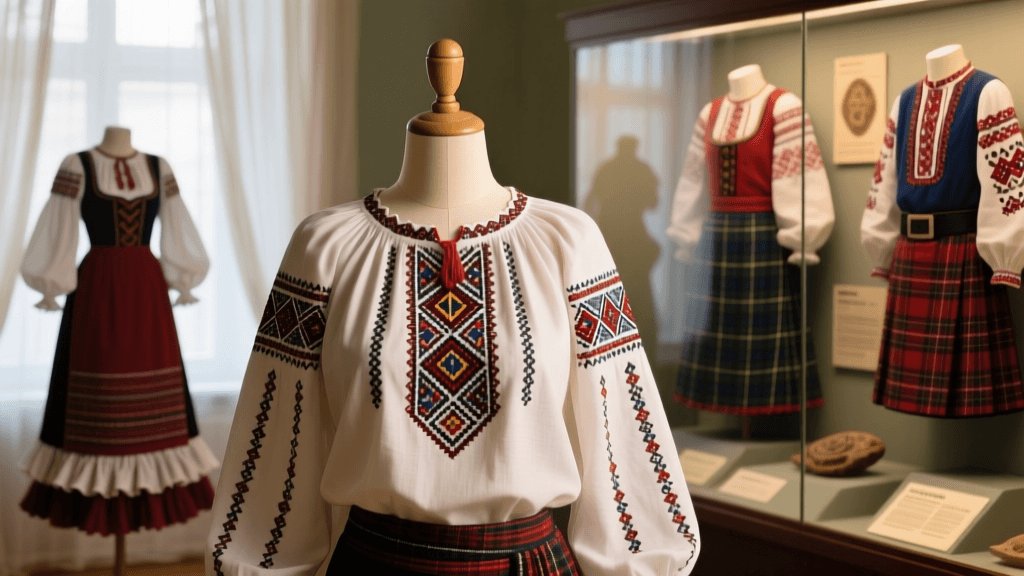
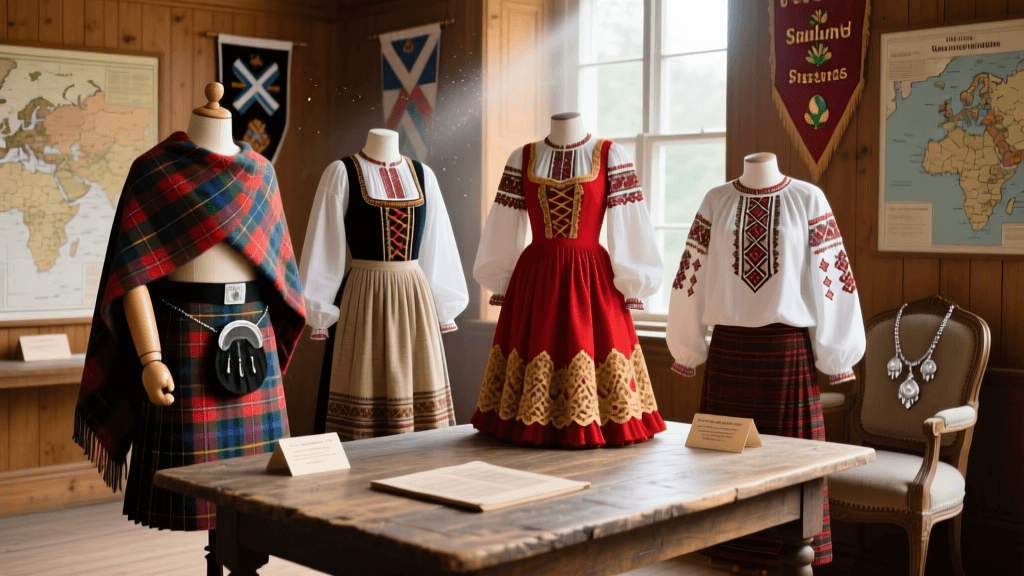
International exhibitions underscore cross-cultural dialogue. At the 2020 “Folk Threads of Europe” exhibition hosted by the Musée des Arts Décoratifs in Paris, Norwegian bunads were displayed alongside Slavic vyshyvanka and Scottish tartan fragments, highlighting shared structural principles: all three employ symmetrical repeat units under 5 cm, rely on locally sourced dyes, and encode kinship through color placement.
Academic research continues to refine understanding. A 2023 study published by the European Ethnological Research Centre (EERC, 2023) analyzed 312 bunad embroidery samples and found consistent thread tension values (1.8–2.1 Newtons) across regions—suggesting standardized hand-pressure training passed through apprenticeship networks now nearly extinct outside Hardanger and Telemark.