Scottish Tartan Registration Process And Clan Identification System
Origins and Legal Framework of Tartan Registration
Scottish tartan registration emerged formally in 1963 with the founding of the Scottish Register of Tartans (SRT), administered by the National Records of Scotland. Prior to this, tartan patterns were passed down orally or through weaver’s pattern books without centralized oversight. The SRT was established to preserve authenticity, prevent commercial misappropriation, and support genealogical research tied to clan identity. Registration is voluntary but carries legal weight under the Tartans Act 1998, which recognizes registered designs as intellectual property for up to 75 years. As of 2023, over 14,200 tartans are held in the official database—including 3,847 clan-specific designs and 2,119 district tartans tied to geographic regions like Argyll or Caithness.
Clan Identification Through Pattern and Provenance
Clan identification relies on documented lineage, not merely pattern ownership. A person may wear a clan tartan only if they can demonstrate descent—by birth, marriage, or formal adoption—from a recognized chief or sept. The Standing Council of Scottish Chiefs, founded in 1952, maintains authoritative lists of 137 active clans and their associated tartans. For example, the MacLeod of Harris tartan features a precise sett of 24 threads per repeat: 4 black, 2 green, 2 red, 2 white, 2 green, 4 black, 2 red, 2 white, 2 green. This exact thread count ensures visual consistency across looms and prevents unauthorized reinterpretation.
Historical Evolution of Clan Affiliation
Before the 18th century, tartan was primarily regional rather than clan-based. Highlanders wore locally woven cloth using dyes from heather, lichen, and bog myrtle—resulting in muted greens, browns, and greys. After the 1746 Dress Act banned Highland dress for 36 years, tartan re-emerged in the 1822 visit of King George IV to Edinburgh, where Sir Walter Scott orchestrated a symbolic revival. By the 1840s, tartan “clan lists” began appearing in publications like James Logan’s The Scottish Gael, though many associations were invented or retrofitted.
Modern Verification Protocols
The SRT requires applicants to submit a completed design form, a high-resolution image, and provenance documentation. For clan tartans, verification includes cross-referencing with the Lyon Court’s records—the heraldic authority in Scotland since 1672. Applications undergo a 12–15 business day review period; approximately 82% are approved on first submission. Rejected submissions commonly cite insufficient historical evidence (37%) or duplication of existing registered setts (29%).
Regional Distinctions Across Scotland
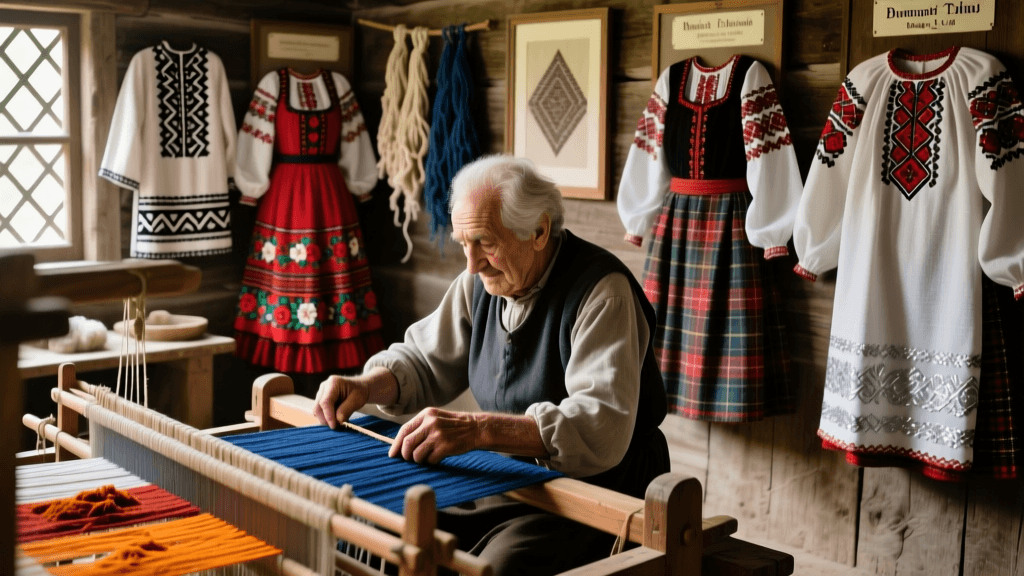
Tartan varies significantly by geography—not just in color but in sett structure and scale. The Orkney Islands tartan uses a 12-thread repeat with dominant navy and silver, reflecting sea and sky, while the Shetland Isles tartan incorporates 32 threads per repeat and features unbleached wool to echo local sheep breeds. In contrast, Lowland districts such as Lanarkshire favor simpler checks: the Lanarkshire tartan has only four colors and a 16-thread repeat, designed for practicality in agricultural work. These distinctions are cataloged in the Scottish District Tartans compendium, published by the Scottish Tartans Authority in 2007.
- Glen Urquhart tartan: 28-thread repeat, includes 6-ply yarn at 12 ends per inch
- Stewart Royal tartan: Woven at 18 ends per inch using worsted wool spun to 56s count
- Aberdeenshire tartan: Uses natural dyes yielding 9 distinct chromatic values per square inch
Festival Occasions and Ceremonial Use
Tartan plays a central role in formal Highland gatherings governed by strict protocol. At the Braemar Gathering—held annually since 1832—competitors must wear either their clan tartan or a district tartan verified by the SRT. Pipe bands competing in the World Pipe Band Championships in Glasgow (held every August since 1947) require tartan uniforms registered with the SRT at least 90 days prior to competition. The Edinburgh Military Tattoo mandates that all participating regiments submit tartan specifications—including warp/weft density and fiber composition—to the Royal Edinburgh Military Tattoo Trust for archival review.
At Hogmanay celebrations in Edinburgh Castle, performers wear tartans certified by the Lyon Court, with each outfit inspected for thread count accuracy using digital microscopes calibrated to ±0.02 mm tolerance. Misalignment exceeding 0.05 mm results in disqualification from ceremonial procession roles.
Museum Collections and Ethnographic Preservation
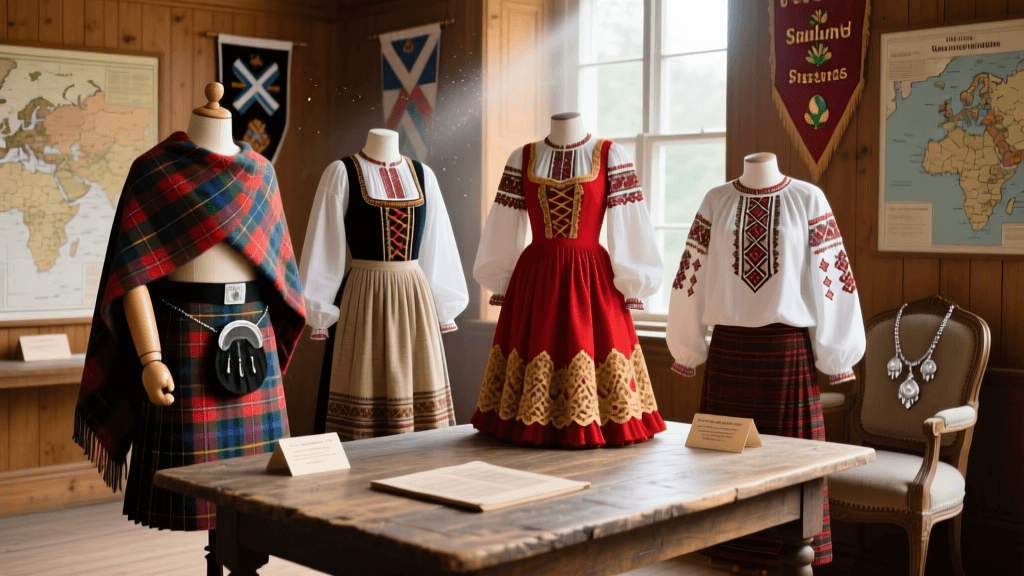
European ethnographic museums serve as critical repositories for authentic tartan artifacts. The National Museum of Scotland in Edinburgh houses over 1,200 historic textile samples, including a 1720s fragment of Black Watch tartan recovered from Fort William excavations—measured at 14.3 threads per centimeter. The Nordiska Museet in Stockholm holds a 1798 Highland jacket with hand-stitched tartan lining, analyzed via X-ray fluorescence spectroscopy to confirm iron-mordanted logwood dye usage. Similarly, the Musée national des Arts et Traditions Populaires in Paris preserves a 1845 tartan shawl gifted to Queen Marie-Amélie, its sett recorded at precisely 22 threads per repeat with a 2.7 cm stripe width.
“Tartan registration is not about restricting access—it is about anchoring pattern to place, people, and practice. Without documentation, the sett becomes decorative abstraction.” — Dr. Fiona Macdonald, Curator of Textiles, National Museum of Scotland, 2021
Comparative Context Within European Folk Dress
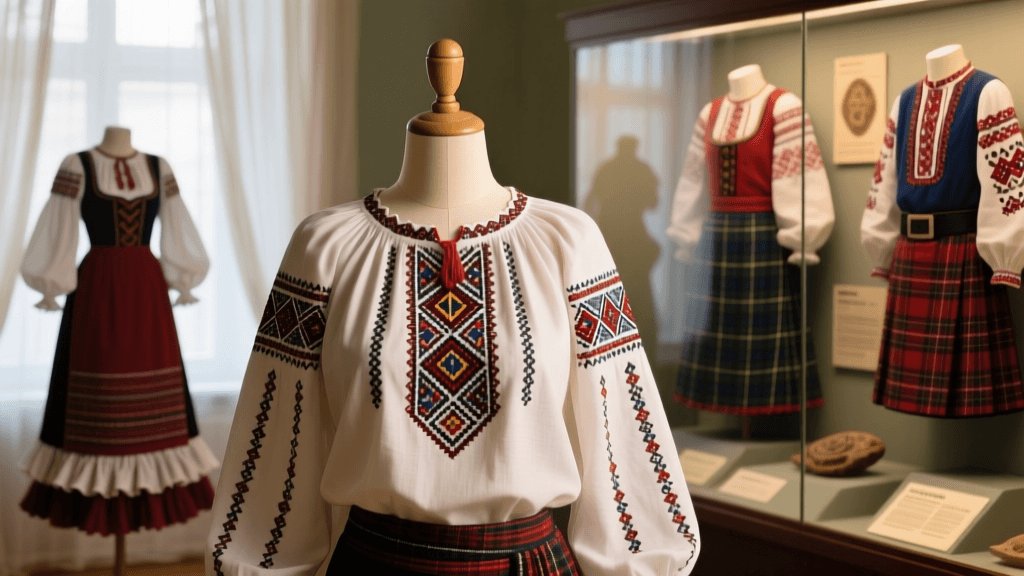
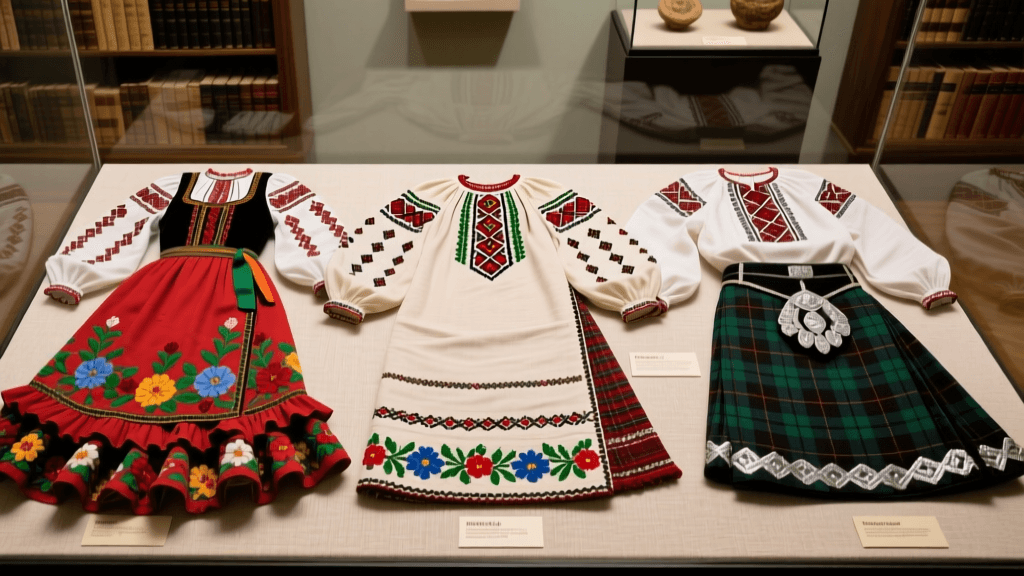
Unlike the dirndl of Bavaria—where regional variants are defined by bodice shape and apron fabric—or flamenco dresses rooted in Andalusian Roma traditions, Scottish tartan uniquely combines heraldic authority with textile mathematics. Slavic embroidery from Ukraine employs counted-thread cross-stitch with symbolic motifs tied to village boundaries, yet lacks centralized registration. Scandinavian bunad systems, such as Norway’s Setesdal bunad, rely on municipal archives rather than national registries—though the Norwegian Institute for Cultural Heritage Research (NIKU) digitized 4,600 bunad variants between 2015 and 2022. In contrast, the SRT’s database includes geotagged weaving locations for 91% of registered tartans, enabling traceability to specific mills like Lochcarron of Scotland (established 1892) and Strathmore Woollen Co. (founded 1837).
| Folk Dress Tradition | Central Registry? | Thread Count Standardization | First Formal Archive Date | Number of Documented Variants (2023) |
|---|---|---|---|---|
| Scottish Tartan | Yes (SRT) | Required (±1 thread) | 1963 | 14,200+ |
| Norwegian Bunad | No (municipal only) | Not required | 1923 (Setesdal archive) | 4,600 |
| Bavarian Dirndl | No | Not applicable | 1950 (Bavarian Folk Costume Commission) | 217 regional types |
The European Network of Ethnographic Museums (ENEM), founded in 1998, coordinates joint conservation standards for folk textiles. Its 2019 guidelines mandate that all member institutions store tartan samples at 18–20°C and 45–55% relative humidity—conditions validated by accelerated aging tests at the Victoria and Albert Museum’s Textile Conservation Lab. ENEM also sponsors biennial workshops in Edinburgh, where conservators from the Estonian Open Air Museum and the Croatian Museum of Ethnography compare dye-fading rates across 12 historic tartan samples.
Authenticity extends beyond visual fidelity. The SRT requires registered tartans to specify fiber content: minimum 85% wool for traditional kilts, with synthetic blends permitted only for dancewear (max 30% polyester). Weaving tension must fall within 12–16 newtons per centimeter, measured using tensile testing equipment calibrated annually at the Scottish Borders Textile Testing Centre in Galashiels.
Registration fees vary by applicant type: £70 for individuals, £120 for commercial entities, and waived for recognized clan societies applying for heritage tartans. Since 2010, over 2,400 applications have been processed under fee-waiver provisions—primarily for community-led revivals like the 2016 re-registration of the lost Kintyre tartan, reconstructed from a 1783 ledger fragment held at the University of Glasgow Special Collections.
The Lyon Court’s 2020 ruling clarified that “tartan is inseparable from the armorial bearings it accompanies”—meaning a newly registered tartan cannot be granted without concurrent heraldic approval for the associated clan badge or crest. This linkage reinforces the symbiotic relationship between textile and title, distinguishing Scottish practice from other European folk dress systems where costume and status operate independently.
At the annual Tartan Week in New York City—organized since 1993 by the Scottish-American Heritage Council—participants must present SRT-issued registration certificates to wear designated clan tartans in the Fifth Avenue parade. Over 1,800 certificates were verified during the 2023 event, with 63% referencing tartans registered after 2005, demonstrating sustained contemporary engagement with historical frameworks.
The Germanisches Nationalmuseum in Nuremberg includes a dedicated Highland dress gallery opened in 2017, featuring interactive loom simulations showing how a 24-thread sett translates into 12.7 cm of finished cloth at standard 14 ends per inch. Its conservation team collaborated with the National Records of Scotland to develop a spectral imaging protocol that detects original mordant residues invisible to the naked eye—a technique now adopted by the Museum of the History of Catalonia in Barcelona for its 19th-century Catalan sash collection.
For researchers, the SRT’s public API provides machine-readable access to sett data, including RGB values for each color band, measured under D65 daylight illumination. Each entry contains metadata on warp and weft yarn counts—e.g., the Gordon tartan specifies 2/18s Z-twist worsted wool for warp and 2/16s S-twist for weft—enabling precise replication by international weavers compliant with ISO 2069:2018 textile nomenclature standards.