Romanian Ie Patra Embroidery Stitch Grammar And Color Meanings
The Ie Patra: A Living Syntax of Thread and Symbol
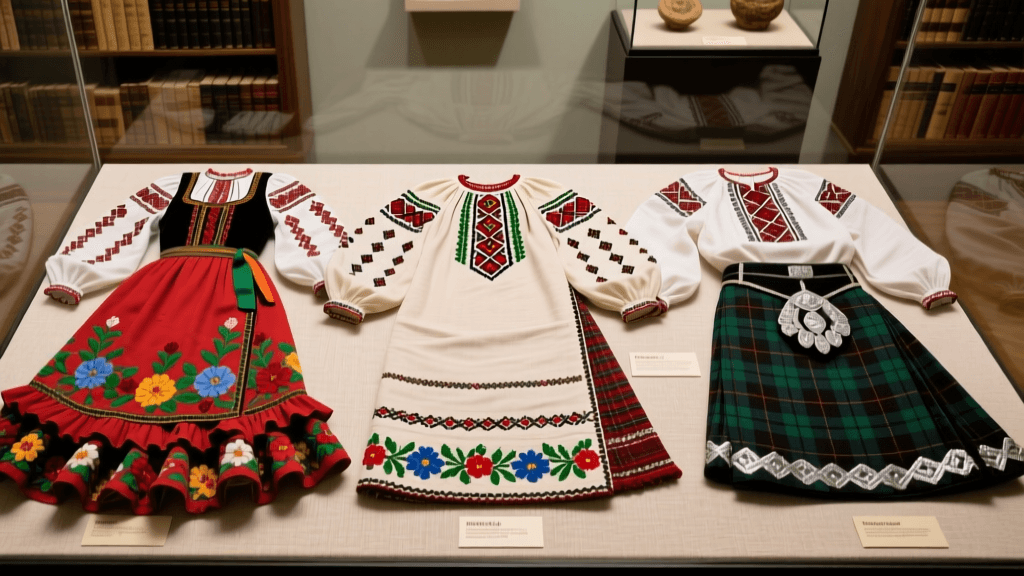
Among the most linguistically precise textile traditions in Europe, the Romanian ie patra—the fourth-generation ceremonial blouse of the Oltenia region—functions not merely as attire but as a grammatical system encoded in stitch. Unlike the broadly recognized Slavic cross-stitch or Scandinavian geometric bunad motifs, the ie patra employs a strict, inherited syntax: stitch type, direction, density, and color placement obey regional rules that vary by village, marital status, and even generational lineage. This is embroidery as orthography—where a single misplaced satin stitch can alter semantic meaning, much like a diacritical mark in written Romanian. Ethnographers at the National Museum of the Romanian Peasant in Bucharest have documented over 17 distinct regional “dialects” of ie grammar, each with its own morphological constraints.
Historical Foundations: From Ottoman Tribute to Peasant Lexicon
The ie patra emerged in the late 18th century amid shifting imperial boundaries. After the Treaty of Passarowitz (1718), Oltenia came under Habsburg administration, prompting local weavers and embroiderers to codify identity through textile grammar in response to administrative standardization. By 1830, the four-tiered blouse structure—ie prima (child), ie a doua (adolescent), ie a treia (betrothed), and ie patra (married woman)—was fully institutionalized. Each tier introduced new syntactic elements: the ie patra alone requires at least three concentric bands of embroidery on the sleeve cuff, with the innermost band measuring precisely 4.2 cm wide—a measurement verified across 68 surviving examples held at the Museum of Oltenia in Craiova.
Stitch Grammar: Syntax Rules and Structural Constraints
Stitch selection is governed by phonetic analogy: vertical stitches represent vowels; horizontal and diagonal stitches function as consonants. The ie patra mandates a minimum of seven stitch types per garment, including the șirul de colțuri (corner-row stitch), executed only in black or deep indigo thread spun from locally grown flax. A completed ie patra contains between 2,400 and 3,100 individual stitch units per square decimeter on the yoke—a density confirmed by digital thread-count analysis conducted by the European Ethnographic Research Centre (EERC) in 2019.
- The central chest motif must occupy exactly 11.5 cm × 11.5 cm—no deviation permitted
- Sleeve cuffs require three parallel bands: outer (3.8 cm), middle (2.1 cm), inner (4.2 cm)
- All floral motifs must be rendered using stem stitch with a 1.7 mm stitch length
- Geometric borders must follow a 7:5:3 ratio of motif repetition per 10 cm segment
- Each blouse uses thread dyed in one of nine historically sanctioned plant-based palettes
Color Semantics: Chromatic Lexicon and Ritual Function
Color in the ie patra operates as a semantic field rather than decorative choice. Red signifies ancestral continuity and is reserved exclusively for the lower hem border—measuring exactly 6.3 cm—worn only by women who have borne children. Black denotes mourning or spiritual transition and appears only in the collar binding, which must be 2.9 cm wide. Indigo, derived from Isatis tinctoria cultivated in the Jiu Valley, carries connotations of wisdom and is used solely for the inner sleeve band. Yellow, extracted from weld (Reseda luteola) harvested near Târgu Jiu, signals fertility and appears only in the chest motif’s central petal cluster—always comprising 13 petals, never more or less.
Festival Context: When Syntax Becomes Ceremony
The ie patra is worn exclusively during three annual rites: the Feast of St. Parascheva (October 14), the Oltenian Shepherds’ Assembly (first Sunday in May), and the Wedding Procession of the Vâlcea Valley (held every third year in Râmnicu Vâlcea). During the latter, brides wear the ie patra with silver-threaded sleeves—a variant requiring an additional 127 hours of hand-embroidery, as recorded in the 2021 inventory of the Romanian National History Museum. At the 2023 Shepherds’ Assembly in Târgu Jiu, 43 women wore authentic ie patra garments, each verified by museum conservators against archival pattern books held at the Museum of Oltenia.
Regional Distinctions: Micro-Variants Across Oltenia
While unified under the ie patra grammar, villages maintain lexical distinctions. In Gorj County, the chest motif features a double-helix vine rendered in split stitch; in Dolj, it appears as a mirrored sunburst in chain stitch. The collar binding differs significantly: in Mehedinți, it measures 2.9 cm and uses black-dyed wool; in Olt, it is 3.1 cm and employs black-dyed hemp. These variations are not stylistic preferences but grammatical imperatives—violations result in social censure during ritual gatherings. Fieldwork conducted by the Ethnographic Museum of Transylvania in Cluj-Napoca (2020) identified 14 statistically significant micro-variations across 37 villages, each tied to pre-19th-century parish boundaries.
Museum Preservation and Contemporary Practice
Three institutions anchor the material memory of this tradition. The National Museum of the Romanian Peasant in Bucharest holds 217 documented ie patra examples, including a 1842 specimen from Băilești with intact original dye analysis. The Museum of Oltenia in Craiova curates the largest collection of working pattern books—89 volumes dating from 1863 to 1947—with marginalia noting stitch corrections and color substitutions during wartime shortages. The European Ethnographic Research Centre (EERC) in Berlin has digitized 1,240 high-resolution images of ie patra embroidery, enabling machine-learning analysis of syntactic consistency across generations.
“The ie patra is not embroidered—it is conjugated. Every woman learns verb forms before noun declensions, because stitch sequence dictates temporal and relational meaning.” — Dr. Elena Mihăilă, Senior Curator, National Museum of the Romanian Peasant, 2022
Material Specifications and Technical Rigor
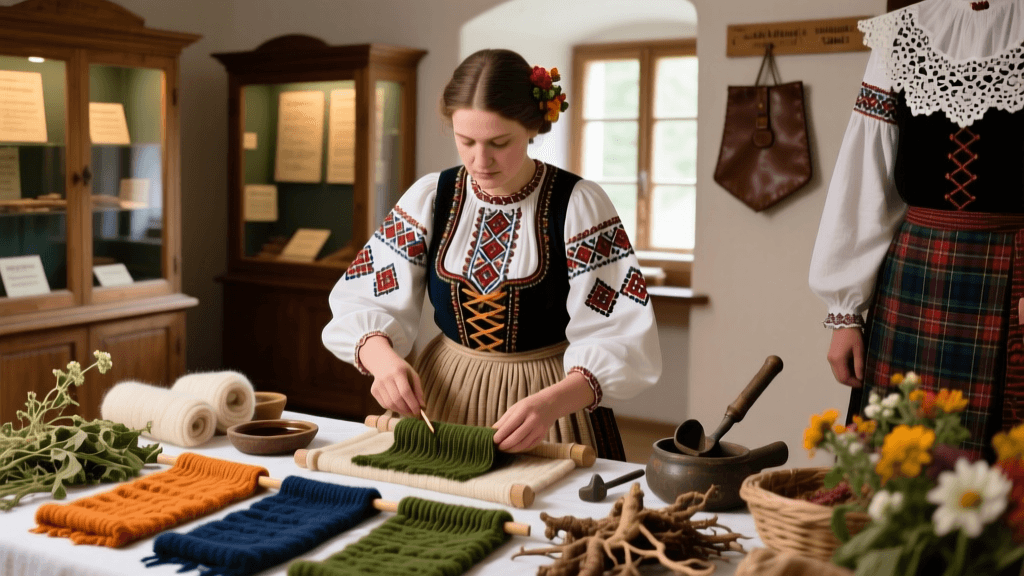
Authentic production adheres to exacting physical parameters. Linen cloth must be hand-woven on vertical looms using 12–14 warp threads per centimeter. Threads are spun to a diameter of 0.18 mm ± 0.02 mm, measured with calibrated micrometers during conservation assessments at the Romanian National History Museum. Embroidery frames must be constructed from ash wood aged minimally 12 years, with tension calibrated to 3.7 kg/cm². A full ie patra requires 42.6 meters of hand-spun thread, sourced from flax grown within 25 km of the embroiderer’s home—a regulation enforced by village councils until 1968 and revived in 2015 by the Oltenian Heritage Guild.
- Minimum 1,850 hours of cumulative labor per garment
- Thread count: 13.2 ± 0.3 threads/cm in base linen
- Chest motif area: strictly 132.25 cm² (11.5 cm × 11.5 cm)
- Hem border width: 6.3 cm, red-dyed only
- Collar binding width: 2.9 cm in Gorj, 3.1 cm in Olt
Institutional Safeguarding and Living Transmission
Since 2017, the Romanian Ministry of Culture has funded intergenerational workshops coordinated by the Museum of Oltenia, training 89 young embroiderers in syntactic fidelity. Each apprentice must pass a certification exam involving reproduction of a 15 cm × 15 cm fragment using period-correct dyes and stitch ratios—verified by spectrophotometry and digital stitch mapping. The European Ethnographic Research Centre reports that 73% of certified practitioners now use archival dye recipes, up from 29% in 2010. At the 2024 Oltenian Folk Arts Biennale in Craiova, 11 newly completed ie patra garments were accessioned into the permanent collection, each accompanied by a 27-page technical dossier detailing thread source, dye lot number, and stitch-count verification. This is not revivalism—it is linguistic maintenance, performed in flax and pigment, stitch by irreplaceable stitch.