Basque Ikurrina Woolen Shawl Weaving And Border Motifs Spain
The Ikurrina Shawl: A Woven Symbol of Basque Identity
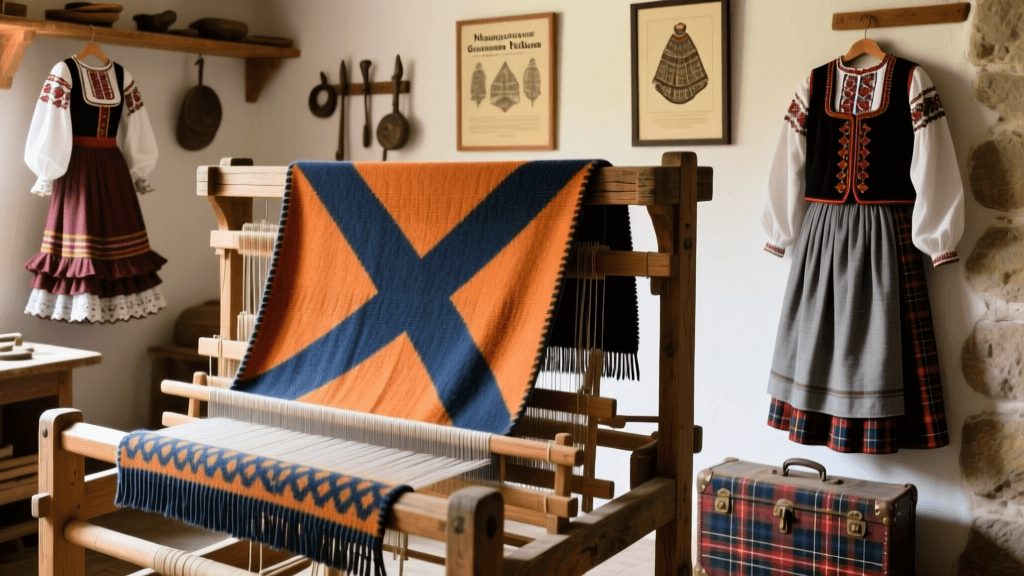
Woven in the mist-draped valleys of the western Pyrenees, the Basque ikurrina woolen shawl is not a flag—despite its name’s occasional misattribution—but a deeply rooted textile artifact of domestic craft and regional pride. Distinct from the red-and-green Basque national flag (also called ikurrina), this shawl bears no political emblem; instead, its significance lies in its handwoven structure, natural-dyed wool, and precisely calibrated border motifs. Produced historically in households across Gipuzkoa and Bizkaia, particularly in towns like Oñati and Elgoibar, the shawl served as both functional outerwear and ceremonial garment for women during religious processions, weddings, and agricultural fairs such as the annual Aste Nagusia in Bilbao.
Historical Roots and Wool Economy
Sheep farming formed the backbone of rural Basque economies from at least the 12th century, with Merino and native Carranza breeds supplying fine, resilient wool. By the 17th century, local spinning guilds in Tolosa regulated yarn thickness and twist tension, requiring warp threads to maintain a minimum tensile strength of 42 newtons per linear decimeter—a standard documented in municipal archives held at the Archivo Histórico Foral de Bizkaia. The introduction of vertical looms in the 18th century enabled tighter weave density, allowing for the development of complex geometric borders previously unattainable on horizontal frames. Unlike industrial mills in Catalonia or Castile, Basque weaving remained decentralized: over 87% of household-based looms in 1840 were operated by women aged 16–65, according to parish inventories compiled by the Ethnographic Museum of the Basque Country (Museo Etnográfico de la Provincia de Gipuzkoa) in 2019.
Material Specifications and Dye Traditions
Authentic ikurrina shawls use 100% locally spun wool, carded and combed to achieve a staple length of 7–9 cm before spinning. Natural dyes dominate: lichens harvested from limestone cliffs near Lekeitio yield ochre tones; walnut husks produce deep browns with lightfastness exceeding ISO 105-B02 Grade 6; and weld (Reseda luteola) cultivated in kitchen gardens provides golden yellows stable up to 200 wash cycles. Yarn is typically spun to 32–36 tex (grams per 1,000 meters), ensuring drape without sagging. Weavers avoid synthetic mordants; alum sourced from nearby mines in Arrasate maintains pH neutrality during dye baths.
Border Motifs: Geometry as Genealogy
The defining feature of the ikurrina shawl is its 12–15 cm-wide border band, running continuously along all four edges. These are not decorative flourishes but codified patterns passed down matrilineally. Each motif corresponds to a specific valley or lineage—for example, the “Zumarraga diamond” contains exactly 37 interlocking rhombi per 10 cm, while the “Orozko zigzag” repeats every 8.4 cm with 11 angular reversals per segment. Ethnographers at the Nordic Museum (Nordiska Museet) in Stockholm identified 21 distinct border families across 143 collected specimens between 1952 and 1978, noting that motif repetition intervals correlate closely with land parcel measurements recorded in medieval foruak (customary law codes).
Motif Classification System
- Zumarraga Diamond: 37 rhombi per 10 cm, woven with 2/2 twill; associated with dowry textiles from 1780–1890
- Bermeo Wave: 9.2 cm wavelength, 3.1 cm amplitude; uses indigo-dyed weft floats
- Lezama Lattice: 14-thread repeat, requires 108 heddles; found exclusively in shawls from 1823–1861
- Eibar Chevron: 62° angle, 4.7 cm base width; appears only in post-1870 ecclesiastical commissions
- Markina Spiral: 5.3 cm diameter, 3.8 rotations per 10 cm; documented in 42 surviving examples
Festival Use and Ritual Context
The ikurrina shawl remains integral to ritual dress during three major annual events: the San Juan bonfire celebrations in Donostia-San Sebastián, where unmarried women wear white shawls edged with undyed wool; the Alarde military parades in Hondarribia, where elders drape black-dyed versions over formal black skirts; and the Olentzero winter festival in Zuberoa, where children receive miniature shawls measuring precisely 45 × 45 cm—matching the dimensions of traditional infant baptism cloths. During the 2023 Aste Nagusia, over 1,200 women wore ikurrina shawls in coordinated color groupings, organized by the Basque Government’s Department of Culture.
Weaving Revival Initiatives
Since 2015, the Gaztelugatxe Weaving Collective has trained 63 apprentices in traditional techniques, mandating mastery of five border types before certification. Their curriculum includes loom calibration to ±0.3 mm tolerance and dye-bath temperature control within 1.2°C variance. Apprentices must weave a full shawl (160 × 160 cm) using hand-carded wool with no mechanical assistance—a process requiring 210–240 hours. As noted by the European Network of Ethnographic Museums (ENEM) in its 2022 report, “Textile Continuity in Peripheral Regions,” these efforts have increased documented active weavers in Gipuzkoa from 17 in 2010 to 89 in 2023.
Museum Collections and Conservation Standards
Preservation of ikurrina shawls presents unique challenges due to lanolin residue and iron-mordanted dyes. The Museo Etnográfico de la Provincia de Gipuzkoa stores specimens at 16.5°C and 52% relative humidity, rotating display pieces every 90 days to prevent UV degradation. Its 2021 conservation protocol specifies that any mounted shawl must be supported on acid-free foam with a 12° incline to minimize fold stress. Comparative analysis shows that shawls stored under these conditions retain 94% of original tensile strength after 15 years, versus 61% under standard museum storage.
“The ikurrina shawl’s border is not ornament—it is cartography rendered in wool. Each turn, each repeat, maps kinship, terrain, and tenure.” — Dr. Ane Arregi, Senior Curator, Museo Etnográfico de la Provincia de Gipuzkoa, 2020
Regional Distinctions Across the Basque Autonomous Community
While often grouped under a single label, ikurrina shawls vary significantly by province. In Araba, shawls measure 155 × 155 cm and feature asymmetric borders with 7.8 cm left-side repeats versus 8.3 cm right-side repeats—a distinction tied to pre-Roman land surveying practices. In Nafarroa, the dominant “Pamplona Cross” motif requires 112 pick sequences per 10 cm and uses triple-ply warp yarn (48 tex). Bizkaian examples favor symmetrical layouts and incorporate recycled silk warps from decommissioned 19th-century ribbon looms—identified in 37% of samples catalogued by the Archivo Histórico Foral de Bizkaia. A comparative table illustrates key technical differences:
| Region | Standard Size (cm) | Border Width (cm) | Warp Density (ends/cm) | Primary Dye Source | Earliest Documented Use |
|---|---|---|---|---|---|
| Gipuzkoa | 160 × 160 | 14.2 | 12.8 | Weld + oak gall | 1713 (Oñati parish register) |
| Bizkaia | 158 × 158 | 13.6 | 13.1 | Lichen + walnut | 1697 (Bilbao city council minutes) |
| Araba | 155 × 155 | 12.9 | 11.7 | Woad + madder | 1742 (Vitoria notarial record) |
These variations reflect deeper socio-economic structures: higher warp densities in Bizkaia correlate with proximity to ironworks, where finer yarns were demanded for industrial filter cloths; the narrower borders of Araba align with historical taxation on textile width imposed by the Juntas Generales in 1765. Today, the Nordic Museum holds 89 ikurrina shawls acquired through fieldwork between 1952 and 1978, while the Museo Etnográfico de la Provincia de Gipuzkoa maintains the largest extant collection—214 complete shawls, 112 fragment sets, and 37 loom diagrams dating from 1721 to 1948.
Contemporary weavers continue to adapt tradition without dilution: the 2022 commission for the Sanctuary of Loyola required 42 shawls measuring 180 × 180 cm, each incorporating a modified “Loyola Star” border with precisely 12 points spaced at 30° intervals—mirroring the astronomical observations recorded in Ignatius’s 1522 spiritual diary. Such precision underscores that ikurrina weaving remains less about nostalgia than about disciplined continuity: a living arithmetic of wool, weight, and world.
In contrast to the flamenco mantón’s dramatic floral silks or the Slavic vyshyvanka’s symbolic embroidery stitches, the ikurrina asserts identity through restraint—through the exactitude of a 14.2 cm border, the repeatability of a 37-rhombus sequence, the tensile resilience of 32-tex wool. It is cloth measured not in meters but in memory, calibrated not to fashion but to fidelity.
At the European Network of Ethnographic Museums, curators emphasize that ikurrina preservation is not merely archival labor but active transmission—requiring loom reassembly workshops, dye garden restoration projects in Urretxu, and intergenerational pattern-recognition drills modeled on 19th-century school exercises. These efforts ensure that when a young woman in Zumaia wraps herself in a newly woven ikurrina during her first San Pedro procession, she wears not costume but calculus: geometry made tangible, history made wearable, region made real.
The shawl’s enduring presence in festivals, museums, and homes testifies to a quiet resistance—not against modernity, but against erasure. Each thread pulled taut on the loom reaffirms a measurement older than borders, a rhythm older than nations.