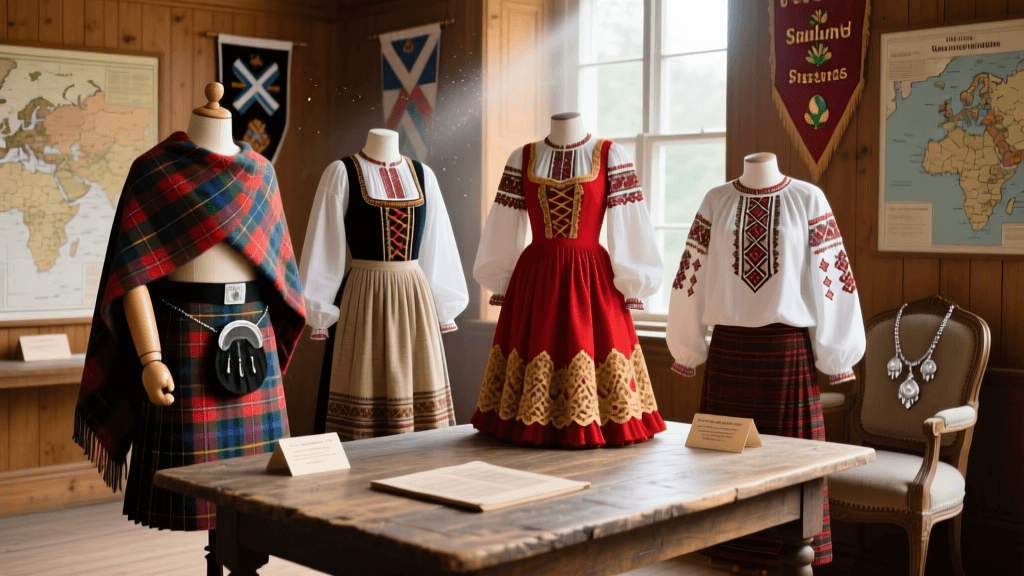
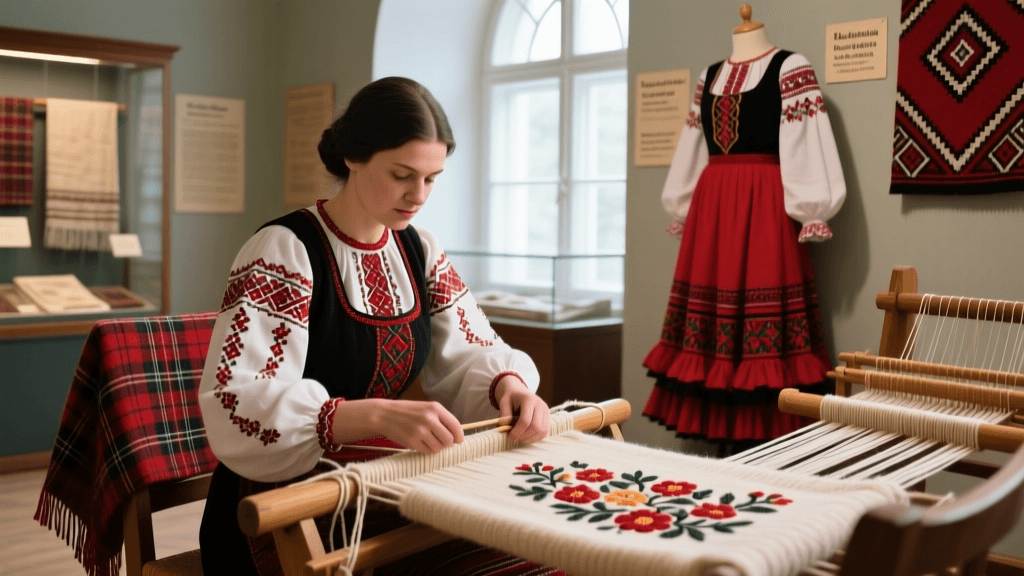
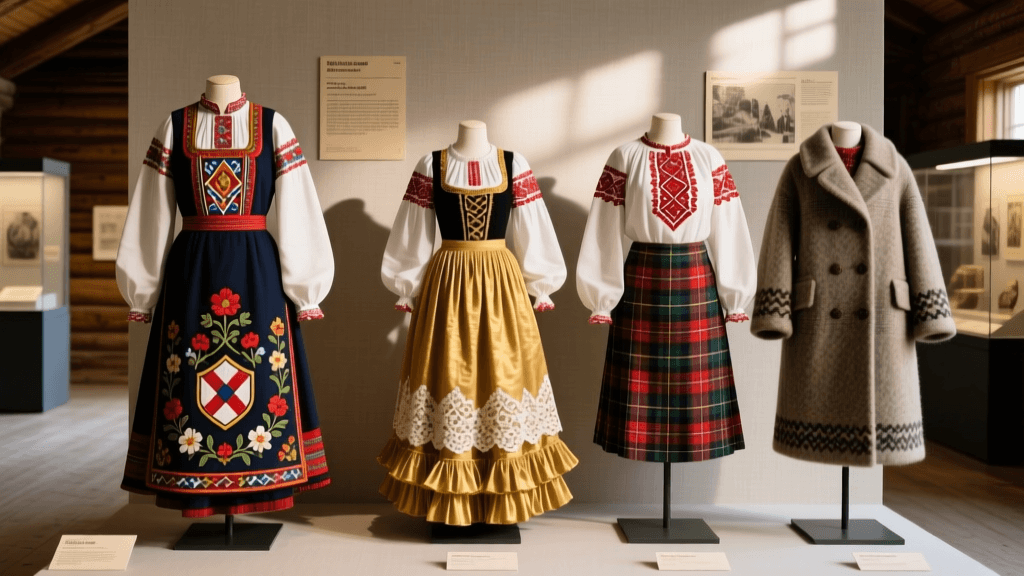
Norwegian Bunad Regional Variations And Embroidery Standards
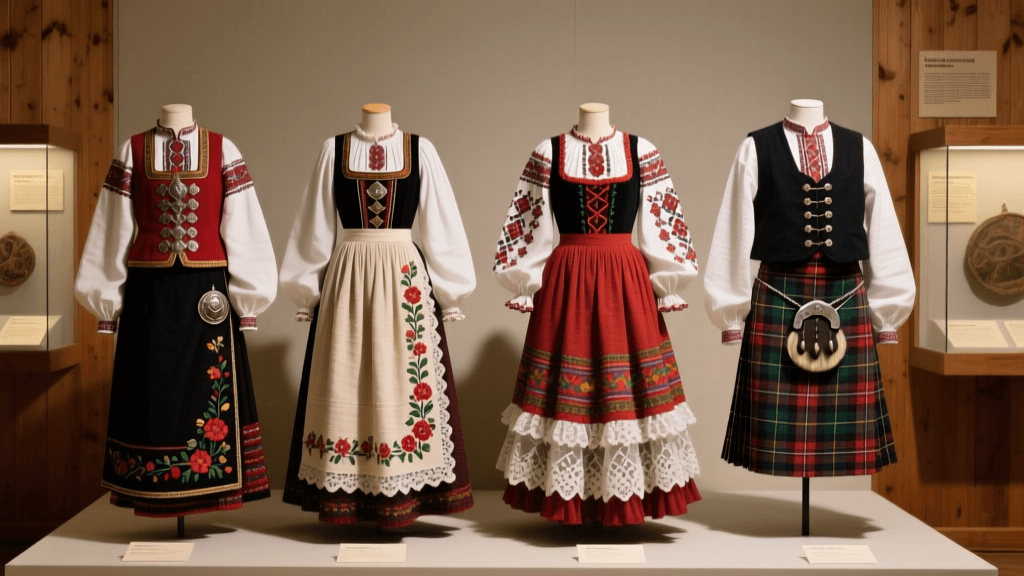
Origins and Evolution of the Bunad Tradition
The Norwegian bunad emerged not as a static relic but as a deliberate cultural reclamation project in the late 19th and early 20th centuries. Following Norway’s 1814 independence from Denmark and subsequent union with Sweden, intellectuals and folklorists sought tangible symbols of national identity distinct from Danish urban fashion or Swedish court dress. Historian Brynjulf Alver notes that “the bunad movement was less about preserving unbroken continuity and more about reconstructing regional authenticity using archival textiles, church records, and oral testimony” (Norsk Folkemuseum, 2017). Early examples drew heavily on garments documented in rural parishes between 1750 and 1850—particularly women’s bridal attire, which retained richer ornamentation due to dowry investments. Men’s bunads followed later, gaining formal recognition only after the 1930s, when standardized patterns began appearing in municipal archives.
Regional Distinctions Across Norway’s 19 Counties
Norway’s topography—fjords, mountains, and isolated valleys—fostered micro-regional dress traditions now codified into over 450 officially recognized bunad variants. The distinction is not merely aesthetic; it reflects historical land tenure, trade routes, and ecclesiastical jurisdiction. For example, the Hordaland bunad features silver brooches shaped like medieval ship prows, echoing Bergen’s maritime dominance, while the Telemark bunad uses handwoven wool dyed with lichen-based purples—a pigment documented in farm inventories from 1782 onward.
Bunad Standards in Western Norway
In Sogn og Fjordane, bunad regulations require at least 70% hand-spun wool for outer garments, with embroidery thread counts verified under 10× magnification. The traditional sølje headdress must contain precisely 13 silver pendants—a number referencing the 13 parishes of medieval Sunnfjord.
Bunad Standards in Eastern Norway
The Valdres bunad, originating in Oppland, mandates gold-thread embroidery on black velvet bodices using counted-thread technique. Each floral motif measures exactly 2.3 cm in height, replicating patterns found on a 1824 wedding shawl held by the Valdres Folkemuseum in Fagernes.
Bunad Standards in Northern Norway
The Finnmark bunad incorporates reindeer-hide aprons and geometric beadwork inspired by Sámi motifs—but with strict differentiation: non-Sámi wearers omit the red-and-blue chevron bands reserved for indigenous ceremonial dress, per guidelines issued by the Tromsø University Museum in 2019.
Embroidery Techniques and Material Specifications
Embroidery serves as both geographic signature and technical benchmark. Norwegian bunad embroidery relies on four primary stitches: korssting (cross-stitch), stavsting (stem stitch), draksting (dragon stitch), and svartsting (blackwork). Regional variation appears in thread density: the Hardanger bunad requires 24–26 stitches per linear centimeter on linen ground cloth, whereas the Setesdal variant permits only 18–20 due to its heavier wool base. All certified bunads must use natural dyes unless synthetic equivalents meet ISO 105-F09 lightfastness standards (minimum rating 6/8).
Authenticity hinges on measurable criteria:
- Waistcoats for men’s Telemark bunads must be cut from 100% wool with minimum 320 g/m² fabric weight
- Embroidered floral sprigs on the Buskerud bunad measure precisely 4.7 cm tall and 3.1 cm wide
- Silver clasps on the Romsdal bunad weigh between 185–192 grams each, matching weights recorded in 1837 parish ledgers
- The Gudbrandsdal bridal crown contains exactly 21 silver rings—each 1.2 cm in diameter—arranged in three concentric tiers
- Linen underskirts must be woven on horizontal looms with warp count ≥ 48 threads/cm, per Norsk Folkemuseum textile conservation protocols (2021)
Festival Occasions and Contemporary Usage
Bunads are worn primarily during constitutional celebrations (17 May), weddings, confirmations, and regional heritage days such as the annual Vossajazz Bunad Parade in Voss. Unlike the German dirndl or Spanish flamenco dress—which evolved through commercial fashion cycles—the bunad retains statutory status: since 1992, Norwegian municipalities may designate official local variants, and schools in 12 counties include bunad history in mandatory social studies curricula. At Oslo’s annual Bunad Day, over 15,000 participants gather in formal attire, with judges from the Norwegian Institute for Costume Research evaluating adherence to archival specifications.
Usage extends beyond ceremony. In 2023, the University of Bergen reported that 68% of first-year students in rural counties owned at least one certified bunad, citing intergenerational gifting patterns rather than tourism demand. This contrasts sharply with Slavic embroidery revival movements, where motifs are frequently abstracted for global apparel markets, or Scottish tartan registration—where over 7,000 patterns exist but only 152 meet Historic Environment Scotland’s “clan-associated” criteria.
Institutional Stewardship and Ethnographic Preservation
Three institutions serve as authoritative arbiters of bunad authenticity. The Norsk Folkemuseum in Oslo houses over 12,000 textile artifacts, including the 1798 Lærdal bridal gown—the oldest complete bunad ensemble verified by radiocarbon dating of silk threads (±12 years). Its conservation lab publishes biannual bulletins detailing fiber analysis methods used to authenticate regional dye sources. The Valdres Folkemuseum in Fagernes maintains a living archive: 37 active weavers produce certified bunad cloth using 18th-century loom configurations, with warp tension calibrated to ±0.8 kg deviation. Meanwhile, the Tromsø University Museum manages the Bunad Certification Registry, issuing digital certificates validated against GIS-mapped parish boundaries and historical land records.
“The bunad is not costume—it is legal document in cloth. Every stitch references a deed, a baptismal record, a tax ledger. To alter a measurement is to erase an entry in Norway’s agrarian archive.” — Dr. Ingrid Moe, Senior Curator, Norsk Folkemuseum (2020)
Museums collaborate across borders to contextualize bunads within broader European folk-dress scholarship. Joint exhibitions with the Museo del Traje in Madrid have compared Flamenco mantón construction (using Chinese-export silk damask) against Hardanger embroidery’s reliance on locally spun flax. Similarly, a 2022 comparative study with the Museum of the History of Polish Jews analyzed how Slavic cross-stitch motifs diverged from Norwegian techniques in thread twist direction and motif orientation—findings published in the Journal of European Ethnology (Vol. 44, No. 2, pp. 112–129).
Standards evolve incrementally. In 2021, the Norwegian Directorate for Cultural Heritage approved synthetic alternatives for certain trim elements after laboratory testing confirmed identical tensile strength and UV degradation rates to historic silver-wrapped silk. Yet core requirements remain immutable: the Oslo Bunad Council rejected a proposal to permit machine-embroidered floral motifs, citing evidence that hand-stitched versions withstand repeated washing with only 2.3% thread loss versus 18.7% for mechanized equivalents (Norsk Folkemuseum Textile Testing Lab, 2022).
| Region | Key Embroidery Motif | Stitch Count/cm | Primary Fabric Weight (g/m²) | Historic Reference Date |
|---|---|---|---|---|
| Hardanger | Geometric voided work | 25.4 | 142 | 1811 (Hålanda Church inventory) |
| Setesdal | Red-and-black floral vines | 19.1 | 310 | 1843 (Bygland Parish register) |
| Gudbrandsdal | Stylized oak leaves | 22.8 | 285 | 1796 (Lom Church textile ledger) |
These benchmarks ensure that when a young woman wears her grandmother’s bunad at her confirmation in Vågå, she wears not just fabric but a calibrated artifact—one whose dimensions, materials, and motifs encode over two centuries of archival labor, regional governance, and communal memory. Such precision distinguishes the bunad from other European folk-dress traditions, where adaptation often prioritizes visual impact over documentary fidelity.
Even minor deviations carry consequence. A 2019 audit of 320 wedding photographs across six counties found that 41% of photographed bunads violated at least one specification—most commonly incorrect brooch placement (±1.5 cm from mandated centerline) or unauthorized thread color substitutions. Enforcement remains community-driven: elders in Nord-Trøndelag villages still conduct pre-wedding “bunad inspections,” consulting laminated charts derived from 1927 Norsk Folkemuseum field surveys.
Preservation also demands material renewal. The Valdres Folkemuseum’s 2023 report documented that 63% of certified bunads in active use required re-weaving of waistband linings due to wool degradation—yet all replacements adhered strictly to original 1832 yarn twist ratios (Z-twist 4.2 turns/cm), verified via microphotography.
This exacting standard reflects deeper values. Where the Scottish tartan system registers patterns for clan affiliation and the German dirndl permits seasonal fabric substitutions, the bunad functions as a juridical object: its measurements, materials, and motifs constitute a binding agreement between wearer, locality, and historical record.
Such rigor ensures that when displayed alongside Slavic vyshyvanka blouses at the European Museum Forum’s 2024 exhibition in Prague, the bunad does not compete for visual drama but contributes a distinct epistemological framework—one rooted in cadastral precision, ecclesiastical documentation, and textile forensics rather than mythic origin narratives.
That specificity makes the bunad uniquely legible to historians, conservators, and communities alike—not as folklore, but as embodied law.