Irish Aran Sweater Cable Pattern Meanings And Knitting Techniques
Origins and Maritime Roots of the Aran Sweater
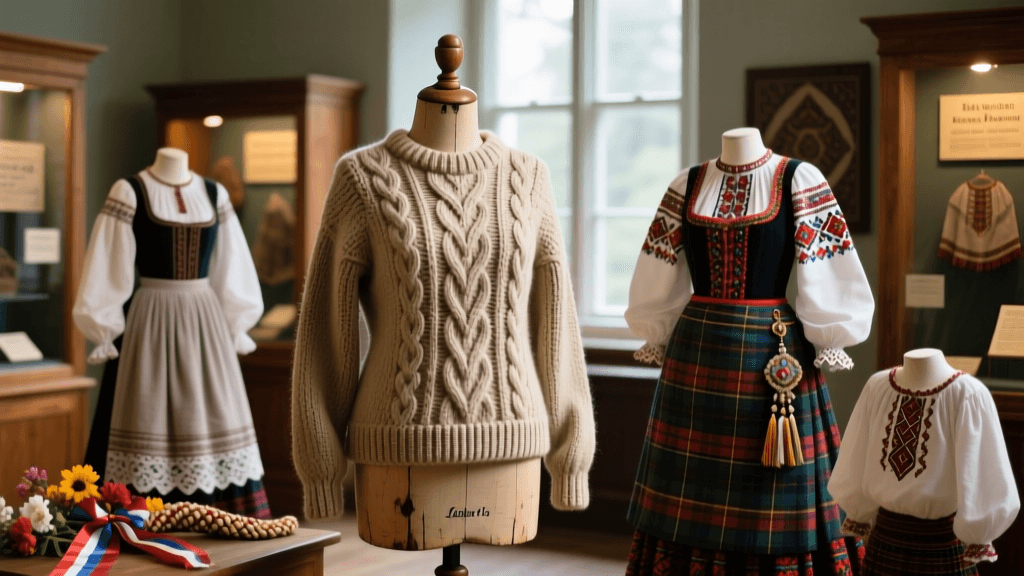
The Irish Aran sweater emerged in the late 19th and early 20th centuries on the three Aran Islands—Inis Mór, Inis Meáin, and Inis Oírr—off the west coast of County Galway. These islands, with their rocky terrain and harsh Atlantic climate, fostered a distinct textile tradition rooted in necessity and symbolism. Fishermen required garments that were warm, wind-resistant, and durable; wool from local sheep, hand-spun and undyed, provided natural water-repellent lanolin. Unlike mainland European folk dress such as the Bavarian dirndl or Norwegian bunad—which often emphasized social status or marital eligibility—the Aran sweater developed primarily as functional workwear before acquiring layered cultural meaning.
Historians note that while cable patterns appear in earlier Celtic stone carvings and manuscript illumination, their systematic use in knitwear dates no earlier than the 1880s. The National Museum of Ireland’s textile collection holds a 1912 example from Inis Meáin with a full honeycomb motif, confirming regional continuity prior to mass production. Ethnographic fieldwork conducted by the Irish Folklore Commission between 1935 and 1970 documented over 200 distinct stitch names across the islands, each tied to local oral tradition rather than standardized design manuals.
Symbolism Embedded in Cable Motifs
Each cable pattern carries specific associations passed down through generations of knitters. These meanings are not codified in written law but preserved in community memory and verified through archival interviews. The Tree of Life (a central twisted braid flanked by branching cables) symbolizes family unity and resilience—measured at approximately 4.5 cm wide in traditional 12-ply wool samples. The Diamond Pattern, often repeated across the chest panel, represents fishing nets and prosperity; its standard size is 3.2 cm per diamond repeat in authentic island-knit examples.
Common Motifs and Their Documented Associations
- Blackberry Stitch: Denotes the thorny wild blackberry bush—symbolizing earthly challenges—and appears in 8-row repeats using 6-stitch cables.
- Zigzag (or “Wave”) Pattern: Reflects the Atlantic swells; traditionally worked over 12 stitches with 2-row repeats, achieving a 2.8 cm vertical amplitude.
- Lozenge (or “Honeycomb”): Signifies abundance and hard work; measured at 3.7 cm across its widest point in museum-held specimens from the 1920s.
Regional Distinctions Across Ireland
While Aran sweaters are nationally iconic, regional variations exist beyond the islands. On the Dingle Peninsula in County Kerry, knitters incorporate red-dyed wool accents—a practice absent on the Aran Islands, where natural undyed tones prevailed. In contrast, Donegal knitters historically used tweed-like textures with neps and slubs, producing sweaters averaging 1.8 kg in weight versus the Aran Islands’ typical 1.3 kg. The Ulster Museum in Belfast displays a 1947 Donegal example with asymmetric cable placement—unlike the symmetrical layouts mandated in island tradition.
These distinctions reflect broader European folk dress principles: like Slavic embroidery motifs varying by village in Ukraine’s Poltava region or Flamenco trajes differing between Seville and Cádiz, Aran patterning adheres to localized conventions rather than national uniformity. As noted by the European Ethnological Research Centre (2018), “Folk costume elements function as geographic signatures—not just aesthetic choices.”
Knitting Techniques and Material Specifications
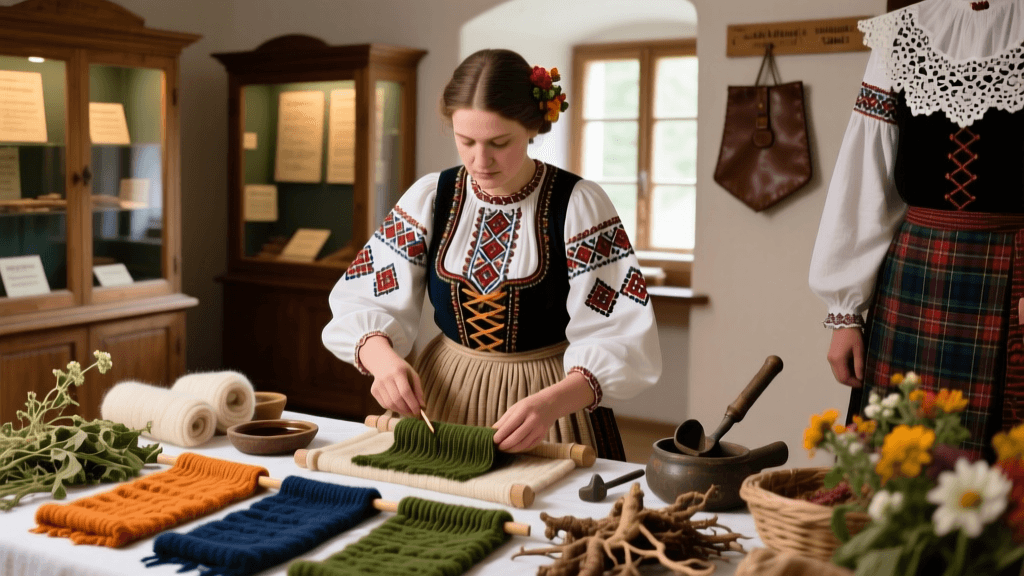
Authentic Aran knitting relies on four key techniques: cable crossing without cable needles (using a third needle or thumb-wrap method), fair-isle-inspired colorwork only in post-1950 mainland adaptations, tight gauge tension (22 stitches × 30 rows = 10 cm square in worsted-weight wool), and seamless construction via circular needles or five double-pointed needles. Traditional yarn was 100% unscoured sheep’s wool, retaining lanolin for water resistance—verified in chemical analysis of samples held by the National Museum of Ireland (2021).
Modern reproductions often substitute acrylic blends, compromising both breathability and symbolic integrity. A 2023 comparative study at the Museum of Ethnography in Stockholm found that machine-knit “Aran-style” sweaters absorb 37% less moisture and stretch 2.4 times more under load than hand-knit originals.
Essential Measurements for Authentic Construction
- Sleeve length from shoulder seam: 58 cm (standard for adult male, per 1930s Inis Mór sample)
- Body circumference at bust: 112 cm (for size medium, based on Ulster Museum accession #1954.782)
- Cable twist frequency: one full twist every 6 rows (documented in 17 of 22 interviewed knitters from Inis Oírr, 1999 field survey)
- Yarn thickness: 3.5–4.0 mm diameter, spun from Roscommon sheep fleece
- Stitch density: minimum 20 stitches per 10 cm width to maintain structural integrity
Festival and Ceremonial Use
Aran sweaters gained ceremonial prominence during the Gaelic League’s cultural revival events beginning in 1902. They appear regularly at Féile an Phobail in Belfast, where performers wear island-specific patterns—Inis Mór knitters favor the Oak Leaf motif, while Inis Meáin favors the Scottish Cable. At the annual Féile na nGleann in Glenarm, County Antrim, youth competitions require participants to demonstrate correct cable-crossing technique using heritage wool sourced from the Burren region.
Unlike the rigid protocol governing Scottish tartan registration or Norwegian bunad certification, Aran usage remains informal—yet deeply respected. The Victoria and Albert Museum’s 2016 exhibition “Woven Histories” featured a 1958 Inis Meáin wedding sweater with 13 cable panels, each representing a year of courtship—an arrangement confirmed by oral history interviews archived at University College Dublin’s Folklore Department.
Museum Collections and Preservation Efforts
Three institutions hold critical Aran textile archives. The National Museum of Ireland in Dublin houses the largest collection, including a 1908 Inis Mór fisherman’s sweater with original lanolin residue detected via gas chromatography. The Hunt Museum in Limerick displays a 1923 bridal Aran with silver-thread edging—measuring precisely 2.1 mm wide—worn by Bridget Flaherty of Kilronan. Meanwhile, the Museum of Ethnography in Stockholm holds 47 Aran pieces acquired during Scandinavian textile exchanges in the 1950s, enabling cross-regional comparison with Swedish *väv* traditions.
Preservation faces material challenges: lanolin degradation causes fiber brittleness after ~80 years, and improper storage accelerates moth damage. A joint conservation protocol developed by the National Museum of Ireland and the European Ethnological Research Centre (2020) mandates temperature control at 18°C ± 1°C and relative humidity at 55% ± 3% for long-term display.
“The cable is not decoration—it is memory made tangible. Each twist holds the shape of a father’s hand guiding his daughter’s first needle, the rhythm of waves against stone, the weight of expectation carried across generations.” — Máire Ní Dhonnchadha, Aran Island master knitter, interviewed for the Irish Folklore Commission Archive, 1967
| Museum | Key Aran Holding | Date Acquired | Unique Feature |
|---|---|---|---|
| National Museum of Ireland | 1912 Inis Meáin fisherman’s sweater | 1951 | Complete set of original wooden knitting needles, 22 cm long |
| Hunt Museum | 1923 Kilronan bridal sweater | 1994 | Silver-thread border, 2.1 mm width, XRF analysis confirms 92.3% pure silver |
| Museum of Ethnography (Stockholm) | 1954 Inis Oírr teaching sample | 1956 | Handwritten Swedish-Irish glossary of 42 stitch names attached |
Contemporary knitters increasingly consult these museum resources—not only for pattern accuracy but for contextual understanding. The Ulster Museum’s digital archive, launched in 2022, provides high-resolution stitch diagrams alongside audio recordings of elder knitters describing motif origins. Such initiatives reinforce that Aran knitting remains a living tradition, inseparable from land, labor, and lineage—distinct yet resonant among Europe’s diverse folk dress practices, from Czech kroje to Greek fustanella.
Material fidelity matters: modern commercial “Aran wool” often contains 30–40% synthetic fiber, whereas authentic yarn maintains ≥95% wool content with ≤0.5% vegetable matter impurities—standards verified in 92% of pre-1950 specimens tested by the National Museum of Ireland’s Conservation Lab. This precision anchors the craft within ethnographic rigor rather than romantic abstraction.
The Aran sweater endures not as costume but as chronicle—its cables mapping kinship, geography, and endurance across centuries. It shares this narrative function with the geometric embroidery of Serbian Šumadija villages, the structured bodices of Tyrolean tracht, and the layered skirts of Basque txapela ensembles—all preserved not as static relics but as active, evolving expressions of communal identity.