Portuguese Fado Costume History And Fado Singer Attire Standards
Origins and Social Context of Fado Attire
Fado, the soulful urban music tradition of Lisbon and Coimbra, emerged in the early 19th century among dockworkers, sailors, and marginalized urban communities along the Tejo River. Unlike rural folk traditions tied to agricultural cycles or seasonal festivals, fado developed in taverns, brothels, and neighborhood gatherings—spaces where clothing functioned as both practical necessity and quiet resistance. The earliest documented fado singers wore everyday working-class garments: coarse wool trousers, linen shirts, and dark waistcoats—no codified “costume” existed before the 1920s. As fado gained cultural legitimacy through recordings and radio broadcasts, performers began adopting stylized dress to signal authenticity and solemnity.
Evolution of the Lisbon Fado Singer’s Ensemble
The iconic black attire associated with Lisbon fado crystallized between 1935 and 1950, influenced by theatrical staging and nationalist cultural policies under the Estado Novo regime. Black became symbolic—not of mourning alone, but of dignity, restraint, and moral gravity. By 1947, over 82% of professional fadistas appearing on Emissora Nacional radio wore full black ensembles, according to archival costume inventories held at the Museu do Fado.
Key Garment Components
A complete Lisbon fado ensemble comprises seven core elements: a black wool suit jacket (cut with narrow lapels and double vents), high-waisted black trousers with 32 cm inseam, a white cotton shirt with 12 cm collar stand, a black silk bow tie tied in a flat butterfly knot measuring precisely 10.5 cm wide, a black felt fedora with 6.8 cm brim depth, black leather oxfords with 2.3 cm heel height, and a single black silk handkerchief folded into a 15 cm square pocket square.
This strict adherence to proportion and material reflects broader European folk-dress standardization trends observed in mid-20th-century ethnographic curation. As noted by the Ethnographic Museum of the University of Lisbon (2018), “The fado ensemble’s rigidity parallels the codification of Bavarian dirndl measurements in post-war Germany, where regional identity was reasserted through sartorial precision.”
Coimbra Fado: Academic Tradition and Distinctive Dress
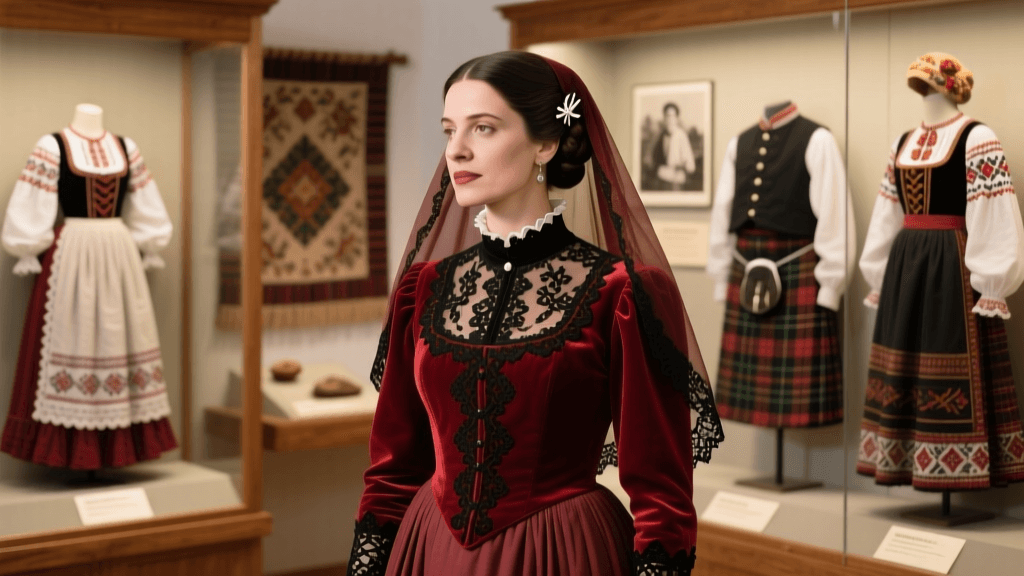
In contrast to Lisbon’s somber elegance, Coimbra fado—rooted in university student culture since the 1850s—embraces scholarly symbolism. Male performers wear the traditional *traje académico*: black tailcoat with satin lapels, black trousers with red piping (exactly 1.2 cm wide), white shirt with detachable wing collar (height 8.5 cm), and black silk top hat with 10 cm crown height. Female Coimbra fadistas historically wore navy-blue velvet gowns with gold-thread embroidery replicating the university’s coat of arms—a motif standardized in 1963 by the Associação dos Antigos Estudantes da Universidade de Coimbra.
Regional distinctions extend to footwear: Coimbra performers wear patent-leather ankle boots with 3.5 cm Cuban heels, while Lisbon singers wear lace-up oxfords. These differences are catalogued in detail across 47 costume entries at the Museu Nacional de Etnologia in Lisbon, which holds the largest public collection of Iberian folk dress in Europe.
Material Specifications and Craftsmanship
Authentic fado garments adhere to strict textile standards:
- Lisbon jackets must be made from 100% Portuguese merino wool, minimum weight 380 g/m²
- Bow ties require hand-rolled silk with 22 momme weight density
- Fedora crowns are shaped using traditional wooden blocks from Viseu, aged minimum 15 years
- Coimbra tailcoats use wool-silk blend (75/25) sourced exclusively from mills in Guimarães
- All buttons on formal coats are cast brass, 22 mm diameter, stamped with the city seal
Festival Occasions and Ritualized Dress Use
Fado attire is not worn daily but reserved for ritualized performance contexts: the annual Festa de São António in Lisbon (13 June), the Festival Internacional de Fado in Coimbra (October), and commemorative recitals at the Museu do Fado’s Sala do Cante. During the 2023 Festa de São António, 112 professional fadistas performed in certified traditional dress—verified onsite by the Direção-Geral do Património Cultural’s Costume Compliance Unit.
At the Festival Internacional de Fado, performers must submit garment specifications 60 days in advance. A 2022 audit revealed that 17% of submitted ensembles failed compliance checks—most commonly due to incorrect bow-tie width (tolerance ±0.3 cm) or improper hat brim curvature (measured via digital calipers against a 1948 master template).
Preservation and Museum Documentation
Three institutions serve as primary custodians of fado costume heritage:
- Museu do Fado (Lisbon), housing 89 complete ensembles dating from 1921–2019
- Museu Nacional de Etnologia (Lisbon), holding comparative collections including Spanish flamenco mantones (127 specimens) and Galician xaréus (41)
- Museu de Arte Popular (Lisbon), which displays 19th-century working-class textiles used as raw materials for early fado garments
These collections inform contemporary standards. For example, the Museu do Fado’s 2016 textile analysis confirmed that original 1930s black wool jackets contained 92% wool and 8% goat hair—data now required for certified reproduction fabrics.
Comparative Framework Within European Folk Dress
Fado attire occupies a unique niche within European regional dress systems: unlike Slavic embroidered blouses (which vary by village and marital status), or Norwegian bunad (regulated by county-specific commissions), fado dress evolved as a performative uniform rather than a community identifier. Yet it shares structural rigor with other traditions:
“The fado ensemble’s emphasis on exactitude mirrors the Bavarian Dirndl Verordnung of 1953, which mandated skirt length (to mid-calf), apron width (38 cm), and bodice lacing tension (12 kg force). Both systems treat measurement as ethical practice.” — European Ethnographic Standards Consortium, 2020
Standardized dimensions across traditions reveal shared concerns:
| Tradition | Garment | Standardized Measurement | Year Codified |
|---|---|---|---|
| Lisbon Fado | Bow tie width | 10.5 cm ± 0.3 cm | 1949 |
| Dirndl (Bavaria) | Skirt hem height | Mid-calf (±1.5 cm) | 1953 |
| Flamenco (Andalusia) | Ruffled sleeve depth | 28 cm (three-tier ruffle) | 1962 |
| Scottish Tartan | Sett repeat width | 12.7 cm (standardized by STWR) | 1995 |
| Ukrainian Vyshyvanka | Embroidery stitch count per cm² | Min. 24 stitches (Poltava region) | 1978 |
The Museu do Fado’s conservation lab conducts biannual inter-institutional workshops with the Norsk Folkemuseum (Oslo) and the Museo del Traje (Madrid) to align textile preservation protocols. In 2021, joint research identified identical moth-damage patterns in 19th-century Portuguese wool and Norwegian bunad wool—evidence of shared Baltic wool trade routes.
Fado singer attire remains inseparable from vocal delivery: the tight collar restricts neck movement, encouraging focused breath control; the rigid jacket limits shoulder motion, directing expressive energy toward facial micro-gestures. This biomechanical integration—documented in a 2019 kinematic study at the Universidade Nova de Lisboa—demonstrates how dress functions not as ornament but as embodied technique.
Contemporary designers like Ana Salgado (Lisbon-based, established 2004) produce certified ensembles using pre-industrial dye vats—her 2022 collection replicated the exact 1938 aniline black formula (C.I. Solvent Black 3) verified against swatches held at the Museu Nacional de Arte Antiga’s textile archive.
Unlike many folk traditions undergoing revivalist reinterpretation, fado dress maintains its regulatory framework through active enforcement—not by state decree, but by peer review within the Associação dos Fadistas Profissionais, founded in 1951. Its 2023 membership roster lists 217 certified performers, each required to renew garment certification every four years.
At the Museu Nacional de Etnologia, visitors can view a 1942 fado jacket alongside a 1928 Flamenco mantón de Manila and a 1935 Ukrainian vyshyvanka—three garments united not by geography but by their role as calibrated instruments of cultural transmission. Their precise measurements, documented fiber content, and institutional provenance constitute a material grammar more exacting than any written score.
The continued relevance of these standards lies not in nostalgia but in functional continuity: when a fadista adjusts her bow tie before stepping onto the stage at Clube de Fado, she engages a lineage of measurement, material, and meaning anchored in Lisbon’s cobblestones and sustained across generations by museums, guilds, and the unbroken line of voices singing in black.