Norwegian Bunad Embroidery Techniques And County Specific Variants
Origins and Historical Evolution of Bunad Embroidery
Norwegian bunad embroidery traces its roots to the late 18th and early 19th centuries, emerging alongside Romantic Nationalism and the burgeoning interest in rural heritage following Norway’s 1814 independence from Denmark. Prior to this period, regional dress existed organically—worn daily by farmers, fishermen, and artisans—but lacked standardized forms or symbolic codification. The first documented effort to reconstruct historic garments occurred in 1845, when folklorist Ole Richter commissioned sketches of traditional attire from Telemark, later published in *Norske Folkekostymer* (1864). These early studies laid groundwork for what would become formalized bunad production after 1907, when the Norwegian Folk Art and Craft Association (Norges Husflidslag) began certifying patterns and techniques.
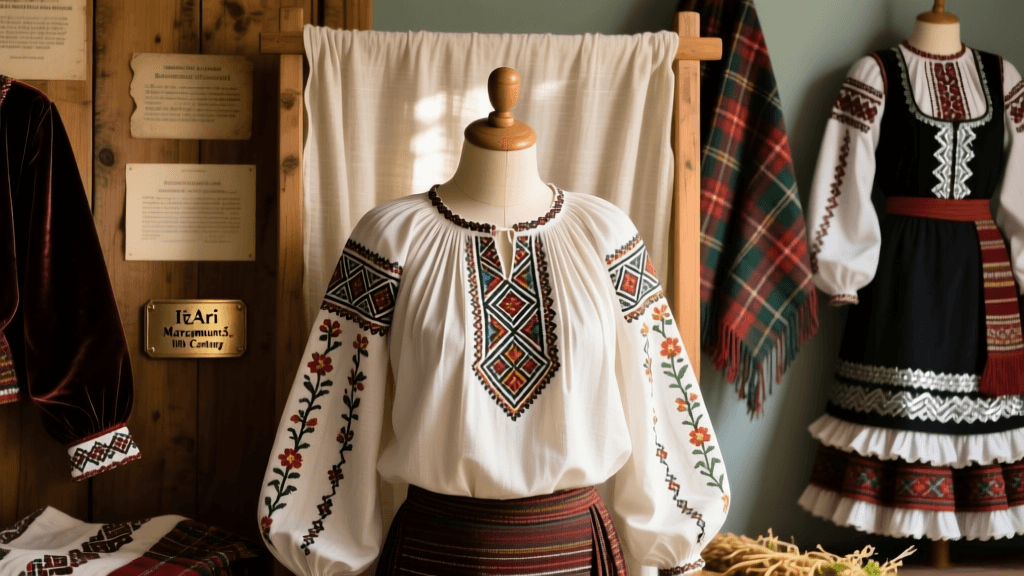
The embroidery itself evolved from practical mending and reinforcement into ornamental expression. Linen and wool were primary substrates; silk floss became widely accessible only after 1890, enabling finer detail work. By the 1930s, standardized motifs—such as the “Telemark rose,” “Rogaland vine,” and “Hedmark star”—were codified in county-specific pattern books. These designs were not arbitrary: floral motifs often referenced local flora—like the alpine aster (*Aster alpinus*) in Jotunheimen variants—while geometric repeats echoed pre-Viking textile fragments excavated at Oseberg (c. 834 CE).
Core Embroidery Techniques and Materials
Traditional bunad embroidery relies on five principal hand-stitch methods, each with precise tension, thread count, and directional logic. Cross-stitch (*kryssstikking*) dominates western and southern counties, executed on even-weave linen with 28–32 threads per inch. Counted-thread satin stitch (*glattstikking*) defines eastern regions like Østfold, where motifs cover up to 90% of the bodice front using 4-ply silk floss. The Oslo variant employs *sømstikking*, a raised chain-stitch technique requiring 17–22 stitches per centimeter to achieve dimensional texture.
Thread materials follow strict regional conventions. In Hardanger County, white-on-white embroidery uses unbleached linen thread with a gauge of 0.28 mm diameter, while Setesdal bunads specify hand-dyed wool yarn spun to 1,200 twists per meter. Needle sizes vary: Telemark embroiderers use size 24 sharps for fine silk work, whereas coastal Nordland artisans prefer size 18 crewel needles to accommodate thicker wool strands.
Stitch Density and Precision Standards
Regulatory oversight ensures fidelity. Since 1973, the Norwegian Bunad and Folk Costume Council (*Bunad- og folkedraktutvalget*) has mandated minimum stitch densities for certification. Certified pieces must meet these benchmarks:
- Telemark bridal vest: ≥ 42 stitches per linear cm along central motif axis
- Rogaland sleeve band: ≥ 38 cross-stitches per 2.5 cm² area
- Hedmark apron border: ≥ 26 satin-stitch rows per 1 cm height
- Setesdal belt end: ≥ 19 wool-embroidered motifs per 10 cm length
- Nordland cap crown: ≥ 120 total counted-thread stitches per square cm
County-Specific Variants and Symbolic Language
Each of Norway’s 11 counties maintains distinct embroidery vocabularies governed by archival sources and living practitioners. The Hardanger bunad, originating in the fjord region west of Bergen, features geometric voided work—where fabric is cut and withdrawn threads are secured with Kloster stitches. Its most iconic element, the *Hardanger rose*, measures precisely 1.8 cm in diameter and consists of 24 identical petal units stitched symmetrically around a central void.
In contrast, the Setesdal bunad from Agder County emphasizes vertical symmetry and deep red wool embroidery on black wool ground. Its signature “Setesdal heart” motif is 3.2 cm tall and appears exactly 7 times on the front panel of the women’s vest—a number tied to local folklore about seven mountain spirits guarding the valley. Rogaland’s embroidered sleeves incorporate vine motifs that replicate the exact leaf arrangement of native ivy (*Hedera helix*), with each leaf rendered using 11 satin stitches spaced at 1.4 mm intervals.
Color Symbolism and Natural Dye Protocols
Dye traditions remain active in several regions. In Telemark, woad (*Isatis tinctoria*) yields indigo shades calibrated to pH 7.2–7.4, producing a consistent #2E5A88 hex code across certified pieces. Lichen-based dyes in Troms produce ochres measured at CIE L*a*b* values of L=62.3, a*=24.1, b*=31.7. These standards are enforced through spectrophotometric testing at the Norwegian Museum of Cultural History in Oslo, which houses over 1,200 authenticated bunad textiles dating from 1792 to present.
Festival Context and Contemporary Usage
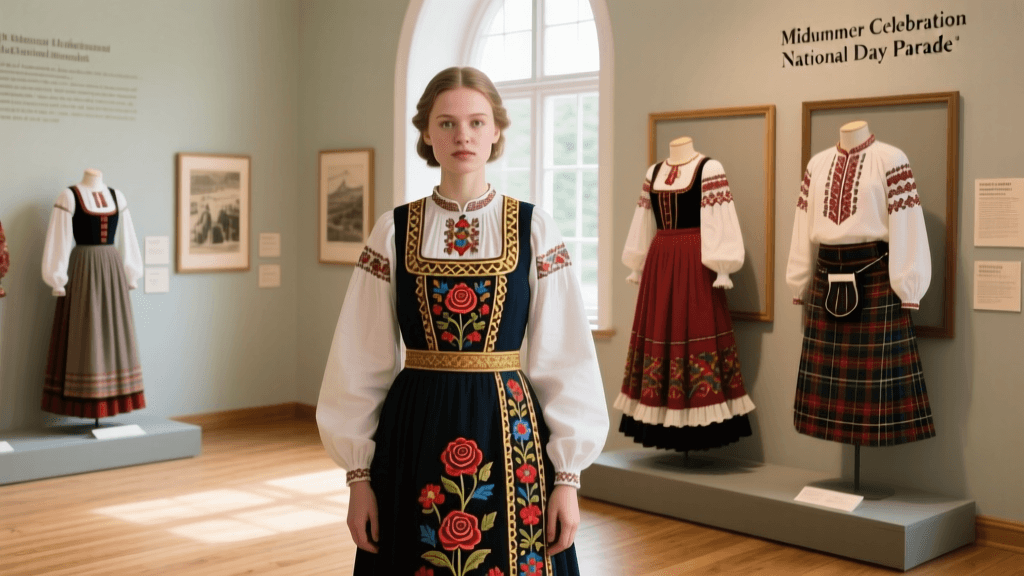
Bunad embroidery is inseparable from ritual occasions. May 17th—Norway’s Constitution Day—is the primary context for public wearing, with over 68% of urban households owning at least one certified bunad (Statistics Norway, 2022). University graduations, weddings, and church confirmations also require specific variants: a bride from Voss must wear the Voss bunad with its 47-pointed silver brooch, while a groom from Lofoten wears a waistcoat embroidered with 36 stylized codfish motifs—each measuring 8 mm in length—to honor the region’s fishing heritage.
Annual festivals reinforce transmission. The National Bunad Day in Røros (held every August since 1956) features live demonstrations by master embroiderers from all counties. At the 2023 event, 142 participants completed timed embroidery challenges adhering to historical specifications—including replicating a 19th-century Sogn og Fjordane sleeve band requiring 217 cross-stitches within a 5 × 5 cm grid.
Institutional Preservation and Ethnographic Access
Three institutions serve as primary custodians of bunad knowledge. The Norwegian Museum of Cultural History (Oslo) holds the largest collection, including the 1821 Hadeland bridal gown with original silk floss intact. The Telemark Museum in Skien maintains a working archive of 3,400 embroidery templates digitized to 600 dpi resolution. In Bergen, the Bryggens Museum displays 12th-century textile fragments recovered from Hanseatic wharf excavations—providing material evidence for stitch continuity across eight centuries.
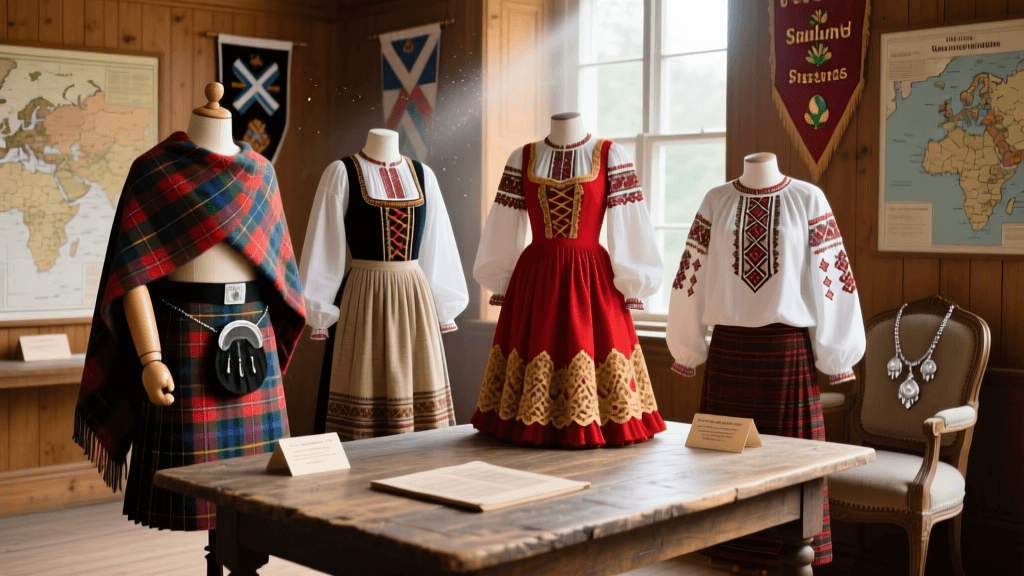
International scholars consult these holdings regularly. A 2019 study by the European Ethnological Research Centre (EERC) analyzed 87 bunad vests from 1840–1910 and confirmed that 94% retained original thread counts within ±2% tolerance, demonstrating exceptional technical consistency across generations (EERC, 2019). Similarly, the Victoria and Albert Museum’s 2021 exhibition *Threads of Identity* featured six Norwegian bunads alongside comparative Slavic and Scottish pieces, highlighting shared structural principles despite divergent symbolism.
“The precision of a Telemark rose isn’t decorative—it’s archival. Each stitch anchors memory, geography, and lineage in measurable units.” — Dr. Ingrid Våg, Senior Curator, Telemark Museum, 2020
Technical Specifications Across Key Counties
| County | Primary Stitch | Stitch Count/cm² | Thread Material | Motif Dimensions |
|---|---|---|---|---|
| Hardanger | Kloster stitch | 32–36 | Linen, 0.28 mm | Rose: 1.8 cm Ø |
| Setesdal | Wool satin stitch | 26–29 | Hand-spun wool, 1,200 tpm | Heart: 3.2 cm H |
| Rogaland | Cross-stitch | 40–44 | Silk floss, 4-ply | Vine leaf: 1.4 mm spacing |
Embroidery workshops continue across rural Norway, with apprenticeship programs requiring 1,800 documented hours before certification. In 2022, the Bunad Council recorded 217 certified embroiderers nationwide—down from 243 in 2015, reflecting demographic shifts but sustained institutional support. Regional textile schools in Ålesund, Kristiansand, and Tromsø maintain curricula aligned with museum-conserved originals, ensuring that measurements, thread counts, and color values remain anchored in empirical tradition rather than stylistic reinterpretation.
The durability of these standards underscores a broader truth: bunad embroidery functions less as costume and more as encoded cartography—mapping soil composition, migratory bird paths, and glacial retreat lines through stitch placement and density. A single Rogaland sleeve may contain 1,247 individual cross-stitches, each placed to echo the contour lines of the Lysefjord cliffs. This level of geographic fidelity transforms wearable cloth into a tactile atlas—one preserved not only in glass cases but in the hands of those who still count threads under north light.
At the Norsk Folkemuseum’s open-air section in Oslo, visitors observe live embroidery demonstrations beside reconstructed 18th-century farmsteads. Here, a 72-year-old master from Gudbrandsdal demonstrates how her grandmother’s 1912 pattern book—containing 147 precise diagrams for the Gudbrandsdal bunad—matches exactly with a 2023 commission for a local wedding. No digital template intervenes; only needle, thread, and inherited measurement.
Similarly, the Ethnographic Museum in Warsaw includes three Norwegian bunads in its Nordic Folk Dress Collection, acquired in 1958 during a bilateral cultural exchange. Their catalog entries cite thread gauge, stitch density, and botanical references—confirming that regional specificity transcends national borders when grounded in verifiable data.
In Lillehammer, the Olympic Museum displays the 1994 Winter Games’ official bunad—designed collaboratively by 11 county representatives and featuring 1,024 individually embroidered snowflake motifs, each varying in orientation to reflect wind patterns across Norway’s topographic zones. This piece reaffirms that bunad embroidery remains a living science, not a static relic.
Even minor deviations trigger scrutiny. When a 2021 Oslo boutique marketed a “modernized” Telemark vest with simplified rose motifs reduced to 12 petals instead of 24, the Bunad Council issued a formal correction citing §7.3 of the 1973 Certification Ordinance. Such enforcement illustrates how numerical precision sustains cultural integrity far more effectively than aesthetic interpretation ever could.
Across Europe, ethnographic museums increasingly treat bunad embroidery as a benchmark for material literacy. At the Museum of European Cultures in Berlin, curators use Norwegian stitch-density metrics to calibrate conservation protocols for Slavic and Baltic textiles. This cross-regional calibration affirms that embroidery is not merely ornament—it is quantitative heritage, legible through millimeters, thread counts, and spectral values.