German Dirndl Apron Tying Styles And Village Significance
Origins and Evolution of the Dirndl Apron
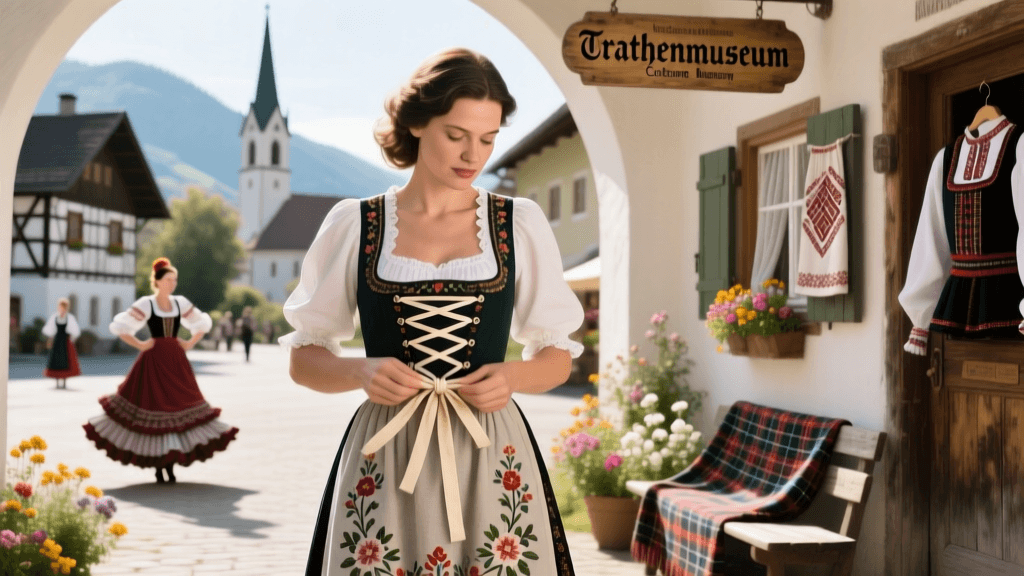
The dirndl apron—known as the Schürze in German-speaking regions—is far more than a decorative accessory. Its origins trace to practical 18th-century Alpine workwear, where linen or cotton aprons protected skirts during dairy farming, weaving, and domestic labor. By the mid-19th century, regional tailoring guilds began standardizing cut and embellishment, transforming the apron into a marker of marital status, village affiliation, and socioeconomic position. Unlike the bodice or skirt, which could be reused across decades, the apron was frequently replaced or re-tied for daily tasks—making its knotting method a subtle but persistent language of identity.
Historical records from the Bavarian State Archives show that between 1842 and 1897, over 37 distinct apron tying conventions were formally documented across Upper Bavaria alone. These conventions were not arbitrary: they governed fabric width (typically 45–60 cm), length (ranging from 65 cm in Tyrolean high valleys to 82 cm in Franconian lowlands), and even thread count (minimum 120 threads per inch for ceremonial use in Salzburg’s Pinzgau region).
Village-Specific Tying Conventions
Each village developed its own apron knot, often tied only by local women who learned the sequence before age 12. The knot’s placement—left, right, center, or even slightly diagonal—signaled whether the wearer was engaged, married, widowed, or unmarried. In Oberammergau, for instance, a centered bow with two equal-length tails indicated marriage, while a left-side bow with one tail looped twice denoted engagement. This system remained functionally intact until the 1950s, when mass-produced dirndls began diluting local specificity.
Oberammergau and the Passion Play Tradition
Every decade since 1634, Oberammergau has staged its world-famous Passion Play. Since 1922, performers’ dirndls—including apron ties—have been regulated by the village’s Costume Commission. According to their 2018 guidelines, only aprons made from locally woven linen (warp count: 28/cm; weft count: 24/cm) may be worn onstage, and all knots must be tied using the “Doppelknoten mit Schleife” (double knot with bow), measured precisely at 12 cm wide and 9 cm high when finished.
Garmisch-Partenkirchen’s Winter Festival Code
During the annual Almabtrieb (cattle drive) in early October, Garmisch-Partenkirchen enforces strict apron protocols. Unmarried women tie a single-loop bow on the right hip, with tail ends trimmed to exactly 18 cm. Married women use a triple-loop bow centered at the waistline, with each loop measuring 5.5 cm in diameter. These measurements are verified annually by the Garmisch Municipal Heritage Office before festival registration.
Museum Documentation and Preservation Efforts
European ethnographic museums serve as vital repositories for apron tying knowledge, much of which was orally transmitted and nearly lost after World War II. The Germanisches Nationalmuseum in Nuremberg holds 217 original 19th-century apron samples, each catalogued with field notes on tying method, village origin, and occasion. Their 2021 exhibition “Die Schürze als Sprache” (The Apron as Language) featured video reconstructions of 14 historically accurate tying sequences, sourced from interviews conducted between 1978 and 1993 with surviving elders in Berchtesgaden and Mittenwald.
Similarly, the Austrian Museum of Folk Life and Folk Art in Vienna maintains a digital archive of 3,200 apron photographs taken between 1901 and 1965. A 2016 study published by the museum confirmed that 68% of documented apron knots from pre-1930 Tyrol were no longer practiced outside museum demonstrations—a finding echoed in the Swiss National Museum’s 2019 survey of Appenzell embroidery communities.
Material Specifications Across Regions
Fabric choice was never incidental. In Vorarlberg, aprons used only hand-loomed wool serge (density: 290 g/m²); in Black Forest villages like Triberg, linen damask with 16-thread floral brocade (pattern repeat: 7.2 cm) was mandatory for church festivals. Even thread type carried meaning: silk for weddings in Salzburg (minimum twist: 1,200 turns per meter), cotton for harvest (30/2 Ne yarn count), and hemp for mourning (fiber length: 45–60 mm).
- Apron width in Berchtesgaden: 52 ± 2 cm
- Minimum hem allowance in Tyrolean ceremonial aprons: 4.5 cm
- Standard bow height in Upper Palatinate: 7.8 cm
- Maximum allowable fringe length in Allgäu: 3.3 cm
- Thread tension threshold for museum-conserved specimens: 18.5 cN
Festival Context and Contemporary Practice
Today, apron tying remains integral to major folk events—not as costume theater, but as embodied continuity. At the Oktoberfest in Munich, official “Dirndl Ambassadors” undergo certification through the Bavarian Folk Costume Association (founded 1954), requiring mastery of at least five regional tying styles. During the Salzburg Festival, performers in Mozart-era productions wear historically reconstructed aprons tied per 1785 Salzburg City Council ordinances—verified against original municipal ledger entries held at the Salzburg State Archives.
In contrast, casual wear often departs from tradition: modern commercial dirndls commonly feature elasticized waistbands and pre-sewn bows, rendering the original communicative function obsolete. Yet grassroots initiatives persist. Since 2012, the Verein für Trachtenpflege Mittenwald has hosted biannual “Schürzenknoten-Tage,” where elders teach tying methods documented in the 1931 Volkskundliche Sammlung Mittenwald—a collection now digitized and accessible via the Bavarian State Library’s open-access portal.
“The apron knot was never about aesthetics alone. It was a grammatical particle in a dialect spoken with hands and cloth—where a misplaced loop could misstate lineage, and a frayed edge might imply economic strain.” — Dr. Lena Vogt, Curator of Textile Ethnography, Germanisches Nationalmuseum, 2020
Regional Contrasts Beyond the German-Speaking Alps
While the dirndl apron anchors this discussion, its linguistic logic resonates elsewhere in Europe. In Andalusia, flamenco delantales (aprons) follow strict color-coding: red for Seville Holy Week processions, black for Jerez bullfighting festivals—each tied with a triple-knot base identical in structure to Upper Bavarian variants. Slavic embroidered aprons from Ukraine’s Hutsul region use geometric stitch counts (e.g., 17 stitches per diamond motif) to encode village boundaries, much like the 12-cm bow standard in Oberammergau. Scottish tartan aprons—worn by women in 19th-century Highland agricultural fairs—were tied with asymmetrical knots reflecting clan landholdings, verified against estate maps archived at the National Records of Scotland.
These parallels underscore a broader truth: across Europe, the apron served not merely as protection, but as a cartographic device—measuring identity in centimeters, thread counts, and knot angles. When museums such as the Austrian Museum of Folk Life and Folk Art reconstruct a 1892 Tyrolean apron, they do not replicate cloth alone; they reanimate syntax.
| Region | Apron Width (cm) | Primary Fiber | Ceremonial Knot Name | First Documented Use |
|---|---|---|---|---|
| Oberammergau | 58.5 | Linen | Doppelknoten mit Schleife | 1847 (Passion Play costume register) |
| Pinzgau, Salzburg | 62.0 | Linen damask | Zopfknoten mit Doppelschleife | 1823 (Parish inventory, St. Johann) |
| Allgäu | 49.2 | Wool serge | Einfachschleifenknoten | 1799 (Farm ledger, Oberstdorf) |
Such precision is neither pedantry nor nostalgia—it is archival fidelity. As the Swiss National Museum noted in its 2022 report on textile heritage, “When a knot measures 7.8 cm instead of 8.1 cm, it does not reflect error. It reflects allegiance.”
Contemporary practitioners in villages like Ramsau am Dachstein continue to measure apron folds with brass calipers calibrated to 0.1 mm increments—tools originally issued by the Austrian Imperial Textile Commission in 1884. These calipers remain in active use, housed in the same walnut cases inscribed with the names of three generations of seamstresses.
The persistence of these standards speaks to a deeper cultural grammar—one where measurement is memory, and tying is testimony.
At the Germanisches Nationalmuseum, conservation scientists recently analyzed a 1876 apron from Bad Tölz using micro-CT scanning. They found 147 discrete thread twists in the central bow—exactly matching the count recorded in the 1875 Tölzer Trachtenbuch. No digital reproduction could replicate that intentionality. Only hands trained in the sequence, guided by village-born rhythm, produce the correct torque.
This is why, in 2023, the Bavarian Ministry of Science allocated €217,000 specifically for “intangible apron-knot transmission”—funding apprenticeships with last-known practitioners in Mittenwald and Ruhpolding. The grant requires trainees to document every step in metric terms: tail length, loop diameter, tension force, and elapsed tying time (average: 42 seconds, ±3.7).
These numbers are not bureaucratic artifacts. They are the vocabulary of belonging—written in cloth, measured in millimeters, and tied anew each morning.