Authentic Viking Smokkr Dress Guide 2026: Patterns & Wools
Introduction to the Smokkr in the 2026 Reenactment Era
The revival of Norse heritage crafting has reached unprecedented heights in 2026. As historical reenactment groups and textile enthusiasts demand stricter adherence to archaeological evidence, the smokkr—commonly known as the Viking apron dress or tragerock—has become a focal point of study and reconstruction. No longer satisfied with the simplified, heavily stylized costumes of the early 2000s, today's artisans are turning to museum-grade textiles, precise tablet weaving, and historically accurate natural dyes to recreate the garments worn by women in Scandinavia and Norse settlements between the 8th and 11th centuries.
At The Garment Atlas, we track the evolution of traditional European folk dress, and the 2026 season has brought remarkable advancements in heritage wool availability. This comprehensive guide will walk you through the anatomy of the smokkr, where to source historically accurate wools this year, and how to construct your own garment using period-correct techniques.
The Great Construction Debate: Tubular vs. Wrapped
Before cutting into your expensive heritage wool, it is vital to understand the archaeological context of the smokkr. The exact silhouette of the Viking apron dress has been debated by textile historians for decades. The two primary theories are the tubular construction and the wrapped construction.
According to the National Museum of Denmark, textile fragments found in the Birka graves and the Hedeby harbor suggest a garment that was either a closed tube or an open rectangle wrapped around the body, suspended by linen or wool loops from a pair of oval tortoise brooches at the shoulders. In 2026, the consensus among high-level reenactors heavily favors the closed, tubular design with side seams, as it provides the structural integrity required to hold heavy bronze brooches without tearing the fabric.
Sourcing Historically Accurate Wools in 2026
The foundation of any authentic smokkr is the textile. Viking-age wools were predominantly woven in tabby (plain weave), 2/1 twill, or diamond twill. Modern commercial wools are often too heavily processed, dyed with synthetic chemicals, and woven with high-twist yarns that lack the soft, fulled drape of historical fabrics.
Fortunately, several heritage mills in the UK, Iceland, and the Baltics have stepped up to meet the 2026 demand for museum-quality reproduction textiles. When sourcing your fabric, look for z/s spun yarns (where the warp and weft are spun in opposite directions), which create the distinctive diagonal texture seen in Viking diamond twills.
2026 Wool Sourcing Comparison Chart
| Wool Breed / Type | Weave Structure | Thread Count (per cm) | Drape & Weight | Best Application |
|---|---|---|---|---|
| Icelandic Heritage Fleece | Tabby (Plain Weave) | 10-12 | Medium, Structured | Outer Smokkr, Cloaks |
| Shetland Moorit | Diamond Twill | 14-16 | Soft, Fluid, Warm | Underdress (Serkr), Fine Smokkr |
| Gotland Pelt Wool | 2/1 Twill | 12-14 | Heavy, Durable | Winter Garments, Outer Layers |
| Manx Loaghtan | Herringbone Twill | 12-15 | Rustic, Textured | Everyday Work Smokkr |
Note: As of early 2026, heritage diamond twills sourced from specialized Baltic weavers typically cost between $45 and $70 per meter, reflecting the labor-intensive nature of traditional loom setup and z/s yarn spinning.
Natural Dyeing: Achieving Period-Correct Colors
The Viking age was not devoid of color. While the popular imagination often pictures drab browns and grays, wealthy Norse women wore vibrant reds, deep blues, and bright yellows. If you are dyeing your own wool in 2026, prioritize historical dyestuffs:
- Madder Root (Rubia tinctorum): For rich brick-reds and terracottas. Requires an alum mordant.
- Woad (Isatis tinctoria): For authentic, slightly greenish-blues. Unlike modern synthetic indigo, woad requires a traditional fermentation vat.
- Weld (Reseda luteola): For brilliant, colorfast yellows. Often over-dyed with woad to create historical greens.
Pro Tip for 2026 Artisans: Always mordant and dye your yarn before weaving or purchasing woven cloth. Dyeing finished yardage often results in uneven penetration, especially in tightly woven diamond twills, which breaks historical accuracy.
Tablet Weaving: Crafting the Trim
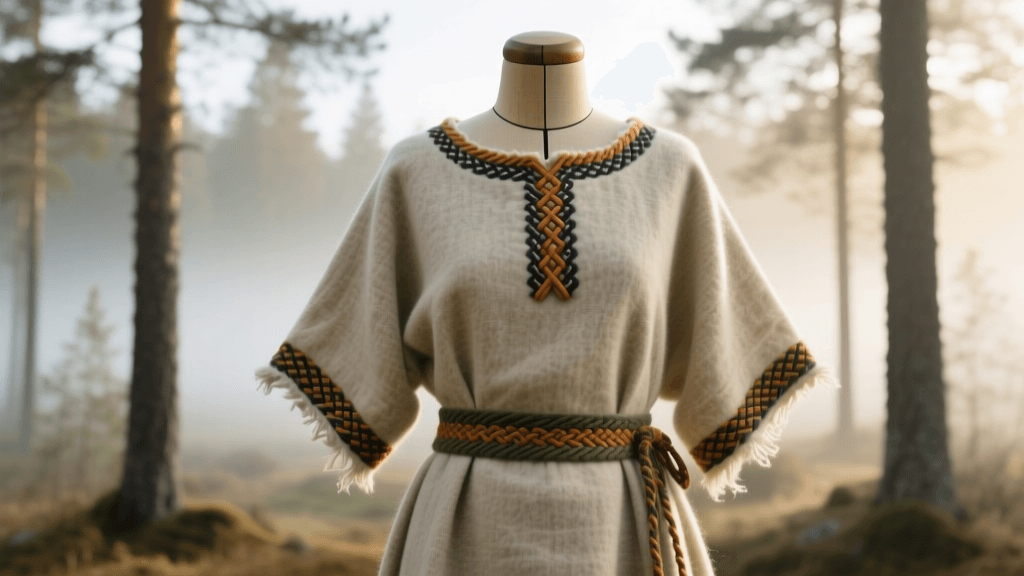
No smokkr is complete without tablet-woven trim adorning the top edge. Archaeological finds, such as those documented by the National Museums Scotland from Viking burials in the British Isles, frequently feature intricate, narrow bands woven using the 3/1 twill technique or double-faced tablet weaving.
To recreate a trim for your smokkr:
- Set up your warp: Use 20 to 30 tablets threaded with fine, worsted-spun wool (approx. 2mm thickness).
- Choose your pattern: The 'Ram's Horn' or simple geometric diamond motifs are highly accurate for the 9th and 10th centuries.
- Tensioning: Use a rigid backstrap loom setup or a modern Oseberg-style upright loom to maintain the high tension required for a tight, durable band.
Step-by-Step Smokkr Construction Guide
Constructing the smokkr requires hand-sewing techniques that mirror the archaeological record. Machine sewing is strictly avoided in high-authenticity circles. Here is how to measure, cut, and sew your garment.
1. Taking Measurements
Measure your bust, waist, and hips. For a historically accurate gathered look, your fabric width should be 1.5 to 2 times your bust measurement. The length should fall anywhere from just below the knee to mid-calf, depending on your status and the era you are portraying (wealthier women often wore longer, trailing garments).
2. Cutting and Seam Allowances
Cut your main rectangular panel. Leave a generous 2 cm seam allowance on the sides to accommodate felled seams. Do not cut armholes; the smokkr is a strapless tube held up by loops.
3. Sewing the Side Seams
Viking seamstresses rarely used raw edges. You must use a flat-felled seam or a running stitch with overcast edges.
- Running Stitch: Use a fine, waxed linen thread. Keep your stitches small (3-4 mm) and even.
- Felling: Fold the seam allowance flat against the inside of the garment and secure it with a whip stitch. This prevents fraying and adds structural strength to the side seams.
4. Creating and Attaching the Loops
The loops (straps) can be made from folded fabric strips, braided wool, or tablet-woven bands. Cut four loops, each approximately 30-40 cm long depending on your torso height. Attach them to the top edge of the smokkr using a strong backstitch, spacing them roughly 15-20 cm apart at the front and back to align with your shoulders.
5. Hemming the Top and Bottom Edges
Fold the top edge down twice (approx. 1 cm each fold) to enclose the raw edge, and secure with a blind stitch or fine whip stitch. Attach your tablet-woven trim over this top hem for a finished, reinforced edge. Hem the bottom edge using a simple single-fold whip stitch.
Fastening with Tortoise Brooches
The smokkr is held together by a pair of oval brooches, colloquially known as tortoise brooches due to their domed, shell-like shape. In 2026, the market for cast bronze replicas is robust. Avoid cheap, shiny brass or zinc-alloy jewelry from mass-market costume shops.
Seek out artisan casters who use the lost-wax casting method with high-quality bronze. For a standard smokkr, brooches measuring between 8 cm and 10 cm in length are ideal. Ensure the pin mechanism is historically accurate (a simple coiled spring and catchplate) rather than utilizing modern clutch-backs or safety-pin mechanisms. The loops of the smokkr are passed over the pin, securing the front and back panels together at the shoulders.
Conclusion
Crafting an authentic Viking smokkr is a deeply rewarding journey into the textile traditions of Northern Europe. By prioritizing historically accurate diamond twills, mastering the running stitch, and embracing the vibrant natural dyes of the era, you elevate your garment from a simple costume to a living piece of history. As the 2026 reenactment season continues to champion archaeological precision, your dedication to traditional construction methods will ensure your smokkr stands out in any mead hall or museum demonstration.