Authentic Viking Smokkr and Brooches: 2026 Reenactment Guide
The Resurgence of Nordic Folk Dress in 2026
As we navigate the 2026 historical reenactment season, the demand for meticulously accurate European folk dress has reached unprecedented heights. Across Scandinavia, from the bustling encampments of the Moesgaard Viking Moot in Denmark to the dramatic coastal landscapes of the Lofotr Viking Festival in Norway, enthusiasts are discarding the inaccurate, mass-produced costumes of the past decade. In 2026, the focus is entirely on archaeological authenticity, sustainable textile sourcing, and museum-grade metalwork. For those looking to immerse themselves in Celtic, Nordic, and Viking traditions, mastering the iconic women’s apron dress—known as the smokkr—and its accompanying tortoise brooches is the ultimate benchmark of dedication. The Garment Atlas is proud to present this definitive resource for historical costumers, textile artists, and cultural heritage enthusiasts looking to bridge the gap between ancient craftsmanship and modern revival. This comprehensive guide explores the latest archaeological consensus, current market pricing for heritage wools, and the strict authenticity standards enforced by major Nordic festivals this year.
Understanding the Smokkr: Beyond the Modern Myth
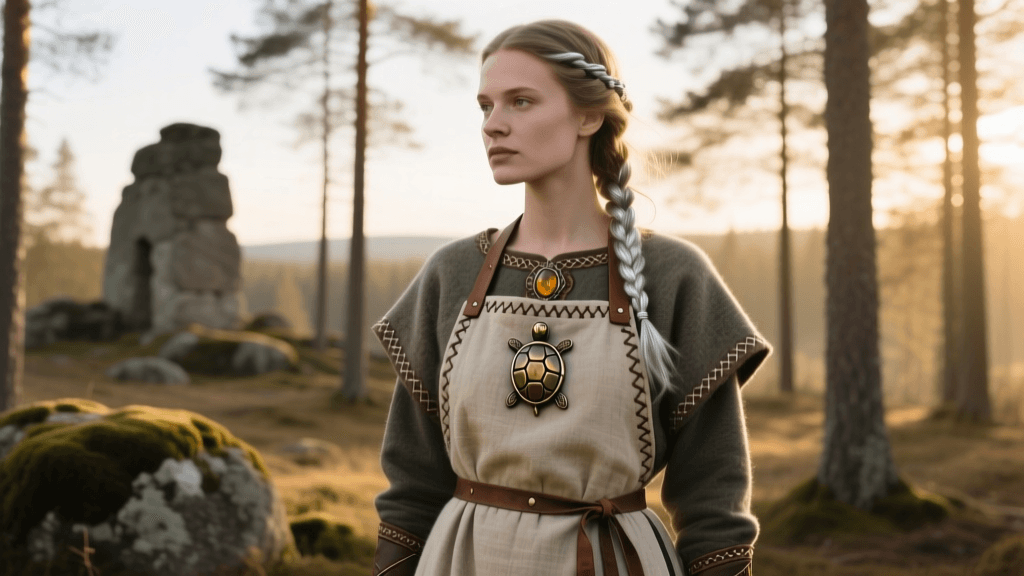
The term 'smokkr' is widely used today to describe the sleeveless, apron-like overdress worn by Viking Age women over a long-sleeved linen or woolen underdress (the serk). However, pop culture and early 20th-century romanticism have heavily distorted its true silhouette. According to extensive research published by the National Museum of Denmark, the modern 'Viking princess' leather bustier with fur trim is a complete historical fabrication. Instead, the authentic smokkr was a sophisticated garment constructed from high-quality wool, typically woven in a diamond twill pattern.
The exact construction remains a subject of academic debate, primarily divided into two schools of thought based on textile fragments found in Birka (Sweden) and Hedeby (Denmark). The Birka model suggests a closed tube dress, suspended by linen or wool loops from a pair of oval brooches at the shoulders. Conversely, the Hedeby fragments point toward an open, wrapped design that overlaps at the front. A third variation, supported by the Kostrup find in Denmark, features a tightly pleated front panel, offering a tailored and elegant drape that has become highly sought after by advanced reenactors in 2026.
Sourcing Authentic Textiles: 2026 Market Guide
Sourcing the correct fabric is where many modern enthusiasts falter. The Vikings valued textiles immensely; a single high-quality woolen dress could represent months of labor, from shearing and spinning to weaving and dyeing. In 2026, the reenactment market has matured significantly, with specialized weavers in the Baltic states and Scandinavia producing historically accurate diamond twill on traditional warp-weighted looms. When commissioning or purchasing your smokkr fabric, you must prioritize heritage sheep breeds. Modern Merino wool is entirely inappropriate due to its fine, uniform crimp, which lacks the structural integrity and slight water-resistant lanolin qualities of ancient Nordic fleeces.
| Wool Breed | Historical Accuracy | 2026 Market Price (per meter) | Best Use Case |
|---|---|---|---|
| Spelsau (Old Norwegian) | Exceptional | €160 - €240 | Outer Smokkr, Cloaks |
| Gotland Pelt Sheep | High | €130 - €180 | Smokkr, Leg Wraps |
| Shetland | Moderate/High | €90 - €120 | Underdresses, Tunics |
| Modern Merino | Poor (Avoid) | €20 - €40 | Not recommended for reenactment |
The Hardware: Oval Tortoise Brooches
The hardware that holds the smokkr together is just as critical as the textile. Oval brooches, commonly referred to as 'tortoise brooches' due to their domed, shell-like shape, are the defining accessory of the Viking Age woman. These were not merely decorative; they were functional load-bearing joints that secured the shoulder straps. In 2026, top-tier metalworkers utilize lost-wax casting techniques to recreate these intricate pieces, favoring high-tin bronze alloys that mimic the golden hue of polished historical artifacts. The motifs cast into the surface of the brooches typically follow established Viking art styles. The Borre style, featuring gripping beasts and ring chains, is ideal for early to mid-Viking Age portrayals (circa 850–950 CE). For later portrayals approaching the 11th century, the elegant, intertwining ribbon-like animals of the Urnes style are the standard.
When purchasing brooches, ensure the pin mechanism is historically accurate: a sturdy iron pin resting in a catchplate, secured by a secondary wire or string through the loops to prevent loss during vigorous festival activities. Additionally, many high-end 2026 replicas now feature subtle silver inlay or niello detailing for those portraying high-status jarls or wealthy merchants, reflecting the grave goods discovered in the Oseberg and Gokstad ship burials documented by the Museum of the Viking Age. Expect to invest between €120 and €300 for a pair of museum-quality, hand-finished bronze tortoise brooches in the current market.
Layering for the Elements: The Serk and Nalbinding
A smokkr is never worn in isolation. Layering is essential for both historical accuracy and survival in the unpredictable Nordic climate. Beneath the woolen overdress, a long-sleeved serk (underdress) made of finely woven linen or lightweight wool is mandatory. The Centre for Textile Research at the University of Copenhagen has extensively documented the use of natural flax fibers in Scandinavian undergarments, noting that while linen rarely survives in the archaeological record due to soil acidity, microscopic remnants found on the backs of metal brooches confirm its widespread use.
For extremities, 2026 authenticity guidelines heavily emphasize the art of nalbinding. Unlike modern knitting, which uses two needles and a continuous ball of yarn, nalbinding is an ancient single-needle technique that creates a dense, highly insulating, and elastic fabric. Using the 'Oslo stitch' (UUOO) and thick, unspun or loosely spun wool yarn, reenactors craft authentic socks, mittens, and hats that are virtually windproof. A pair of hand-nalbound wool socks will typically cost around €80 to €110 from skilled artisans today.
Meeting 2026 Reenactment Authenticity Standards
If you plan to attend premier events like the Moesgaard Viking Moot or the Lofotr Viking Festival in 2026, you must adhere to strict authenticity regulations. Event organizers now employ dedicated historical accuracy officers who inspect garments at the gate. Synthetic dyes, machine-visible stitching, and modern metal zippers or buttons are strictly prohibited and will result in denial of entry to the main historical encampments. To ensure your dyes pass inspection, seek out textiles colored with historically verified botanical sources: madder root for rich reds, woad or indigo for blues, and weld or onion skins for vibrant yellows.
Furthermore, all visible seams must be hand-stitched using period-appropriate techniques, such as the backstitch or running stitch, finished with flat-felled seams to prevent fraying. By investing in authentic Spelsau wool, mastering the layered serk and smokkr combination, and securing cast bronze tortoise brooches, you will not only meet the rigorous standards of 2026 but also pay profound respect to the incredible textile engineering of the Viking Age.