Authentic Slavic Vyshyvanka & Shevitsa Blouses: 2026 Buyer Guide
The Renaissance of Eastern European Folk Dress in 2026
As we navigate the 2026 fashion landscape, the global appreciation for slow fashion and heritage textiles has reached unprecedented heights. Among the most sought-after garments are the traditional embroidered blouses of Eastern Europe and the Balkans. Specifically, the Ukrainian Vyshyvanka and the Bulgarian Shevitsa have transcended their regional roots to become global symbols of resilience, artistry, and cultural pride. However, with this surge in popularity comes a market flooded with mass-produced, machine-made imitations. For collectors, cultural enthusiasts, and conscious consumers, knowing how to source, authenticate, and care for genuine artisan pieces is more critical than ever.
This comprehensive guide will walk you through the intricate regional techniques, the symbolism behind the motifs, and actionable advice on how to acquire authentic Slavic and Balkan embroidered blouses in 2026. According to UNESCO's Intangible Cultural Heritage guidelines, traditional craftsmanship is not merely about the final product, but the generational knowledge passed down through communities. Preserving this knowledge starts with informed sourcing.
Decoding the Vyshyvanka: Ukrainian Mastery
The Ukrainian Vyshyvanka is far more than a simple peasant blouse; it is a wearable manuscript. Historically, the embroidery served as a talisman, protecting the wearer from evil spirits, with the densest stitching placed around the neck, cuffs, and hem—areas where the body was most vulnerable. In 2026, master artisans in regions like Poltava, Chernihiv, and the Hutsul Carpathians continue to employ techniques that take hundreds of hours to complete.
Key Regional Techniques
- Poltava White-on-White: Renowned for its ethereal beauty, this technique utilizes up to 180 different shades of white and unbleached linen thread. It relies heavily on cutwork (lishva) and satin stitches, creating a textured, almost sculptural surface that catches the light beautifully.
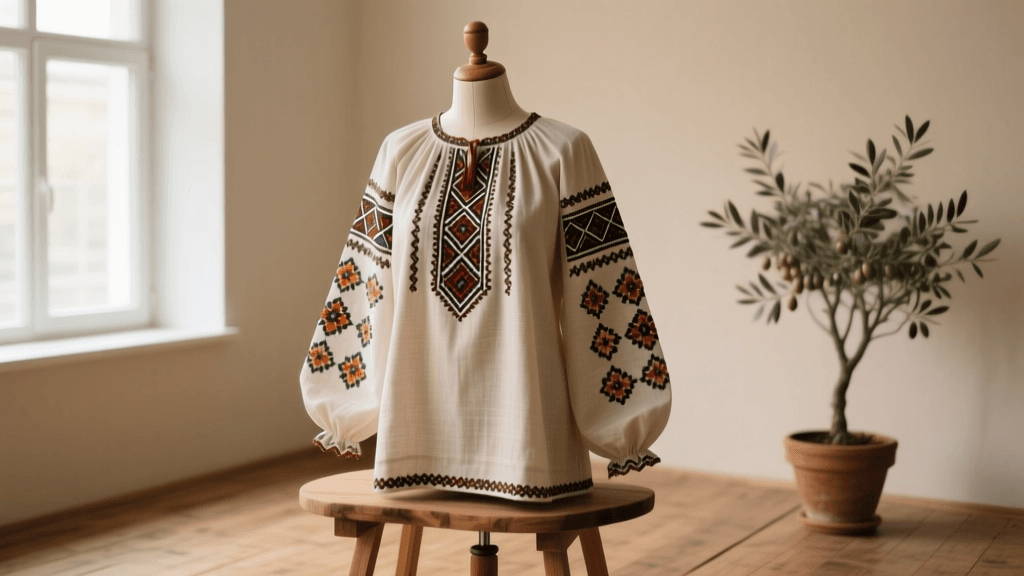
- Hutsul Geometric Embroidery: Originating from the Carpathian mountains, Hutsul blouses are famous for their vibrant, dense geometric patterns. Artisans frequently incorporate metallic threads, wool, and even glass beads, utilizing the nyz (low stitch) and zavolikannya (running stitch) to create striking, diamond-heavy motifs.
- Chernihiv Cutwork: This style features bold, sweeping floral and geometric patterns, often combining black and red threads on a stark white background, utilizing intricate drawn-thread work that requires immense mathematical precision.
The Bulgarian Shevitsa: Geometry and Symbolism
Traveling south into the Balkans, the Bulgarian Shevitsa represents the pinnacle of geometric abstraction in European folk dress. Unlike the floral motifs common in Western European embroidery, the Shevitsa relies on ancient, stylized symbols rooted in agrarian and pagan traditions. In 2026, ethnographic museums and the Victoria and Albert Museum's textile archives continue to highlight the mathematical complexity of Balkan needlework.
Essential Motifs and Color Theory
The foundation of the Shevitsa is the cross-stitch, but the application is deeply symbolic. The Elbetitsa (an eight-pointed star) represents the cardinal directions, the sun, and the harmony of the universe. The Kanitsa (a stylized jug) symbolizes water, fertility, and the feminine life force.
Color selection is never arbitrary. Red is the dominant hue, symbolizing life, blood, and protection. Black represents the earth and the ancestors, while green signifies youth and the eternal cycle of nature. Yellow and gold are reserved for the sun and spiritual enlightenment. When sourcing a genuine Shevitsa in 2026, look for natural, plant-dyed threads which possess a muted, complex depth that synthetic, factory-dyed threads simply cannot replicate.
How to Authenticate Handcrafted Embroidery
The market is currently saturated with computerized machine-embroidered blouses marketed as 'traditional.' While these may be aesthetically pleasing, they lack the structural integrity, cultural authenticity, and investment value of handcrafted pieces. Here is how to verify authenticity when purchasing in 2026:
- Examine the Reverse Side: This is the golden rule of textile authentication. Hand embroidery, particularly traditional Slavic techniques like the nyz stitch, is often reversible or nearly as neat on the back as on the front. Machine embroidery leaves a chaotic web of connecting threads and heavy stabilizer backing.
- Analyze the Thread and Fabric: Authentic 2026 artisan pieces use high-count, naturally slubbed linen or hemp. If the fabric has a synthetic sheen or feels like polyester-blend muslin, walk away. Similarly, genuine hand-spun cotton or wool threads have slight irregularities, whereas machine rayon threads are uniformly glossy.
- Look for 'Perfect' Imperfections: Human hands cannot achieve the microscopic uniformity of a CNC embroidery machine. Slight variations in tension, tiny overlapping stitches, and organic flow are hallmarks of human craftsmanship.
- Verify the Artisan Provenance: Reputable sellers in 2026 provide detailed provenance, including the name of the artisan, their village or region, and the specific stitch techniques used. Smithsonian Folkways and similar cultural preservation organizations emphasize that ethical sourcing requires transparency regarding the maker's identity and compensation.
2026 Sourcing and Pricing Comparison Table
Understanding the current market value is essential for collectors and buyers. The table below outlines what you can expect when sourcing Eastern European and Balkan embroidered blouses in 2026.
| Garment Category | Origin / Style | Embroidery Method | 2026 Avg. Price (USD) | Lead Time |
|---|---|---|---|---|
| Commercial Factory Blouse | Various (Mass Market) | Computerized Machine | $45 - $90 | Immediate |
| Semi-Artisan Tunic | Ukraine / Romania | Machine outline, Hand fill | $120 - $250 | 2 - 4 Weeks |
| Authentic Hutsul Vyshyvanka | Carpathian Mountains | 100% Hand (Wool/Beads) | $450 - $800 | 3 - 6 Months |
| Poltava White-on-White Heirloom | Central Ukraine | 100% Hand (Cutwork/Satin) | $900 - $1,500+ | 6 - 12 Months |
| Traditional Rhodope Shevitsa | Bulgaria | 100% Hand (Cross-stitch) | $350 - $600 | 2 - 5 Months |
Modern Styling for Heritage Garments
In 2026, the styling of folk dress has evolved beyond festival wear or national holidays. Fashion stylists and cultural advocates are integrating these heritage pieces into everyday, high-end wardrobes. The key to styling a Vyshyvanka or Shevitsa today is contrast and balance.
- The Tailored Contrast: Pair a voluminous, heavily embroidered white linen blouse with sharply tailored, high-waisted wool trousers or a structured midi skirt. This balances the romantic, historical silhouette with modern, architectural tailoring.
- Layering for Depth: In cooler months, layer a delicate Poltava white-on-white blouse under a sleek, dark velvet blazer or a minimalist leather jacket. The texture clash highlights the intricate cutwork while keeping the look grounded in contemporary urban fashion.
- Accessorizing Mindfully: Avoid pairing these blouses with overly rustic or 'peasant-style' accessories, which can push the outfit into costume territory. Instead, opt for modern, minimalist gold or silver jewelry, or contemporary ceramic pieces that echo the geometric motifs of the embroidery.
Preservation and Care Guidelines
Investing in an authentic, hand-embroidered garment is an investment in a piece of art. Proper care is essential to ensure these textiles survive for future generations. Follow these archival-level care instructions:
- Washing: Never machine wash or dry clean authentic heritage blouses. The harsh chemicals in dry cleaning can dissolve natural plant dyes and weaken linen fibers. Hand wash in cold water using a pH-neutral, conservation-grade detergent. Do not wring or twist the fabric; instead, roll it in a clean, dry towel to absorb excess moisture.
- Drying: Always dry the garment flat, away from direct sunlight. UV rays will rapidly degrade both the natural fibers and the organic dyes, causing irreversible fading and fiber brittleness.
- Ironing: Iron the garment while it is still slightly damp, always on the reverse side. Place a clean, white cotton pressing cloth between the iron and the embroidery to prevent crushing the three-dimensional texture of stitches like the satin stitch or cutwork.
- Storage: Do not hang heavy, heavily embroidered blouses on wire or wooden hangers, as the weight of the embroidery will distort the linen weave over time. Store them flat in archival, acid-free tissue paper inside a breathable cotton storage box. Avoid plastic bins, which trap moisture and encourage mildew growth.
"A true Vyshyvanka is not merely sewn; it is sung into existence with every pull of the needle. To wear it is to carry the voices of your ancestors." — Traditional Carpathian Artisan Proverb
Conclusion
The enduring legacy of the Slavic Vyshyvanka and the Balkan Shevitsa lies in their ability to adapt while maintaining their profound cultural roots. As we move through 2026, supporting authentic artisans not only preserves these ancient techniques but also champions a more sustainable, meaningful approach to global fashion. By understanding the regional nuances, demanding transparent provenance, and caring for these garments with the respect they deserve, you become an active participant in the living history of European folk dress.