Crafting a 15th-Century Burgundian Houppelande: 2026 Guide
The Enduring Legacy of the Burgundian Houppelande in 2026
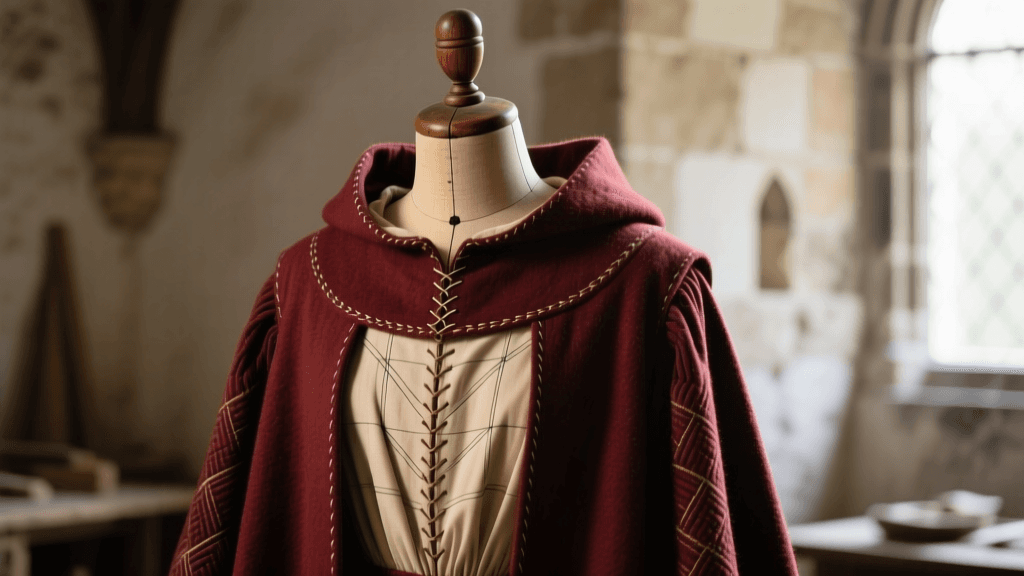
The Burgundian houppelande remains one of the most striking and opulent garments of the late medieval period. As we navigate the historical reenactment and living history landscape in 2026, the demand for sartorial accuracy has never been higher. Emerging in the late 14th century and reaching its zenith under the lavish court of Philip the Good in the 15th century, the houppelande is characterized by its massive, floor-sweeping volume, high standing collar, and extravagant sleeves. For modern artisans, recreating this masterpiece requires a deep understanding of historical tailoring, geometric pattern drafting, and the nuances of heavy textile manipulation.
Unlike the fitted cotehardie that preceded it, the houppelande was designed to showcase wealth through the sheer volume of fabric used. In 2026, the historical costuming community has moved away from synthetic shortcuts, embracing heritage weaving techniques and ethical material sourcing. According to research archives maintained by The Textile Research Centre (TRC) in Leiden, the drape and weight of historical broadcloths were achieved through intensive fulling and teasing processes, creating a dense, felt-like wool that could support massive pleats without collapsing. Replicating this structural integrity is the primary challenge for today's garment makers.
Authentic Textile Sourcing for the Modern Artisan
Sourcing appropriate textiles in 2026 requires navigating a shifted global supply chain. The best historical wools now come from specialized heritage mills in Yorkshire, England, and Biella, Italy, which have recently expanded their custom-run services for independent historians and theatrical wardrobes. When selecting wool for a houppelande, you must avoid modern lightweight suitings. Instead, seek out heavy melton, beaver cloth, or heavily fulled broadcloth weighing between 14 and 18 ounces per square yard.
For the elite court look, silk damasks and heavy brocades are essential. In 2026, ethical silk farms and peace-silk weavers in Southeast Asia and Southern Europe are producing stunning, heavy-weight jacquards that mimic the pomegranate and thistle motifs popular in 15th-century Lucca and Venice. When purchasing, always request a burn test or a detailed fiber-content breakdown to ensure you are not inadvertently buying a polyester-blend jacquard, which will melt under the heat of a modern iron and fail to pleat correctly.
2026 Fabric Comparison and Pricing Chart
| Material | Historical Equivalent | Weight / Drape | Best Application | 2026 Avg Cost/Yard |
|---|---|---|---|---|
| Heavy Wool Broadcloth | Fulled Medieval Wool | 16oz / Stiff, structural | Main garment body, heavy pleats | $65 - $95 USD |
| Silk Damask / Brocade | Lucca Silk Weaves | 12oz / Fluid, luxurious | Nobility garments, sleeve linings | $110 - $180 USD |
| Heavyweight Linen Canvas | Medieval Linen Interlining | 10oz / Rigid, supportive | Collar stiffening, pleat backing | $25 - $40 USD |
| Modacrylic Heritage Fur | Vair / Ermine / Fox | Varies / Plush, ethical | Hem bands, collar lining, cuffs | $85 - $150 USD |
Drafting the Pattern: Mathematics and Drape
The houppelande is fundamentally an exercise in geometry. The most common and historically supported cut for the body is the "bâtard" or half-circle cut, though full-circle and rectangular panel constructions also exist. For a standard floor-length houppelande for a person of average height (5'6" to 5'9"), you will need to draft a massive half-circle pattern.
To calculate your radius, measure from the base of your neck (where the high collar will sit) to the floor, then add three inches for the hem allowance. If this measurement is 60 inches, your fabric radius is 60 inches. The neck hole is calculated by taking your neck circumference, dividing by 6.28 (2 x Pi), and adding an inch for seam allowance. Because the garment is essentially a giant cape that is belted or pleated at the waist, the shoulder seams are often left open or minimally shaped, relying on the cartridge pleating to pull the fabric into the body's contours.
Drafting the Extravagant Sleeves
The sleeves of a Burgundian houppelande are its most defining feature. The "poke" or "bag" sleeve is essentially a massive tube or teardrop shape that hangs to the floor, with a slit cut at the front or side for the arm to pass through. When drafting these sleeves in 2026, it is highly recommended to use a muslin toile first. The armhole (armscye) must be exceptionally large—often extending down to the natural waist—to accommodate the sheer volume of fabric being pleated into it. A standard modern armhole will restrict movement and cause the heavy wool to tear at the seams.
The Art of Cartridge Pleating
Cartridge pleating is the structural heartbeat of the houppelande. This technique allows yards of heavy wool to be condensed into a small waistband or armhole without adding bulk. According to guidelines on historical garment construction endorsed by The Costume Society, cartridge pleating requires immense physical strength and specialized notions.
To begin, you must mark parallel lines across the top edge of your fabric, typically spaced one inch apart. Using a heavy-duty, waxed linen thread (such as an 18/3 or 20/3 weight, which is widely available from historical sewing suppliers in 2026), sew running stitches along these lines. Do not use modern polyester thread; it will snap under the tension of 15 pounds of wool. Once your rows of running stitches are complete, pull the threads simultaneously to gather the fabric into tight, tube-like pleats. These pleats are then whipped directly to the inside of your waistband or sleeve lining using a heavy whipstitch, ensuring each pleat is secured individually for maximum durability.
Linings, Faux Furs, and Ethical Trims
A true houppelande is fully lined, often with contrasting fabrics or furs. In the 15th century, the elite lined their garments with vair (squirrel belly) or ermine. Today, strict wildlife protection laws and ethical standards have revolutionized how we approach historical trim. In 2026, high-end modacrylic and blended synthetic furs have become incredibly sophisticated, offering the exact guard-hair and undercoat texture of historical pelts without the ethical or legal complications.
When lining the garment, use the "bagging" method. Sew your main wool fabric and your lining fabric right-sides together along the hem, front edges, and collar, then turn the garment right-side out. This encloses all raw edges and provides a clean, luxurious finish. For the high standing collar, you must interline the space between the wool and the lining with heavy linen canvas or modern buckram to ensure it stands upright and frames the face properly, rather than collapsing against the neck.
Essential Accessories: The Chaperon and Belt
No Burgundian houppelande is complete without its accompanying accessories. The chaperon hat, which evolved from a simple hood into a complex, sculptural headdress, is mandatory for a complete 15th-century silhouette. The chaperon consists of the patte (the face-opening), the cornet (the padded roll), and the liripipe (the long trailing tail). In 2026, many artisans use carved foam cores wrapped in wool batting to create the cornet, reducing the weight on the wearer's head while maintaining the dramatic, turban-like twists seen in period illuminations.
Finally, the garment must be cinched with an ornate leather belt. For men, this belt is often worn low on the hips, featuring cast brass or pewter mounts and an exceptionally long tail that hangs nearly to the floor. For women, the belt is worn high, just under the bust, emphasizing the voluminous drape of the skirt. Sourcing historically accurate, lead-free cast brass fittings from specialized European leatherworkers has become significantly easier in 2026, allowing for a level of detail that perfectly complements the grandeur of the houppelande.
Conclusion
Constructing a 15th-century Burgundian houppelande is a monumental undertaking that tests the limits of an artisan's patience, mathematical precision, and physical endurance. However, the result is a garment of unparalleled majesty that bridges the gap between modern craftsmanship and medieval opulence. By prioritizing heavy, historically accurate textiles, mastering the geometry of the circle cut, and executing flawless cartridge pleating, you can create a houppelande in 2026 that would turn heads in the court of Philip the Good himself.