Tailoring the 15th-Century Burgundian Houppelande: 2026 Guide
The Resurgence of the Houppelande in 2026
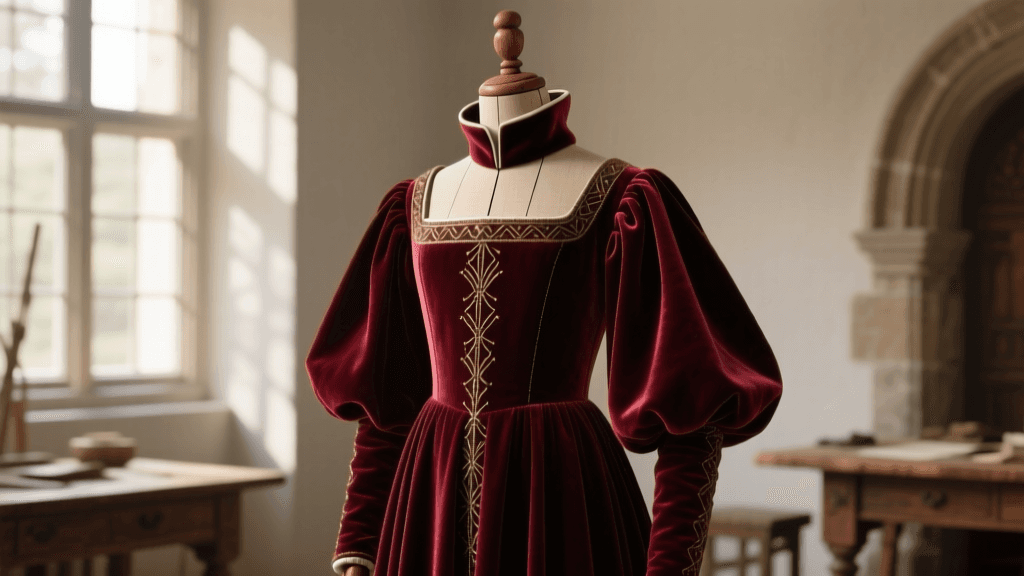
As the historical European martial arts (HEMA) community and the global Renaissance festival circuit gear up for the 2026 season, there has been a massive resurgence in the demand for high-fidelity, historically accurate late medieval garments. Among the most iconic and visually striking of these is the Burgundian houppelande. Characterized by its voluminous folds, towering high collar, and dramatic sleeve variations, the houppelande was the ultimate status symbol of the 15th-century European elite. For modern tailors, historical reenactors, and costume designers, constructing a houppelande in 2026 requires a delicate balance of historical pattern drafting, authentic material sourcing, and modern ergonomic adjustments. This comprehensive guide will walk you through the exact steps to tailor a museum-quality Burgundian houppelande for the current year's reenactment season.
Historical Context: Anatomy of the Burgundian Gown
Originating in the late 14th century and reaching its zenith in the 15th century, the houppelande was worn by both men and women across the Burgundian court and broader European nobility. Unlike the closely fitted cotehardie that preceded it, the houppelande was defined by its extravagance of fabric. It was typically worn over a linen chemise and a wool kirtle, acting as an opulent outer layer. The garment was constructed from massive rectangular and circular panels, belted tightly at the high waist or just under the bust for women, creating deep, tubular folds that cascaded to the floor. For deeper visual research into surviving late medieval textiles, silhouettes, and period tapestries that depict these garments in motion, the Victoria and Albert Museum's Fashion Collection remains an indispensable digital archive for modern tailors seeking primary source inspiration.
Sourcing Authentic Materials in 2026
The success of a houppelande relies entirely on the drape and weight of the fabric. In 2026, the historical costuming community has largely moved away from synthetic brocades and poly-blends, favoring ethically sourced, mill-direct natural fibers. The outer shell requires a heavy, fulled wool—such as melton or broadcloth—that can hold stiff pleats without fraying. For the lining, a medium-weight linen or silk taffeta is essential to allow the garment to slide over the kirtle while adding structural weight to the hem.
To study the drape, weave structures, and volume of extant garments and period textiles, researchers and master tailors frequently consult the Metropolitan Museum of Art's Costume Institute collection, which provides high-resolution imagery of surviving medieval fragments. Furthermore, for archaeological insights into medieval textile weaves and natural dyeing methods, the Textile Research Centre in Leiden provides excellent historical context on Northern European wool production and historic dye recipes, helping modern artisans choose historically plausible color palettes like madder red, woad blue, and weld yellow.
2026 Fabric Sourcing & Cost Breakdown
| Fabric Type | 2026 Avg. Cost (per yard) | Historical Accuracy | Best Use Case |
|---|---|---|---|
| Heavy Melton Wool (20-24oz) | $45 - $75 | Excellent | Outer gown, winter festivals, high nobility |
| Silk Taffeta / Dupioni | $30 - $55 | Excellent | Lining, sleeve turnbacks, summer courts |
| Medium-Weight Linen (5.3oz) | $18 - $28 | Good (for lining) | Inner lining, chemise, structural interlining |
| Cotton Velveteen | $25 - $40 | Moderate | Budget alternative to silk pile weaves |
Drafting the Pattern: Geometric Precision
Unlike modern tailoring, which relies on complex curved armholes and princess seams, 15th-century pattern drafting was fundamentally geometric. The houppelande is constructed primarily from rectangles, triangles (gores), and circles. To achieve the signature voluminous folds, the body of the gown is cut from massive rectangular panels. A standard women's houppelande requires a front and back panel, each measuring at least 60 inches in width at the hem, with additional triangular gores inserted at the sides to create a sweeping train.
The Bombard Sleeve
The most recognizable feature of the Burgundian houppelande is the bombard sleeve. This sleeve is cut as a massive half-circle or full circle, with the wrist opening positioned at the outer edge. When the arm is raised, the excess fabric drapes dramatically toward the floor. In 2026, pattern drafters recommend using a lightweight muslin mockup to test the sleeve's pivot point. The armhole itself should be cut relatively high and tight against the body's natural shoulder joint, allowing the heavy sleeve to hang from the shoulder rather than dragging the entire gown off-center. The sleeve opening is often lined with a contrasting silk or fur, which is turned back and tacked into deep, decorative pleats.
The High Collar
The standing collar of the houppelande is a marvel of medieval engineering. It must stand upright, framing the face and supporting the complex headwear of the era. To achieve this without modern synthetic interfacing, 2026 tailors use multiple layers of heavy linen canvas, pad-stitched together with silk thread. The collar is cut as a curved rectangle, slightly wider at the top than the base, and reinforced with a thin strip of modern millinery wire hidden within the top hem to maintain its shape during long days at Renaissance festivals.
Historical Sewing Techniques for Modern Tailors
While a modern sewing machine can be used for the long structural seams of the skirt, the visible seams, hems, and structural reinforcements should be finished by hand to maintain historical integrity. The weight of a fully lined wool houppelande can exceed 15 pounds, placing immense stress on the shoulder and waist seams.
- The Backstitch: Used for all load-bearing seams, such as the armholes and the attachment of the collar. A tight backstitch using heavily waxed linen thread mimics the strength of a modern machine lockstitch while allowing the seam to flex with the wearer's movement.
- Flat-Felling: To prevent the heavy wool from fraying and to reduce bulk, all interior seams should be flat-felled. This involves trimming one seam allowance, folding the other over it, and securing it with a running stitch or a whipstitch.
- The Prick Stitch: Used for attaching the lining to the outer wool shell at the hem and the sleeve cuffs. The prick stitch is worked from the right side, catching only a single thread of the outer fabric, creating an invisible, highly secure hem that allows the lining to roll slightly to the inside.
- Cartridge Pleating: To attach the massive volume of the skirt to the fitted bodice or waistband, cartridge pleating is essential. Unlike standard knife pleats, cartridge pleats are rounded and tubular, standing away from the body and creating the distinct, organ-pipe silhouette seen in 15th-century portraiture.
Accessorizing the Silhouette: The Hennin and Chaperon
A houppelande is incomplete without its accompanying headwear, which serves to elongate the silhouette and denote social rank. For women, the steeple hennin is the quintessential Burgundian accessory. In 2026, modern milliners construct the hennin's cone using lightweight buckram and flexible steel boning, replacing the historically accurate but difficult-to-source pasteboard and whalebone. The cone is covered in silk velvet and draped with a sheer silk organza veil, which is pinned to a velvet frontlet that sits just above the eyebrows. For men, the chaperon—a complex, turban-like headpiece evolved from the hood—is wrapped using a long, bias-cut strip of fine wool, secured with hidden pins to create the signature twisted crown and trailing liripipe.
Conclusion
Tailoring a 15th-century Burgundian houppelande in 2026 is a rewarding journey into the heart of medieval sartorial extravagance. By prioritizing heavy, natural fibers, utilizing geometric pattern drafting, and employing robust historical hand-sewing techniques, modern artisans can recreate garments that are not only visually breathtaking but also structurally sound enough to withstand the rigors of contemporary historical reenactment. Whether you are preparing for a high-court gathering at a major Renaissance festival or contributing to a museum's living history exhibit, the houppelande remains a testament to the enduring power of medieval European fashion.