Authentic Carpathian Vyshyvanka & Ie Blouses: 2026 Buyer's Guide
The Enduring Legacy of Carpathian Folk Dress in 2026
The revival of Slavic and Balkan folk dress has reached remarkable new heights in 2026, driven by a global resurgence in slow fashion, heritage preservation, and a deep appreciation for ancestral craftsmanship. Among the most coveted and culturally significant garments in Eastern European textile traditions are the Ukrainian Vyshyvanka and the Romanian Ie. Originating from the rugged, mystical landscapes of the Carpathian Mountains, these embroidered blouses are far more than mere clothing; they are wearable manuscripts that encode regional identity, spiritual protection, and familial lineage.
For collectors, cultural enthusiasts, and conscious consumers, navigating the 2026 market for authentic Eastern European folk dress requires a discerning eye. The proliferation of mass-produced, machine-embroidered replicas has made it increasingly difficult to distinguish true artisan heritage from fast-fashion imitations. This comprehensive guide will equip you with the historical knowledge, technical vocabulary, and practical sourcing strategies needed to authenticate and acquire genuine Carpathian textiles this year.
The Soul of the Carpathians: Vyshyvanka and Ie
While both the Ukrainian and Romanian traditions share geographical roots in the Carpathian basin, their stylistic executions, symbolic motifs, and structural constructions possess distinct regional dialects.
The Ukrainian Vyshyvanka
The Vyshyvanka is the quintessential Ukrainian embroidered shirt. In the Carpathian regions—particularly Hutsulshchyna, Pokuttya, and Bukovyna—the embroidery is characterized by dense, geometric patterns. The Hutsul tradition is famous for its vibrant use of orange, yellow, and green threads, often incorporating cross-stitch and intricate cutwork. Historically, the placement of the embroidery on the collar, cuffs, and chest was believed to protect the wearer's vital energy centers from malevolent spirits. In 2026, authentic Hutsul blouses remain highly prized for their mathematical precision and bold color palettes.
The Romanian Ie
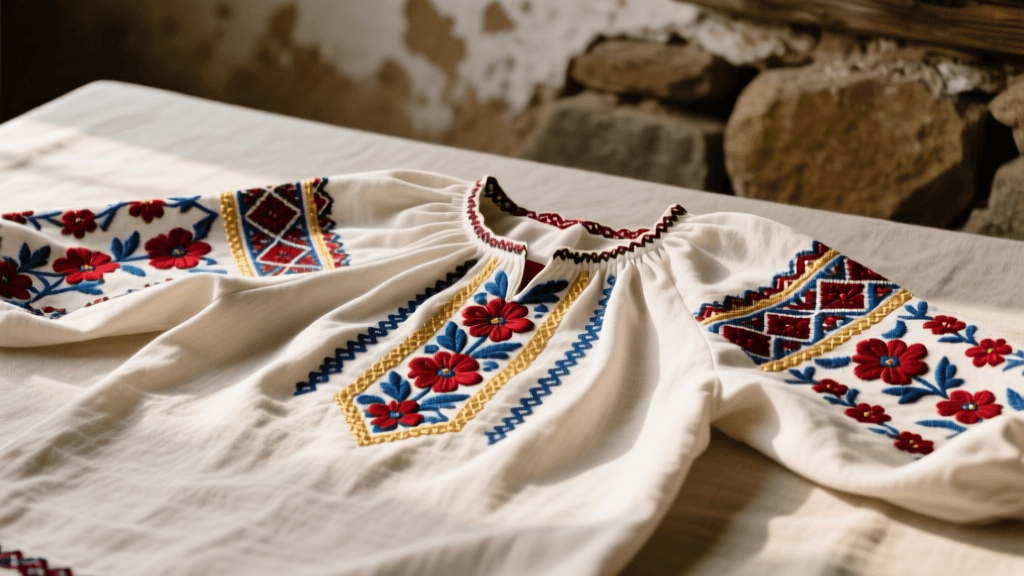
The Romanian Ie (pronounced 'ee-eh') is a masterclass in structured elegance and symbolic storytelling. The traditional Carpathian Ie is constructed from multiple rectangular panels of hand-loomed linen or hemp, gathered at the neck and cuffs. The embroidery is strictly regulated by ancient compositional rules, featuring the altiță (a dense, rectangular band on the shoulder), the încreț (a gathering fold below the shoulder), and the râuri (flowing, diagonal or vertical lines that cascade down the sleeves). The Maramureș and Bucovina regions are particularly renowned for their monochromatic or subtly polychromatic floral and solar motifs.
Decoding Regional Embroidery Techniques
To authenticate a garment, one must understand the techniques used to create it. According to the UNESCO Representative List of the Intangible Cultural Heritage of Humanity, traditional hand-stitching methods are vital cultural assets that require safeguarding. Here are the primary techniques you should look for when examining a Carpathian blouse:
- Nyz (Ukrainian): A running stitch executed from the reverse side of the fabric. The artisan counts the threads of the warp and weft to create geometric patterns that appear as a negative image on the back and a positive image on the front.
- Zavolikannya (Ukrainian): A horizontal weaving stitch that mimics the look of woven fabric, often used to create dense, banded patterns across the chest and shoulders.
- Brodivka (Ukrainian/Romanian): An intricate cutwork or whitework technique where threads are pulled and wrapped to create lace-like openwork, highly popular in the Pokuttya and Argeș regions.
- Punctul Bătrânesc (Romanian): The 'old stitch' or stem stitch, used for outlining floral motifs and creating the flowing râuri lines on the sleeves of the Ie.
2026 Market Trends: Artisan Heritage vs. Fast Fashion
The 2026 European textile market has seen a massive shift toward transparency and ethical sourcing. Buyers are increasingly demanding proof of hand-loomed fabrics and natural dyes. However, the market is simultaneously flooded with automated machine-embroidered garments imported from overseas, often mislabeled as 'traditional folk wear.' Understanding the material and structural differences is critical.
| Feature | Authentic Artisan Handmade (2026) | Commercial Factory-Made Replica |
|---|---|---|
| Base Fabric | Hand-loomed linen, hemp, or raw cotton; irregular slubs visible. | Uniform, machine-woven poly-cotton blends or chemically treated rayon. |
| Embroidery Thread | Mercerized cotton, hand-spun wool, or natural silk. | Synthetic polyester or acrylic yarn with high synthetic sheen. |
| The Reverse Side | Neat, nearly identical to the front; no long floating threads or messy knots. | Cluttered with jump stitches, loose threads, and visible stabilizer backing. |
| Construction | Rectangular geometric cuts, hand-gathered necklines, traditional gussets. | Modern curved armholes, serged seams, machine-zipper closures. |
| Price Range (USD) | $250 – $800+ | $35 – $90 |
How to Authenticate a True Heritage Garment
When evaluating a potential purchase, whether online or at a European heritage boutique, apply these three critical authentication tests:
1. The Reverse Side Test
Always request high-resolution photos of the inside of the garment. True Carpathian embroidery, particularly the Ukrainian nyz and Romanian altiță, is executed with such mathematical rigor that the reverse side is almost as pristine as the front. If you see a chaotic web of jump threads, synthetic stabilizer mesh, or messy knots, the piece is machine-made.
2. Fiber and Dye Verification
Authentic 2026 heritage pieces prioritize natural fibers. As outlined by the Food and Agriculture Organization (FAO) guidelines on natural fibres, flax (linen) and hemp possess distinct thermoregulatory and antimicrobial properties that synthetics cannot replicate. Perform a burn test on a loose thread if possible: natural linen will burn quickly, smell like burning paper, and leave fine, crushable ash, whereas polyester will melt into a hard, plastic bead. Furthermore, seek out artisans who utilize traditional botanical dyes, such as madder root for reds, weld for yellows, and woad or indigo for blues.
3. Structural Integrity and Seams
Traditional Carpathian blouses are constructed using straight, rectangular panels to avoid wasting any hand-loomed fabric. They do not feature modern darting or curved armholes. The sleeves are attached using intricate hand-gathering techniques, often secured with a braided cord (smoc) rather than elastic bands.
Sourcing Guide: Where to Buy in 2026
Sourcing an authentic Vyshyvanka or Ie requires bypassing tourist traps and connecting directly with heritage cooperatives and verified master artisans.
- Artisan Cooperatives in Lviv and Cluj-Napoca: Both cities serve as hubs for regional textile guilds. In 2026, many of these cooperatives have launched direct-to-consumer digital storefronts, allowing international buyers to commission bespoke pieces with verified certificates of authenticity.
- Museum Gift Shops and Cultural Foundations: Institutions such as the National Museum of Ukrainian Folk Decorative Art and the Romanian Peasant Museum (Muzeul Național al Țăranului Român) often partner with master artisans to sell authenticated, high-quality replicas and vintage restorations.
- Verified Digital Platforms: When using platforms like Etsy, filter for sellers located in Ukraine, Romania, or Moldova who provide video evidence of their hand-stitching process. Look for shops that explicitly detail the regional origin of their patterns (e.g., 'Hutsul cross-stitch' or 'Maramureș geometric Ie').
'A true Carpathian blouse is not merely a garment; it is a wearable manuscript of a family's history and a region's cosmology. To wear it is to carry the weight and warmth of generations.'
Caring for Heirloom Embroidered Textiles
Proper conservation is essential to maintain the structural integrity and vibrancy of natural fibers and dyes. The Victoria and Albert Museum's textile archives provide foundational conservation principles that apply perfectly to home care for folk dress:
- Washing: Never machine wash an authentic hand-loomed blouse. Hand wash in cool water using a pH-neutral, conservation-grade detergent. Avoid aggressive wringing, which can distort the geometric alignment of the embroidery.
- Drying: Lay the garment flat on a clean, dry towel away from direct sunlight to prevent UV degradation of natural botanical dyes.
- Ironing: Iron the garment while it is still slightly damp, always on the reverse side, using a pressing cloth to protect the raised texture of the embroidery stitches.
- Storage: Store in a cool, dry environment wrapped in acid-free tissue paper. Avoid wire hangers, which can distort the delicate hand-gathered necklines; instead, fold the garment carefully or use padded, archival-quality hangers.
Conclusion
Investing in an authentic Carpathian Vyshyvanka or Ie in 2026 is a profound commitment to cultural preservation and sustainable fashion. By understanding the intricate geometry of regional stitches, demanding natural hand-loomed fibers, and sourcing directly from heritage cooperatives, you ensure that the ancient textile traditions of the Slavic and Balkan peoples continue to thrive in the modern era. Whether worn as a statement of cultural pride or preserved as a family heirloom, these garments remain a testament to the enduring beauty of Eastern European folk art.