Norwegian Bunad vs Bavarian Tracht: 2026 Heritage Guide
The 2026 Revival of European Regional Folk Dress
As we navigate the cultural landscape of 2026, the appreciation for authentic European folk dress has evolved from niche historical reenactment into a vibrant, living tradition. Travelers, diaspora communities, and textile enthusiasts are increasingly rejecting mass-produced, fast-fashion costumes in favor of meticulously crafted, regionally accurate garments. According to recent heritage textile reports published by the Association of Dress Historians, there has been a significant surge in demand for artisanal folk garments, driven by a global desire for sustainable, culturally rooted fashion and a deeper connection to ancestral heritage.
Two of the most iconic and frequently misunderstood traditions in European folk dress are the Norwegian Bunad and the Bavarian Tracht. While both are prominently featured during national holidays and regional festivals, their origins, construction methods, and cultural rules differ vastly. This comprehensive guide explores the intricate details of these garments, providing actionable advice for sourcing, wearing, and respecting these traditions during the 2026 festival season.
The Norwegian Bunad: A Tapestry of Fjords and Valleys
The Norwegian Bunad is not merely a historical costume; it is a highly regulated, deeply personal expression of regional identity. Rooted in the romantic nationalism of the late 19th and early 20th centuries, the Bunad movement was spearheaded by cultural figures like Hulda Garborg, who sought to preserve rural Norwegian textile traditions against the tide of industrialization. Today, the Norsk institutt for bunad og folkedrakt (Norwegian Institute of Bunad and Folk Costume) rigorously oversees the historical accuracy of Bunad designs, ensuring that modern reproductions remain faithful to their regional origins.
Regional Variations: Hardanger vs. Setesdal
Norway boasts over 450 distinct Bunad variations, each tied to a specific valley, fjord, or municipality. Two of the most prominent are the Hardangerbunad and the Setesdalsbunad.
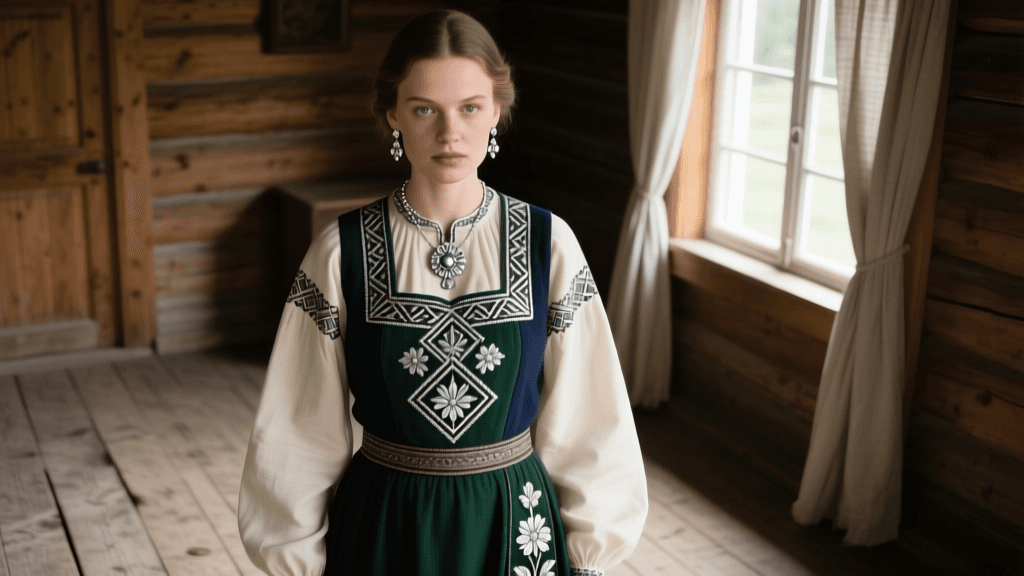
- The Hardangerbunad: Often referred to as the 'first' Bunad, this garment originates from the Hardanger fjord region. The women's dress is characterized by its striking contrast: a black wool bodice and skirt paired with a pristine white linen apron and shirt, heavily adorned with vibrant, geometric cross-stitch embroidery in red, yellow, and green. The men's version features a rich blue wool jacket with intricate silver buttons and red wool knee-breeches.
- The Setesdalsbunad: Hailing from the isolated Setesdal valley, this Bunad is renowned for its heavy, dark wool and extensive use of oxidized silver. The women's stakk (skirt) is heavily pleated and features a broad, colorful woven band at the hem, while the men's bukse (trousers) are made from thick, undyed sheepskin or dark wool, designed to withstand harsh mountain winters.
The Crucial Element: Norwegian Silver (Sølv)
No Bunad is complete without its accompanying silver jewelry, which historically served as a family's portable wealth and a marker of social standing. In 2026, authentic Norwegian silverwork remains a highly specialized craft. A complete set of filigree silver for a Setesdalsbunad—including the large chest plate (brystknapp), belt buckles, and cufflinks—can easily exceed 35,000 NOK (approximately €3,000). Artisans continue to use traditional techniques like filigree (tvintråd) and casting, often custom-aging the silver to match heirloom pieces passed down through generations.
The Bavarian Tracht: Beyond the Oktoberfest Cliché
While the global image of Bavarian dress is often reduced to the commercialized, mass-produced costumes seen at tourist-heavy beer tents, authentic Bavarian Tracht is a sophisticated, historically grounded sartorial system. The term 'Tracht' translates roughly to 'what is worn' or 'customary dress,' and it encompasses a wide array of regional styles that dictate everything from the cut of the jacket to the specific embroidery motifs on the leather.
Miesbacher and Werdenfelser Tracht
To understand authentic Tracht, one must look to specific regional guilds and historical archives, such as those preserved by the Bayerisches Nationalmuseum (Bavarian National Museum). Two of the most respected regional variations are the Miesbacher and Werdenfelser Tracht.
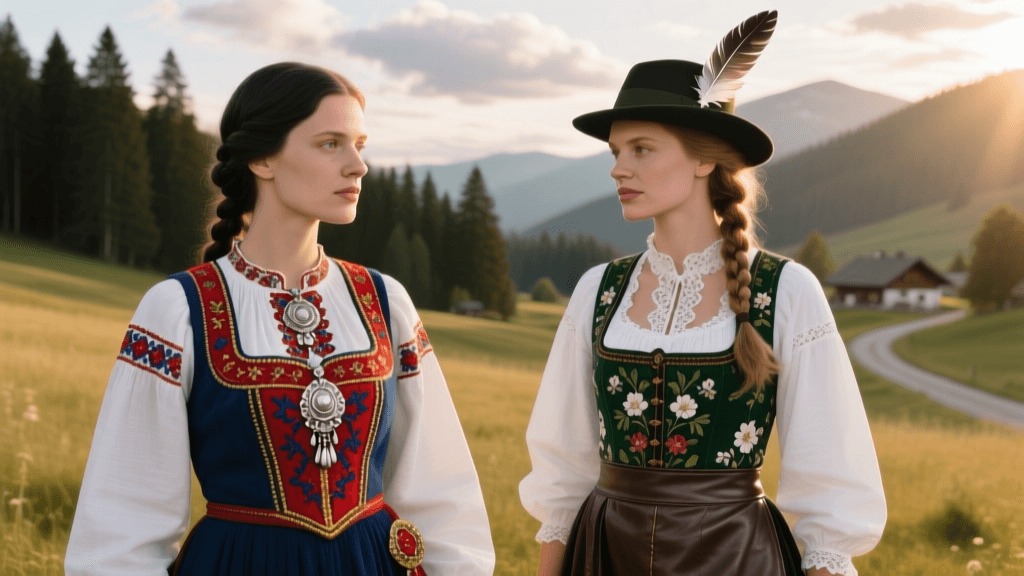
- Miesbacher Tracht: Originating from the alpine foothills south of Munich, the men's Miesbacher Tracht is the quintessential image of the alpine hunter and woodsman. It features a grey or green loden wool jacket with horn buttons, a crisp white shirt, and a silk embroidered vest (Weste). The women's Miesbacher Dirndl is elegant and modest, featuring a high-necked blouse, a tightly fitted bodice made of silk or fine wool, and a hand-pleated skirt that falls strictly below the knee.
- Werdenfelser Tracht: Native to the Garmisch-Partenkirchen region, this style is heavily influenced by the rugged terrain of the Wetterstein mountains. The men's Lederhosen here are often longer (Kniebundhosen) and feature darker, more intricate floral embroidery, while the women's Dirndls frequently incorporate heavier, locally woven linen and darker, earth-toned aprons.
Authentic Materials: Hirschleder and Loden
The hallmark of genuine Bavarian Tracht is its uncompromising material quality. Authentic Lederhosen are crafted exclusively from Hirschleder (deer leather) or Gamsleder (chamois leather), which is tanned using traditional brain-tanning or vegetable-tanning methods. This results in a leather that is incredibly soft, breathable, and durable. In 2026, a pair of hand-embroidered, bespoke Hirschleder Lederhosen from a master saddler in Upper Bavaria typically costs between €1,400 and €2,200. Similarly, the wool used for jackets and skirts is often Loden, a dense, water-resistant woolen fabric that has been milled and felted in alpine mills for centuries.
Comparative Analysis: Bunad vs. Tracht
While both garments serve as markers of regional pride, their construction philosophies and cultural applications differ significantly. The table below outlines the core distinctions for enthusiasts and buyers in 2026.
| Feature | Norwegian Bunad | Bavarian Tracht |
|---|---|---|
| Primary Origin | Rural Norwegian valleys and fjords | Alpine regions of Bavaria and Austria |
| Core Materials | Wool, linen, broadcloth, oxidized silver | Deer leather (Hirschleder), Loden wool, silk |
| Embroidery Style | Geometric cross-stitch, floral wool thread | Alpine floral motifs (Edelweiss, Acanthus), silk thread |
| 2026 Avg. Cost (Full Set) | €2,500 - €4,500 (including silver) | €1,200 - €2,800 (including leather and accessories) |
| Tailoring Wait Time | 12 to 24 months for certified makers | 3 to 8 months for bespoke leather and tailoring |
| Primary Festival | Syttende Mai (Constitution Day, May 17) | Oktoberfest, Maibaumaufstellen (Maypole festivals) |
Sourcing Authentic Garments in 2026
If you are planning to attend European heritage festivals in 2026 and wish to purchase authentic garments, preparation is essential. The market for genuine folk dress is constrained by the availability of master artisans.
Sourcing the Bunad
Purchasing a Bunad requires engaging with certified ateliers, often located in the specific region the Bunad represents. For example, if you have ancestral ties to Telemark and wish to commission an Øst-Telemark Bunad, you must contact local husflidslag (craft associations) or approved tailors. Expect to attend multiple fittings. Because the silver is often the most expensive component, many buyers in 2026 opt to purchase the silver set first, commissioning the textile garments as budget allows. Always request a certificate of authenticity and verify that the atelier adheres to the Bunad- og Folkedraktrådet (Bunad and Folk Costume Council) guidelines.
Sourcing the Tracht
For Bavarian Tracht, avoid the tourist shops lining Munich's Marienplatz. Instead, seek out traditional Trachtenausstatter (Tracht outfitters) in smaller alpine towns like Miesbach, Garmisch, or Berchtesgaden. When buying Lederhosen, inspect the embroidery: authentic hand-stitched 'Säckler' work will have slight, natural irregularities and use thick, waxed silk thread. For Dirndls, look for labels that guarantee 'Made in Bavaria/Austria' and check the apron material; a true Tracht Dirndl will feature a hand-woven linen or pure silk apron, never polyester.
Festival Etiquette for the Modern Wearer
Wearing these garments in 2026 requires an understanding of cultural etiquette to avoid appearing disrespectful or treating the clothing as a mere costume.
Syttende Mai (Norwegian Constitution Day)
Celebrated on May 17th, Syttende Mai is the pinnacle of Bunad wear. Etiquette dictates that the Bunad must be immaculate. Shoes should be traditional silver-buckled leather shoes or simple, elegant black leather pumps—never modern sneakers or heavy boots. Hair is typically worn neat and pulled back, and makeup is kept minimal and natural. It is considered highly inappropriate to wear a Bunad if you are heavily intoxicated; the garment commands a level of sobriety and respect akin to formal military or academic dress.
Oktoberfest and Alpine Festivals
While Oktoberfest in September 2026 will undoubtedly feature thousands of mass-produced costumes, wearing authentic Tracht sets you apart and earns the respect of locals. For women, the placement of the Dirndl apron bow is a strict code: tied on the left indicates you are single, on the right means you are married or taken, in the center traditionally signifies virginity (though less commonly policed today), and at the back indicates you are widowed or working as a waitress. For men, ensure your Lederhosen suspenders (Hosenträger) are properly crossed at the back and that your hat (Tirolerhut) features a natural fiber brush (Gamsbart) rather than cheap synthetic alternatives.
Conclusion
Whether you are drawn to the intricate silverwork and deep historical roots of the Norwegian Bunad or the rugged elegance and alpine practicality of the Bavarian Tracht, investing in authentic European folk dress is a commitment to preserving living history. By understanding the regional nuances, respecting the artisans, and adhering to cultural etiquette, you ensure that these magnificent textile traditions continue to thrive throughout 2026 and beyond.