Authentic Hardanger Bunad Guide 2026: Embroidery & Silver
The Enduring Legacy of the Hardanger Bunad in 2026
The Norwegian bunad is far more than a simple folk costume; it is a wearable genealogy, a marker of regional pride, and a masterclass in traditional European textile arts. Among the over 450 distinct regional bunads documented across Norway, the Hardanger bunad holds a revered status. Often referred to as the "grandmother of all bunads," its origins trace back to the late 19th and early 20th centuries when national romanticism sparked a revival of rural dress. Today, in 2026, the Hardanger bunad remains one of the most meticulously regulated and highly sought-after traditional garments in Scandinavia.
Unlike mass-produced festival wear found in other parts of Europe, an authentic Hardanger bunad is governed by strict guidelines set forth by the Bunad- og folkedråktrådet (The Council for Folk Costumes). This governing body ensures that every stitch, fabric choice, and silver accessory adheres to historical precedents from the Hardangerfjord region. As we navigate the 2026 cultural landscape, there is a renewed emphasis on slow fashion and heritage crafts, making the commissioning of a Hardanger bunad a profound investment in European material culture.
Whether you are a textile enthusiast, a descendant of the Hardanger region looking to reconnect with your roots, or a collector of European folk dress, understanding the intricate anatomy, embroidery techniques, and silver requirements of this garment is essential. This comprehensive 2026 guide breaks down everything you need to know about acquiring, crafting, and maintaining an authentic Hardanger bunad.
Anatomy of the Hardanger Bunad: Regional Variations
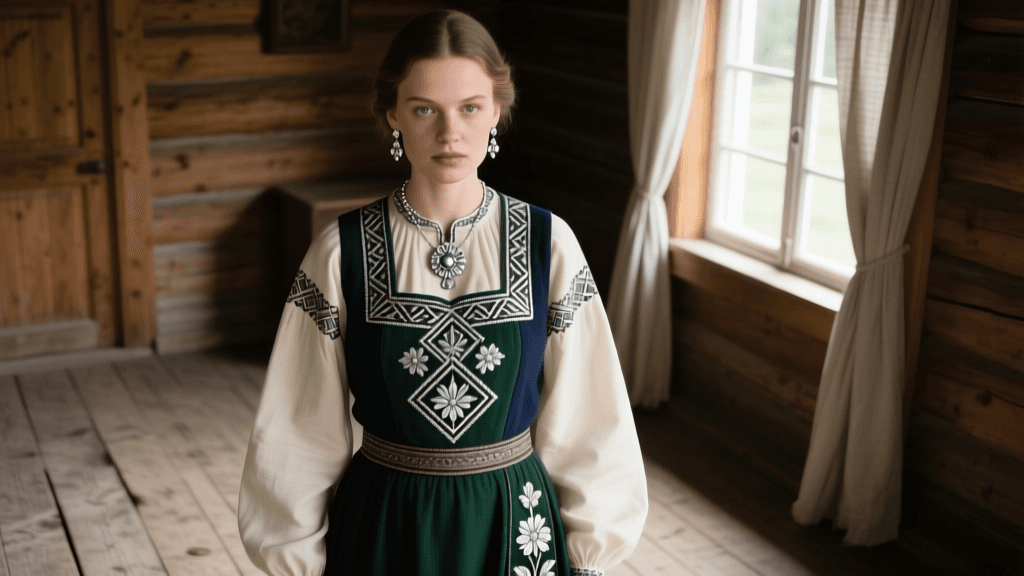
The Hardanger region is vast, and historically, the isolation of its valleys led to distinct micro-variations in local dress. While the modern "standard" Hardanger bunad is widely recognized, purists and the Norges Husflidslag (National Craft Association) acknowledge specific sub-regional differences, particularly in the color of the bodice and the style of the apron embroidery. The foundation of the women's bunad consists of a woolen skirt (stakk), a fitted bodice (liv), a linen shirt (skjorte), and an elaborately embroidered apron (forkle).
| Sub-Region | Bodice Color | Skirt Details | Apron Embroidery Style |
|---|---|---|---|
| Ullensvang | Deep Red | Green wool with black velvet hem | Rich floral cross-stitch with drawn thread work |
| Odda | Black or Dark Blue | Black wool with subtle green trim | Geometric whitework and Hedebo-style cutwork |
| Kvam | Red with gold trim | Green wool, slightly lighter shade | Simplified whitework, heavier linen base |
Mastering the Embroidery: Whitework and Cross-Stitch
The true soul of the Hardanger bunad lies in its embroidery, particularly the kvitsaum (whitework) found on the linen shirt and apron. In 2026, the demand for historically accurate whitework has surged, leading to multi-year waitlists for master embroiderers at local Husfliden cooperatives. The shirt features intricate Hedebo-style cutwork and drawn thread work at the cuffs and collar, while the apron showcases a blend of meticulous cross-stitch and whitework.
For those undertaking the embroidery themselves—a process that typically takes between 250 and 400 hours—material selection is critical. The 2026 standard requires a 35-count Zweigart linen base for the apron to ensure the geometric patterns align perfectly with the historical grid. Embroiderers must use high-grade mercerized cotton threads, such as DMC Coton à Broder or Anchor Tapis, in specific ecru and white shades. Synthetic blends or modern optical-white threads are strictly forbidden by the heritage councils, as they react poorly to traditional washing methods and lack the historical matte finish.
The cross-stitch motifs on the apron's borders are deeply symbolic, featuring stylized eight-petal roses (åttebladrose), tulips, and geometric stars. These motifs are not merely decorative; they served as regional identifiers in the 18th and 19th centuries. When sourcing embroidery kits in 2026, it is vital to purchase only from certified Husfliden retailers to guarantee that the pattern charts have been verified against original garments held in the Norwegian Museum of Cultural History.
The Silver Standard: 2026 Jewelry Requirements and Pricing
No Scandinavian folk costume is complete without its silver, and the Hardanger bunad requires some of the most elaborate silver jewelry (søljer) in Norway. The silver serves as the "crown" of the outfit, historically acting as a portable form of wealth and a display of the family's social standing. Due to global precious metal market fluctuations, the cost of authentic bunad silver has risen significantly by 2026, making these pieces substantial financial investments.
A complete Hardanger silver set includes several mandatory pieces:
- Skjortelås (Shirt Clasp): Worn at the neck, this piece often features dangling spoon-shaped pendants or small bells that historically warded off evil spirits.
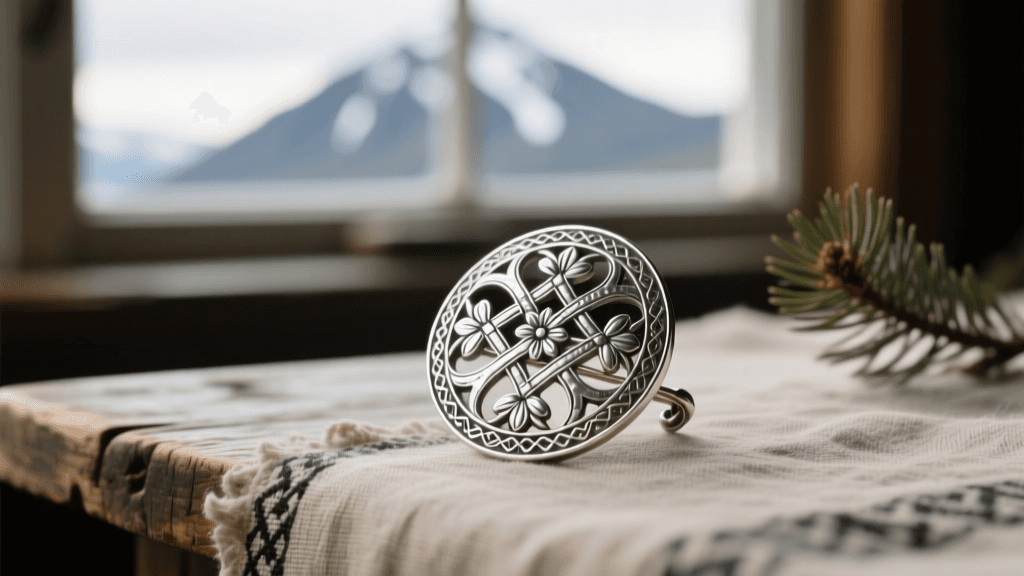
- Bringespenne (Chest Piece): A large, ornate brooch used to fasten the bodice, typically featuring a central rosette surrounded by filigree leaves.
- Beltespenne (Belt Buckle): A wide, heavy silver buckle worn over the woven wool belt.
- Knapper (Buttons): Small domed silver buttons used on the bodice and occasionally the shirt cuffs.
- Maljer (Eyelets): Silver rings sewn into the bodice through which the lacing ribbon is threaded.
In 2026, buyers must ensure their silver is stamped 925 (sterling silver). While silver-plated alternatives exist for budget-conscious buyers, they are frowned upon in formal settings and degrade over time. Master silversmiths in Voss and Bergen continue to hand-forge these pieces using traditional repoussé and filigree techniques. A complete, hand-forged 925 sterling silver set for the Hardanger bunad currently ranges from 25,000 to 40,000 NOK, depending on the complexity of the filigree and the weight of the belt buckle.
Commissioning Your Bunad: Measurements and 2026 Cost Breakdown
Acquiring an authentic Hardanger bunad is not like buying a modern garment off the rack; it is a bespoke process that requires forward planning. In 2026, the lead time for a fully assembled, custom-tailored bunad ordered through a Husfliden cooperative is typically 12 to 18 months. This accounts for the weaving of the vadmel (traditional Norwegian woolen cloth), the hand-stitching of the bodice, and the assembly of the embroidered components.
When attending your fitting, the tailor will require precise measurements. Unlike modern fashion which relies on standard sizing charts, bunad tailoring requires exact anatomical data to ensure the rigid bodice sits correctly without restricting breathing, and that the heavy wool skirt falls exactly to the mid-calf. Essential measurements include the bust, natural waist, high hip, shoulder-to-waist, and shoulder-to-floor (while wearing the specific heel height you intend to wear with the bunad).
| Component | Material / Description | Estimated Cost (NOK) | Estimated Cost (USD) |
|---|---|---|---|
| Wool Skirt & Bodice | Custom-woven vadmel, velvet trim, silk lining | 18,000 NOK | $1,750 |
| Linen Shirt & Apron | 35-count linen, hand-embroidered whitework | 14,500 NOK | $1,400 |
| Silver Jewelry Set | 925 Sterling silver, hand-forged filigree | 32,000 NOK | $3,100 |
| Accessories | Woven belt, silk ribbon, bunad shoes, cape | 6,500 NOK | $630 |
| Tailoring & Assembly | Custom fitting, historical stitch finishing | 12,000 NOK | $1,160 |
| Total Estimated Cost | Complete Authentic Ensemble | 83,000 NOK | $8,040 |
Preservation and Care for Heirloom Textiles
Given the substantial financial and emotional investment required to acquire a Hardanger bunad, proper preservation is paramount. The materials used—raw wool, unbleached linen, and sterling silver—require specific environmental conditions to survive for generations. Modern dry cleaning is strictly prohibited for bunads. The harsh chemicals used in standard dry cleaning strip the natural lanolin from the vadmel wool, leaving it brittle and prone to tearing, and can permanently discolor the delicate whitework embroidery.
For routine maintenance in 2026, textile conservators recommend airing the garment outdoors on a dry, overcast day to naturally refresh the wool fibers. Spot cleaning should only be done with a specialized, pH-neutral wool wash and cold water. When storing the bunad, it must never be kept in plastic garment bags, which trap moisture and encourage mildew. Instead, use a breathable cotton garment cover and store the bunad in a cool, dark closet. To protect the wool from moth damage, utilize natural cedar blocks or dried lavender sachets, replacing them every six months to maintain their efficacy.
The silver jewelry should be removed before storage to prevent tarnishing and accidental snagging on the delicate linen embroidery. Store the silver pieces in an anti-tarnish cloth pouch, separate from one another to avoid scratching the intricate filigree. By adhering to these strict care protocols, your Hardanger bunad will remain a pristine, wearable artifact of European folk dress, ready to be passed down to the next generation.