Viking Smokkr Apron Dress: 2026 Weaving & Dyeing Guide
The Resurgence of the Authentic Viking Smokkr in 2026
The landscape of historical reenactment and heritage crafting has evolved dramatically as we move through 2026. Gone are the days of fantasy-inspired, leather-studded Viking costumes. Today, the focus is squarely on archaeological accuracy, experimental archaeology, and the meticulous reconstruction of traditional garments. At the heart of the female Viking Age wardrobe is the smokkr, commonly referred to as the apron dress. This iconic garment, suspended by shoulder straps and fastened with ornate oval brooches, represents a pinnacle of early medieval textile engineering. For modern crafters, weaving, dyeing, and constructing a smokkr in 2026 requires a deep understanding of historical textiles, natural dye chemistry, and period-accurate sewing techniques.
Archaeological Evidence: Hedeby, Birka, and Køstrup
To build an authentic smokkr, we must look to the surviving textile fragments unearthed across Scandinavia. According to the National Museum of Denmark, the preservation of textiles in Viking Age graves is rare, but the fragments found at Hedeby, Birka, and Køstrup provide invaluable blueprints. The Hedeby fragment suggests a tailored, darted garment that hugged the body, while the Køstrup find reveals a pleated front panel adorned with a tablet-woven band. Meanwhile, the Birka graves offer extensive evidence of the layering system, where the smokkr was worn over a linen or fine wool underdress (serk). In 2026, the consensus among textile archaeologists favors a wrapped or tubular construction, heavily dependent on the specific regional and temporal context of the persona being portrayed.
Sourcing Authentic Heritage Wool in 2026
The foundation of any accurate smokkr is the fabric. Modern commercial wools are often too uniform, heavily processed, and lack the historical drape. In 2026, serious reenactors turn to heritage sheep breeds that closely mimic the Old Norse landrace sheep. The Spælsau (short-tailed sheep) and Gotland breeds are highly prized for their dual-coated fleeces, which feature a long, water-resistant outer coat (tog) and a soft, insulating inner coat (thel). When woven into a diamond twill or herringbone pattern, these wools replicate the luxurious textiles found in high-status Viking graves.
2026 Heritage Wool Sourcing Guide for Viking Reenactment
| Heritage Wool Type | Historical Equivalent | 2026 Avg. Cost (per meter) | Best Supplier Region |
|---|---|---|---|
| Spælsau Double Coat | Old Norse Landrace | €65 - €95 | Norway / Iceland |
| Gotland Pelt Wool | Baltic Trade Wool | €45 - €65 | Sweden / Baltics |
| Diamond Twill Weave | Hedeby/Birka Fragments | €120 - €160 | UK Heritage Mills |
| Wadmal (Thick Felted) | Winter Travel Gear | €80 - €110 | Finland / Estonia |
The Natural Dyeing Process: Madder and Woad
Color in the Viking Age was a display of wealth and trade connections. While the lower classes wore undyed wools in natural browns, greys, and whites, the elite flaunted vibrant reds, blues, and yellows. Research highlighted by Hurstwic indicates that madder root (Rubia tinctorum) and woad (Isatis tinctoria) were the dominant dyestuffs. In 2026, sourcing organic, ethically harvested madder and woad is easier than ever, but the chemistry of the dye bath remains unforgiving.
Step 1: Mordanting for Colorfastness
Before any dyeing can occur, the wool must be mordanted to ensure colorfastness. For a 500-gram batch of diamond twill wool, you will need 75 grams of alum (aluminum potassium sulfate) and 25 grams of cream of tartar. Dissolve the mordants in hot water, add the pre-scoured, wet wool, and slowly bring the temperature to 90°C (194°F). Maintain this heat for one hour, then let the wool cool in the bath overnight. This slow cooling process is critical for allowing the metallic salts to bond deeply with the wool fibers.
Step 2: Dyeing with Madder (Viking Red)
To achieve the iconic Viking red, madder root is unparalleled. However, madder is highly sensitive to temperature and water chemistry. If the dye bath exceeds 75°C (167°F), the yellow and brown compounds in the root will extract alongside the red alizarin, resulting in a muddy, brick-orange color. For a vibrant, deep red in your 2026 dye kitchen, use 100% WOF (Weight of Fiber) in madder root powder. Heat your water to exactly 65°C (149°F), add the madder, and hold it at this temperature for two hours. Add a handful of chalk (calcium carbonate) to the bath; madder thrives in hard, alkaline water, which shifts the hue from orange-red to a true, rich crimson.
Step 3: Dyeing with Woad (Viking Blue)
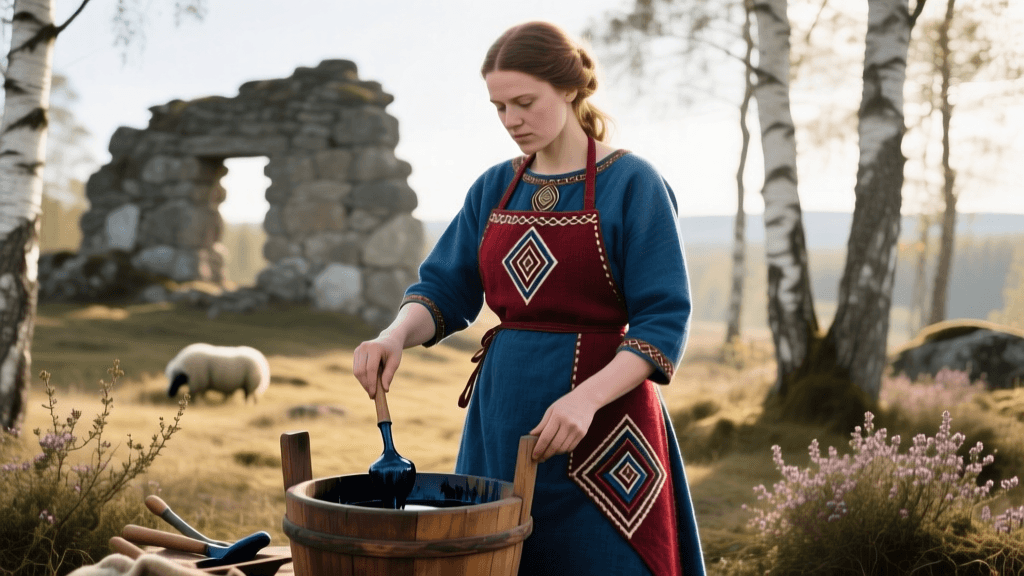
Woad provides the elusive and highly prized Viking blue. Unlike madder, woad requires a fermentation or chemical reduction vat to strip the oxygen from the indigotin molecules, making them soluble. In 2026, many crafters use a fructose-based organic reduction vat, which is safer and more environmentally friendly than traditional lye and urine vats. The woad vat must be kept at a steady 50°C (122°F) and maintained at a pH of 9 to 10. When you pull the wool from the yellow-green vat and expose it to the air, the magic of oxidation occurs, turning the fibers a brilliant, colorfast blue within minutes.
Construction Techniques and Tablet Weaving
Once your fabric is dyed and dried, construction begins. Experimental archaeology projects at the Lofotr Viking Museum demonstrate that Viking tailors were highly skilled, utilizing specific stitches for different structural needs. Avoid the modern backstitch for long seams, as it lacks the flexibility of period stitches. Instead, use a fine running stitch for the main side seams, followed by a whip stitch to fold and secure the raw edges flat against the inside of the garment. This creates a clean, durable finish that prevents fraying and mimics the archaeological record.
When cutting the fabric, remember that Viking Age looms were warp-weighted, meaning the fabric was woven to specific dimensions rather than cut from a massive continuous bolt. To honor this, plan your pattern pieces to minimize waste. A simple tubular smokkr can be constructed from a single rectangular piece of fabric, roughly 1.5 to 2 meters in circumference and 90 to 100 centimeters in length, depending on your height. The straps, or loops, should be cut on the bias or woven separately as narrow bands, measuring roughly 40 to 50 centimeters long to allow for proper draping over the shoulders.
The Art of Tablet Weaving
No high-status smokkr is complete without tablet-woven trim. The top edge of the apron dress was frequently reinforced and decorated with intricate bands. The Mammen style, characterized by interlacing beasts and vine-like tendrils, is a popular choice for 2026 reenactors. Using 30 to 40 wooden or bone tablets threaded with fine, naturally dyed silk or worsted wool, you can weave a band that takes several dozen hours to complete. To achieve the correct tension, secure one end of the warp to a sturdy upright post or your belt, and use a weighted beater to pack the weft threads tightly together. The resulting band should be stiff, dense, and highly durable, capable of withstanding the friction of the bronze brooch pins over years of wear. This slow, meditative process connects the modern crafter directly to the women of the Viking Age, who spent countless winter hours weaving these status symbols.
Accessorizing the Smokkr: Brooches and Beads
Finally, the smokkr is suspended by two loops, fastened at the collarbone with a pair of oval "tortoise" brooches. In 2026, the market for historically accurate cast bronze and brass brooches is robust, with many artisans using lost-wax casting methods based directly on Birka and Gotland molds. Between the brooches, a festoon of glass beads, amber, and imported carnelian was often draped. Sourcing authentic lampwork glass beads from specialized artisans in Scandinavia or the UK adds the final layer of historical authenticity to your ensemble.
Conclusion
Crafting a Viking smokkr in 2026 is more than just a sewing project; it is an act of historical preservation and deep cultural connection. By investing in heritage wools, mastering the delicate chemistry of natural madder and woad dyes, and employing period-accurate construction techniques, you breathe life into the past. Whether you are preparing for the summer reenactment season or simply honoring the textile traditions of your ancestors, the authentic apron dress stands as a testament to the ingenuity, artistry, and enduring legacy of Viking Age craftsmanship.