Styling Baltic Amber & Slavic Headwear: 2026 Guide
The 2026 Renaissance of Eastern European Folk Accessories
As we navigate the cultural landscape of 2026, the revival of traditional European folk dress has moved far beyond mere costume replication. Today’s heritage enthusiasts, festival-goers, and textile artisans are deeply invested in the authentic sourcing, historical accuracy, and respectful styling of regional accessories. Among the most captivating elements of Eastern European and Baltic folk dress are the intricate jewelry and elaborate headwear that have defined cultural identity for centuries. From the sunlit shores of the Baltic Sea to the forested highlands of the Carpathians, accessories like raw amber necklaces, silver filigree coin pendants, and the iconic kokoshnik headpieces are experiencing a massive resurgence in contemporary wardrobes.
This comprehensive guide explores the current 2026 market for authentic folk accessories, providing actionable advice on how to source, authenticate, and style Baltic amber and traditional Slavic headwear for modern heritage events, folk dances, and cultural festivals.
Baltic Amber: The Gold of the North
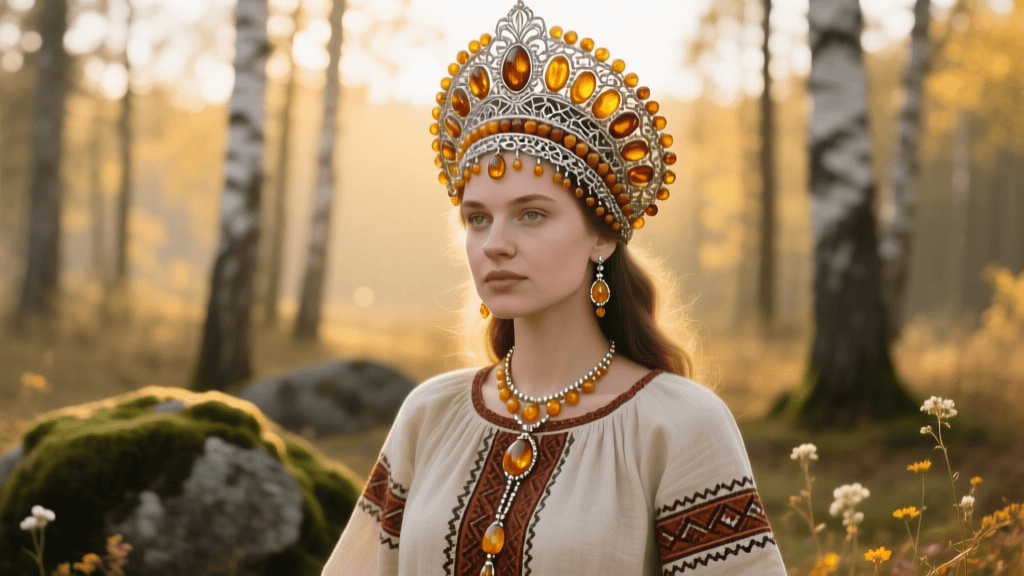
Baltic amber, or succinite, has been a cornerstone of Latvian, Lithuanian, Polish, and northern Ukrainian folk dress for millennia. Historically, amber was believed to possess healing properties and was worn as a talisman against illness and evil spirits. In traditional village settings, a woman’s amber necklace often indicated her marital status, regional origin, and family wealth. Today, according to the Gemological Institute of America (GIA), Baltic amber remains the most highly prized organic gemstone in Europe, valued not just for its beauty but for its prehistoric botanical inclusions.
In 2026, the prevailing trend in folk dress styling has shifted away from the perfectly polished, uniformly round amber beads that dominated the late 20th-century tourist markets. Modern heritage practitioners heavily favor raw, unpolished amber chunks and baroque shapes that closely mimic the historical artifacts found in regional museums. These irregular stones are typically strung on natural linen or hemp cords, allowing the jewelry to sit heavily against the collarbones, perfectly complementing the rough texture of hand-woven linen shirts (vyshyvanka) and wool vests.
2026 Market Guide to Baltic Amber
Sourcing authentic amber requires a keen eye, as synthetic resins and copal (immature amber) frequently flood the market. The International Amber Association recommends purchasing only from certified dealers who provide certificates of authenticity. Below is a breakdown of the 2026 amber market tailored for folk dress enthusiasts.
| Amber Classification | Visual Characteristics | 2026 Avg. Price (per gram) | Best Folk Dress Pairing |
|---|---|---|---|
| Raw / Unpolished | Matte finish, natural crust, irregular shapes | €6.00 - €14.00 | Heavy linen tunics, Hutsul wool vests |
| Baroque (Polished) | Smooth, asymmetrical, high luster | €4.50 - €9.00 | Festive silk-blend aprons, velvet bodices |
| Botanical Inclusion | Contains prehistoric leaves, bark, or spores | €25.00 - €80.00+ | Heirloom display, minimalist linen shifts |
| Butterscotch / Opaque | Cloudy yellow to deep white, highly prized | €12.00 - €30.00 | Dark wool skirts, embroidered sheepskin coats |
Silver Filigree and Traditional Coin Jewelry
Moving southward into the Carpathian Mountains and the Balkans, the jewelry transitions from organic gemstones to intricate metalwork. The Hutsul people of western Ukraine and the highland communities of Romania are renowned for their brass and silver filigree work. In 2026, the namysto—a traditional necklace made of strung coins, glass beads, and coral—remains a vital component of the festive folk wardrobe.
Authenticating vintage coin jewelry requires careful examination of the metallurgical composition. Many historical pieces utilized Austro-Hungarian or Ottoman silver coins, which were pierced and soldered rather than drilled to preserve their numismatic value. When assembling a modern namysto for contemporary wear, artisans recommend using sterling silver spacer beads and heavy-duty silk thread to support the significant weight of the coins. A traditional multi-strand coin necklace can weigh upwards of 500 grams, requiring a reinforced neckline on the accompanying blouse to prevent fabric tearing.
Crown and Wreath: The Kokoshnik and Vinok
No European folk dress is complete without its corresponding headwear. Headpieces in Eastern Europe were historically the most expensive and heavily guarded items in a woman’s trousseau, often passed down through generations. In 2026, two distinct styles dominate the heritage revival scene: the Russian kokoshnik and the Ukrainian vinok.
Styling the Kokoshnik for Modern Heritage Events
The kokoshnik is a traditional Russian headdress characterized by its halo-like crest. Originating in the northern provinces, it was traditionally worn by married women to completely conceal their hair, in accordance with Orthodox customs. The crest is typically constructed from a rigid base of birch bark or heavy buckram, covered in velvet or brocade, and heavily embroidered with river pearls, gold thread, and glass beads.
- Regional Variations: The tall, pointed kokoshnik of the Kostroma region pairs best with heavy, floor-length sarafans, while the softer, crescent-shaped kokoshnik of the Vologda region is suited for lighter, everyday linen garments.
- Modern Securing Techniques: Historical kokoshniks were tied with thick ribbons at the back of the head. For 2026 festival wear, where dancing and movement are involved, artisans recommend integrating discreet, padded comb inserts into the buckram base to anchor the piece securely to the hair without relying solely on ribbon tension.
- Pearl Netting (Ryasny): Many elaborate kokoshniks feature ryasny—strands of pearls that drape over the cheeks. Ensure these strands are weighted with small glass beads at the termini to prevent tangling during movement.
Constructing an Authentic Vinok
In contrast to the rigid kokoshnik, the Ukrainian vinok is a vibrant, living crown of wildflowers, herbs, and woven grasses, traditionally worn by unmarried women. The modern revival of the vinok has seen a shift toward sustainable, locally foraged materials rather than the plastic artificial flowers that plagued the mid-century tourist trade.
Constructing a proper vinok requires an understanding of floral symbolism and structural engineering. The base must be woven from flexible willow or birch branches, padded with moss for comfort. In 2026, botanical stylists emphasize the use of dried or preserved flowers treated with vegetable glycerin to maintain flexibility and color throughout long outdoor festivals. The ribbons trailing from the back of the vinok are equally important; they must reach the shoulder blades, with specific color combinations denoting regional origins—for example, blue and gold ribbons are heavily associated with the Kyiv region, while deep reds and greens are prominent in the Carpathian foothills.
Caring for Heritage Textiles and Gemstones
Investing in authentic folk accessories requires a commitment to proper preservation. The organic nature of both amber and historical textiles makes them highly susceptible to environmental damage.
- Amber Maintenance: Amber is exceptionally soft (2 to 2.5 on the Mohs scale). It should never be cleaned with ultrasonic jewelry cleaners or harsh chemicals, which will cause the surface to craze and cloud. Instead, wipe amber gently with a soft, lint-free cloth dampened with lukewarm water, and occasionally polish it with a drop of pure almond oil to restore its luster.
- Silver and Coin Polish: Vintage silver filigree and coin necklaces develop a dark patina over time. While some collectors prefer this aged look, folk dress purists often maintain the bright shine of the silver to mimic the pristine condition expected of historical festival wear. Use a mild silver dip, but avoid abrasive polishing cloths that can wear away the delicate filigree wires.
- Textile and Buckram Storage: Kokoshniks and heavy embroidered headbands must never be stored flat, as this will crush the velvet nap and distort the rigid buckram frame. Store them on custom-carved foam head forms in a climate-controlled environment, away from direct sunlight which will rapidly fade the natural dyes used in the embroidery threads.
Conclusion
The styling of European folk accessories in 2026 is a beautiful intersection of historical reverence and modern craftsmanship. Whether you are draping a heavy strand of raw Baltic amber over a hand-loomed linen shirt, or carefully securing a pearl-encrusted kokoshnik for a midsummer heritage dance, these pieces serve as a tangible link to the artisans and ancestors who shaped Europe’s rich textile history. By prioritizing authentic materials, understanding regional nuances, and practicing meticulous care, today’s folk dress enthusiasts ensure that these magnificent traditions continue to thrive for generations to come.