Norwegian Bunad Wool Spinning And Rose Painting Techniques
Origins and Evolution of the Norwegian Bunad
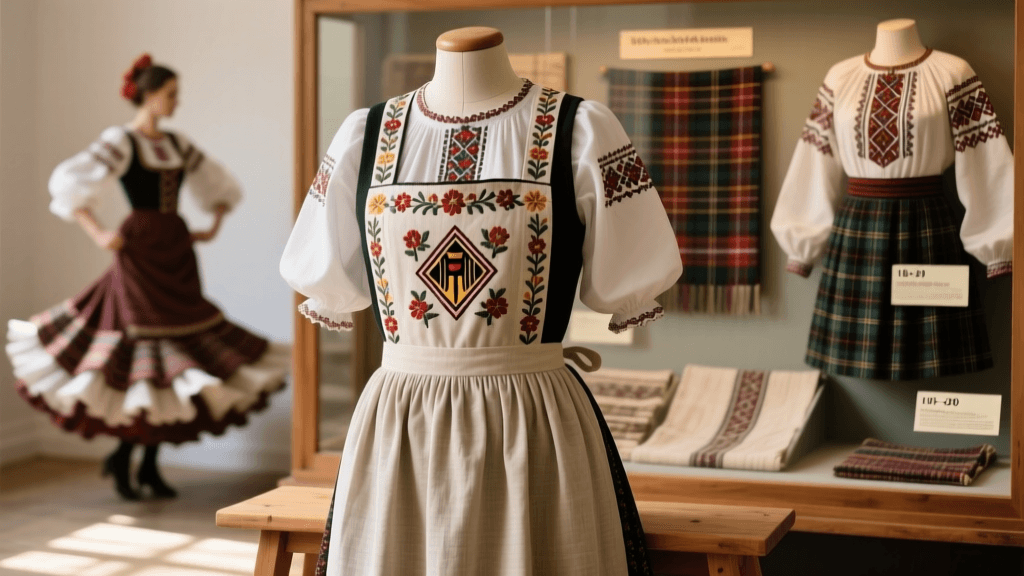
The Norwegian bunad emerged as a conscious cultural revival in the late 19th and early 20th centuries, rooted in regional folk dress but formalized during Norway’s national romantic movement. Unlike static museum artifacts, bunads were reinterpreted by scholars, tailors, and women’s associations to assert linguistic and sartorial sovereignty following the 1814 dissolution of the union with Denmark and prior to full independence from Sweden in 1905. Early documentation relied heavily on surviving garments held at the Norsk Folkemuseum in Oslo, where over 15,000 textile items—including 327 complete bunad ensembles—date from as early as 1750. The first standardized bunad, the Hardanger bunad, was codified in 1922 by Hulda Garborg and the Norwegian Women’s Public Health Association, establishing precedent for regional committees to authenticate design elements.
Wool Spinning: From Flock to Fiber
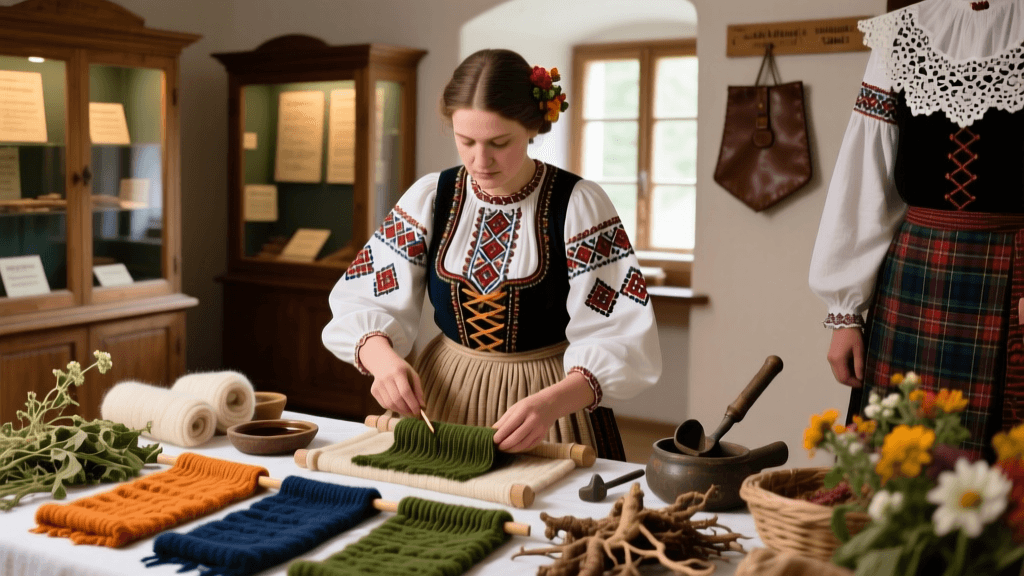
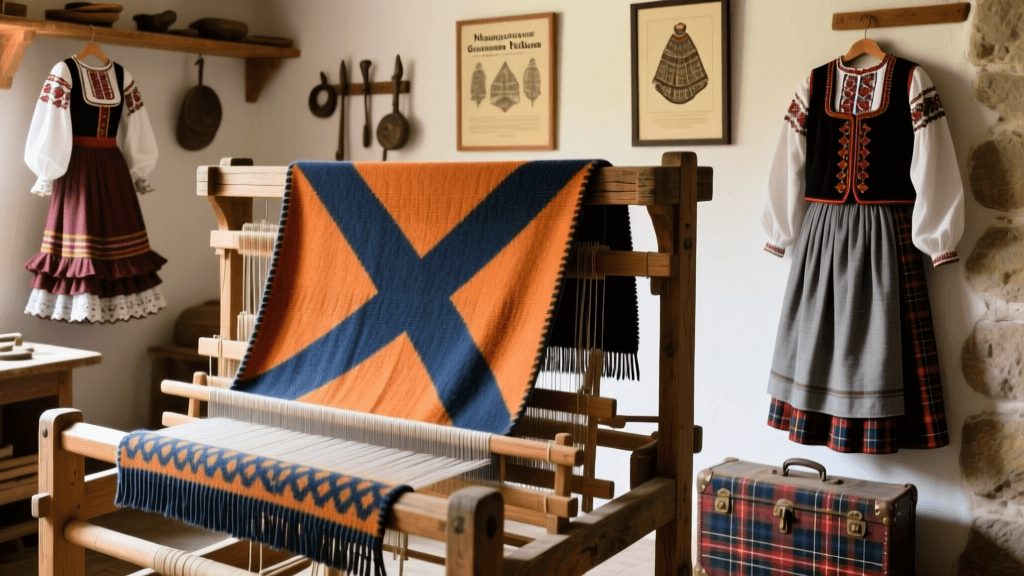
Traditional Norwegian wool spinning remains inseparable from bunad construction, particularly in western and mountainous regions where sheep farming sustained communities for centuries. Raw fleece is hand-sorted by grade, then washed using rainwater or soft spring water—never hot or chemically treated—to preserve lanolin essential for durability. Spinning occurs on drop spindles or treadle wheels; the average spinner achieves 1.2–1.8 meters of yarn per minute when drafting fine singles for embroidery threads. A single bunad jacket may require up to 4.5 kilograms of raw wool, processed into approximately 1,200 meters of two-ply yarn. Regional distinctions appear in twist direction: Hardanger spinners use Z-twist (clockwise), while Telemark practitioners favor S-twist (counter-clockwise), a detail verified through fiber analysis at the University of Bergen’s Textile Archaeology Lab (2018).
Spindle Specifications and Regional Standards
- Hardanger drop spindles weigh between 65–85 grams and measure 22–26 cm in length
- Telemark spindles average 48 grams and 19 cm, optimized for faster rotation
- Rogaland spinners historically used stone whorls averaging 3.2 cm in diameter
- A single skein of spun wool for bunad weaving measures precisely 120 meters before plying
- Yarn count for traditional bunad weaving ranges from 18–22 wraps per centimeter
Rose Painting: Symbolism and Technique
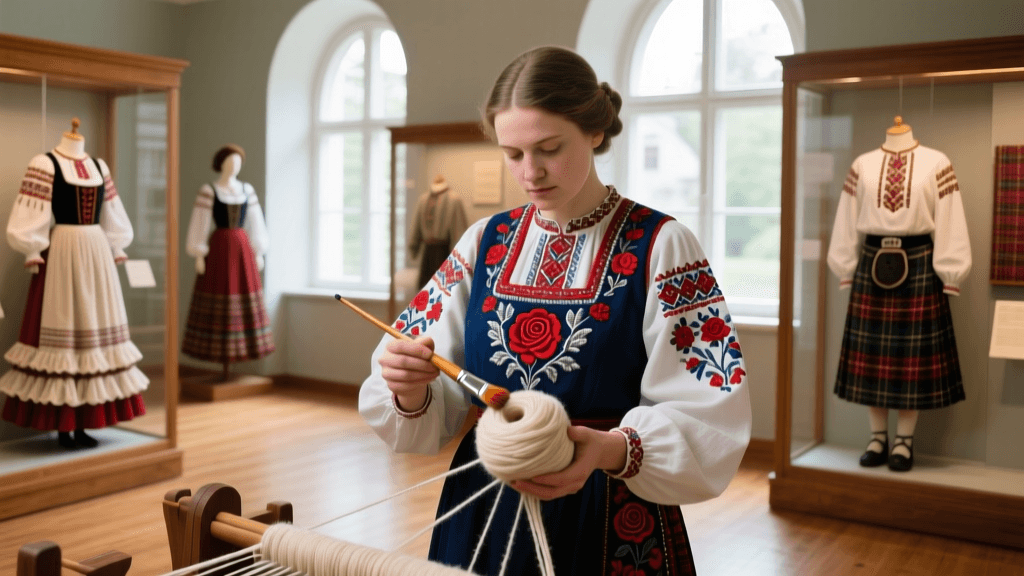
Rose painting—or rosemåling—is not decorative embellishment alone but a coded visual language tied to agrarian cosmology and seasonal cycles. Originating in rural Valdres and Hallingdal in the 1700s, the technique spread via itinerant painters who traveled village-to-village carrying portable pigment kits. Brushes are handmade from squirrel tail hair bound to birch twigs; a single fine-line brush contains exactly 17 hairs. Paints derive from natural sources: iron oxide for red (ground from local hematite deposits), copper sulfate for green, and chalk mixed with casein binder for white. Each motif carries meaning—the eight-petaled rose symbolizes resurrection and renewal, while the “Hallingdal heart” features 13 concentric rings representing Christ’s years in Galilee.
Palette and Application Precision
- Red pigment concentration must reach 28% iron oxide by weight for archival stability
- Brush strokes for petal outlines maintain consistent 0.3 mm thickness under magnification
- Traditional rosemåling requires three drying intervals totaling 42 hours between layers
- A full bunad chest panel averages 47 individual rose motifs across 84 cm² surface area
- Master painters complete no more than six panels per month to ensure pigment adhesion integrity
Regional Distinctions Across Norway
No two bunads are identical—even within counties, parish-level variations exist in cut, sleeve shape, and ornament placement. The Setesdal bunad features black wool with silver brooches weighing 210–230 grams each, while the Nordland version uses undyed reindeer hide for vests and incorporates 14-karat gold thread in collar embroidery. In Finnmark, Sami-influenced bunads integrate tin-thread appliqué and geometric patterns aligned to cardinal directions—north-facing motifs contain 37 stitch repeats, reflecting lunar cycle calculations. The Bergen bunad, revived in 1956, mandates silk damask bodices measuring exactly 52 cm from shoulder seam to waistline, with pleats spaced at 1.8 cm intervals.
| Region | Wool Source | Spindle Weight (g) | Typical Rose Motif Count | Museum Holding Location |
|---|---|---|---|---|
| Hardanger | Gudbrandsdal sheep | 74 ± 3 | 29 per apron | Norsk Folkemuseum, Oslo |
| Hallingdal | Old Norwegian Spælsau | 51 ± 2 | 41 per chest panel | Valdres Folkemuseum, Ål |
| Troms | North Norwegian sheep | 68 ± 4 | 18 per belt buckle cover | Nordnorsk Vitensenter, Tromsø |
Festival Occasions and Contemporary Practice
Bunads are worn during specific civic and seasonal milestones—not daily attire but ceremonial armor of identity. May 17th (Constitution Day) sees over 420,000 Norwegians don bunads nationwide, with Oslo’s parade alone involving 12,000+ participants in certified regional dress. Confirmation ceremonies require youth to wear family heirloom bunads or newly commissioned pieces validated by county bunad councils. At weddings, the bride’s bunad must include at least one inherited element—be it a brooch, belt, or embroidered handkerchief—to signify lineage continuity. The annual National Bunad Conference, held since 1974 in Lillehammer, convenes 320+ artisans, historians, and weavers to review standards; its 2023 proceedings documented 17 regional revisions to dye recipes and 9 spindle-weight adjustments based on archaeological textile findings.
Authenticity protocols are enforced by the Norwegian Bunad and Folk Costume Council (NBF), which certifies 86 official regional variants. Certification requires submission of fabric swatches, spindle measurements, and pigment chromatography reports. Only garments meeting all 39 criteria—including wool micron count (22–26 µm for outer layers) and rose-paint pH (6.2–6.8)—receive the official NBF seal. This rigor reflects broader European ethnographic conservation ethics, echoed in the V&A Museum’s 2021 exhibition Folk Threads: Identity and Craft in Northern Europe, which featured 14 bunads alongside Swedish folkdräkter and Finnish kankuri.
“The bunad is not costume—it is contract: between wearer and ancestor, land and loom, memory and making.” — Dr. Ingrid Løvoll, Senior Curator, Norsk Folkemuseum (2019)
At the Valdres Folkemuseum in Ål, visitors observe live demonstrations of wool scouring in oak-ash lye baths maintained at 42°C for precisely 18 minutes—a temperature calibrated to remove grease without damaging keratin structure. Similarly, the Nordnorsk Vitensenter in Tromsø hosts biannual workshops where participants spin 300 meters of yarn using replicas of 18th-century spindles excavated near Skjervøy. These institutions anchor practice in empirical continuity, resisting commodification while ensuring transmission. When Oslo’s Norsk Folkemuseum conducted a 2022 survey of 1,843 bunad owners, 63% reported learning spinning or rosemåling from grandparents, and 89% emphasized that “correct measurement—not aesthetic preference—defines authenticity.” That insistence on quantifiable fidelity separates Norwegian tradition from stylized reinterpretation elsewhere in Europe.
Across the continent, comparative study reveals shared principles: Slavic embroidery counts stitches per square centimeter to encode clan affiliation; Scottish tartan sett widths adhere to millimeter tolerances defined in the 1819 Lyon Court Register; Bavarian dirndl bodice lengths vary by village elevation—each 100-meter increase above sea level shortens the front panel by 0.7 cm. Yet Norway’s bunad system remains unique in its legally recognized regional governance, its integration of material science into cultural stewardship, and its unbroken chain of technical instruction—from spindle weight to rose-paint pH—preserved not in archives alone but in living hands.