Ancient Greek Chiton Guide 2026: Doric vs Ionic Styles
The Renaissance of Hellenic Dress in 2026
As we navigate the cultural landscape of 2026, the revival of ancient European folk dress has reached unprecedented levels of historical accuracy and mainstream popularity. From the grand stages of the Athens & Epidaurus Festival to immersive historical reenactments across Europe and North America, the demand for authentic ancient Greek and Roman garments has never been higher. At the heart of this sartorial revival is the chiton, the foundational tunic of the ancient Mediterranean world. Unlike modern tailored clothing, the chiton was a masterclass in geometric draping, relying on the natural fall of woven textiles rather than complex cutting and sewing. For contemporary enthusiasts, theater costumers, and heritage practitioners, understanding the nuanced differences between the Doric and Ionic chiton is essential for achieving a historically accurate silhouette.
The ancient Greeks and Romans viewed clothing not merely as functional protection from the elements, but as a profound expression of cultural identity, social status, and philosophical ideals. The Roman tunica evolved directly from these Greek predecessors, adapting the drape for a more militaristic and administrative society. Today, reconstructing these garments requires a deep understanding of ancient textile weights, natural dyeing techniques, and the precise mathematics of the drape. This comprehensive guide will walk you through the anatomy, sourcing, and construction of the chiton, ensuring your 2026 wardrobe is both historically grounded and beautifully crafted.
The Anatomy of the Chiton: Doric vs. Ionic
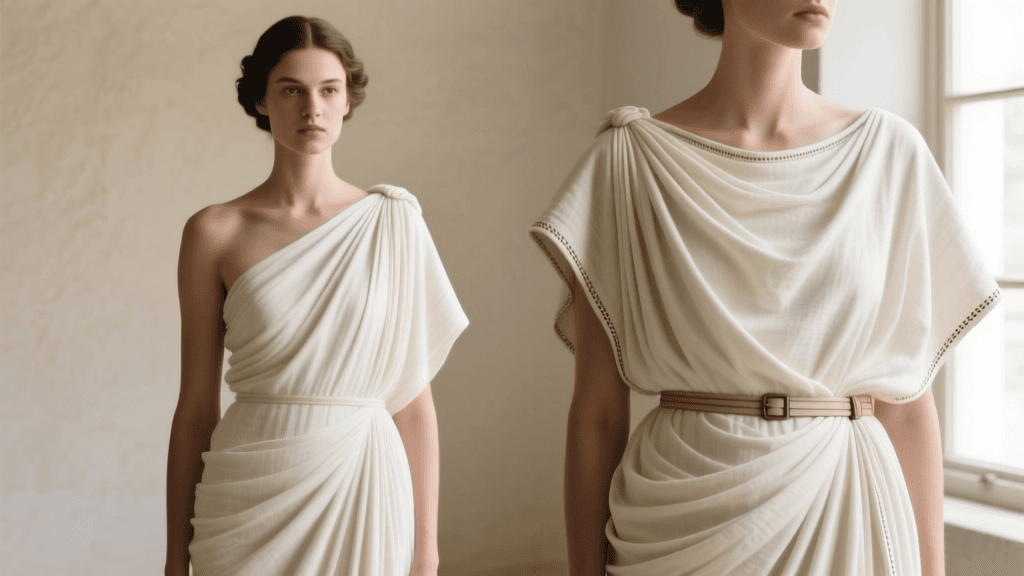
The evolution of the chiton reflects the broader cultural and economic shifts of the ancient Mediterranean. According to the Metropolitan Museum of Art's Heilbrunn Timeline of Art History, the transition from the heavy, structured Doric peplos to the lighter, more fluid Ionic chiton mirrored Greece's increasing trade and cultural exchange with the East, particularly Ionia and Persia. While both garments serve the same fundamental purpose, their construction, fabric choices, and draping methods are distinctly different.
| Feature | Doric Chiton (Peplos) | Ionic Chiton |
|---|---|---|
| Primary Fabric | Lightweight Worsted Wool | Medium-weight Linen or Silk |
| Construction | Draped, folded over (apoptygma) | Sewn or pinned along the arm |
| Fastening | Single or double large fibula at shoulder | Multiple small pins along the arm seam |
| Sleeve Style | Cap sleeve formed by the overfold | Long, flowing sleeve created by pinning |
| Historical Peak | c. 6th Century BCE (Archaic Period) | c. 5th Century BCE onwards (Classical) |
| Drape Quality | Structured, heavy, geometric folds | Fluid, lightweight, numerous small pleats |
Sourcing Authentic Materials in 2026
The most common mistake modern reenactors make is using contemporary, mass-produced fabrics that lack the correct weight and weave structure. Ancient textiles were woven on warp-weighted looms, producing a fabric with a distinctly different drape and selvedge than modern bolt fabric. In 2026, the market for heritage textiles has expanded, making it easier than ever to source appropriate materials.
Choosing the Right Wool for the Doric Chiton
For a Doric chiton or peplos, you must avoid modern suiting wools or thick winter wools. Instead, seek out lightweight worsted wool or tropical wool with a plain tabby weave. The fabric should be heavy enough to hold a crisp pleat but light enough to drape gracefully. In 2026, heritage weavers in the UK and Greece offer historically accurate tabby-woven wool, typically priced between €45 and €70 per meter. You will need approximately 3.5 to 4 meters of fabric, assuming a standard historical width of 140cm to 150cm.
Selecting Linen for the Ionic Chiton
The Ionic chiton demands a fabric that can hold dozens of tiny, intricate pleats. Medium-weight, unbleached or naturally dyed linen is ideal. Look for a fabric weight of around 150 to 180 grams per square meter (GSM). Modern linen often features a slubby texture; while historically acceptable, a more evenly spun linen will yield a cleaner, more aristocratic Classical silhouette. Expect to pay around €25 to €40 per meter for high-quality European flax linen. You will need a wider piece of fabric for the Ionic style—typically a rectangle measuring your full wingspan (roughly 2.5 to 3 meters wide) and your height plus 40cm.
Natural Dyeing Techniques for Historical Accuracy
While the romanticized vision of ancient Greece is one of pristine white marble and white garments, historical reality was vastly more colorful. The World History Encyclopedia notes that ancient Greeks frequently dyed their garments using vibrant plant and insect-based dyes. If you are constructing a garment for a high-level 2026 reenactment, consider natural dyeing.
- Saffron and Weld: For brilliant yellows, weld (Reseda luteola) was heavily used. Saffron was reserved for the ultra-wealthy and specific religious ceremonies, such as the priestesses of Artemis at Brauron.
- Madder Root: Rubia tinctorum provides a range of reds, from pale terracotta to deep brick red, depending on the mordant used. Alum mordanting is essential for colorfastness.
- Woad and Indigo: For blues, woad was the primary European source in antiquity. Achieving a deep, even blue requires careful vat management, but the result is a stunning, historically accurate hue that pairs beautifully with bronze accessories.
Step-by-Step Draping and Construction
Unlike modern patterns, the chiton requires no cutting. The garment is formed entirely from a single, large rectangle of fabric. The beauty of the chiton lies in its adjustability; a single garment could be draped to suit different body types and occasions.
Draping the Doric Peplos
- Measure the Apoptygma: Fold the top edge of your wool rectangle down by 30 to 45 centimeters. This overfold (apoptygma) creates the structural weight that pulls the garment taut across the chest.
- Wrap the Body: Wrap the fabric around your body, ensuring the fold sits at the top. The garment should overlap at the side seam by at least 15 centimeters to prevent gaping when walking.
- Pinning the Shoulders: Gather the front and back layers (including the overfold) at each shoulder. Secure them with a heavy, historically accurate bronze or silver fibula (brooch). The placement of these pins determines the neckline width.
- Belt and Blouse: Tie a woven wool belt around the waist. Pull the fabric up and over the belt to create the kolpos (blousing), adjusting the hem so it falls just below the knee for men, or to the ankles for women.
Constructing the Ionic Chiton
- Prepare the Width: The Ionic chiton uses a much wider piece of linen. Hold the fabric behind your back, extending your arms outward.
- Create the Sleeves: Starting at the shoulder, pinch the front and back layers together and secure them with a small pin. Continue pinning down the length of your arm, spacing the pins about 5 to 7 centimeters apart. This creates the iconic flowing, open sleeve.
- Secure the Neckline: The pins closest to the neck form the neckline. Adjust the tension to ensure it sits comfortably without slipping off the shoulders.
- Stitching (Optional): While ancient Greeks often pinned the sleeves daily, modern reenactors frequently sew the arm seams for convenience, leaving the top shoulder gaps open or stitching them shut. For 2026 festival wear, sewing the side seam from the hem up to the armpit is highly recommended to prevent wardrobe malfunctions in high winds.
Accessorizing the Ancient Silhouette
A chiton is rarely worn alone. To complete the ensemble, one must incorporate the appropriate outerwear and accessories. The himation was the standard rectangular cloak worn over the chiton. Draping a himation requires practice; it was typically thrown over the left shoulder, wrapped around the back, and brought across the front, leaving the right arm free. For colder weather or travel, the chlamys, a shorter woolen cloak fastened at the right shoulder with a fibula, was favored by soldiers and hunters.
Footwear is equally important. Bare feet are acceptable for indoor or sacred settings, but for outdoor 2026 festivals, a pair of handcrafted leather krepides (strappy sandals) or embades (enclosed leather boots) is essential. Avoid modern rubber soles; seek out artisan cobblers who use traditional vegetable-tanned leather and wooden pegs or hand-stitching to construct period-accurate footwear. Finally, jewelry should be kept to solid metals—bronze, silver, and gold. Avoid faceted gemstones, which were not used in ancient Greek jewelry; instead, opt for intaglios, granulation, and repoussé metalwork.
Caring for Your Heritage Garments
Maintaining natural fibers requires specific care to ensure longevity. Wool chitons should rarely be washed with water; instead, air them out in the shade and use a soft brush to remove dust. If washing is necessary, use a specialized wool wash in cold water and lay flat to dry to prevent felting and shrinkage. Linen Ionic chitons, conversely, become softer and more drapeable with every wash. Machine wash on a gentle cycle with a pH-neutral detergent, and while still damp, iron on a high setting to set the pleats and maintain a crisp, structured appearance. By investing in high-quality materials and adhering to these historical construction methods, your 2026 ancient Greek wardrobe will not only look spectacular but will stand the test of time, honoring the rich textile traditions of the ancient Mediterranean.