Authentic Romanian Ie Blouse Guide 2026: Regional Styles & Sourcing
The Global Resurgence of the Romanian Ie in 2026
In 2026, the appreciation for authentic European folk dress has transcended mere historical costuming, firmly establishing itself within the realm of sustainable, heritage-driven fashion. At the forefront of this movement is the Romanian ie (pronounced 'yeh'), a traditional peasant blouse characterized by its intricate hand-embroidery and masterful textile construction. Following its monumental inscription on the UNESCO Representative List of the Intangible Cultural Heritage of Humanity, the demand for authentic, regionally accurate ie blouses has skyrocketed. According to the UNESCO Intangible Cultural Heritage registry for Romania, the traditional art of the craft of the ie and its associated practices have catalyzed a massive revival among younger generations of artisans and global textile collectors.
For collectors, cultural historians, and sustainable fashion enthusiasts navigating the 2026 market, understanding the distinct regional variations of the ie is paramount. Mass-produced, machine-embroidered replicas flood the fast-fashion market, making the ability to identify and source genuine, hand-stitched regional pieces an essential skill. This comprehensive guide breaks down the anatomy, regional styles, and current sourcing realities of the Romanian ie in 2026.
The Anatomy of the Authentic Ie
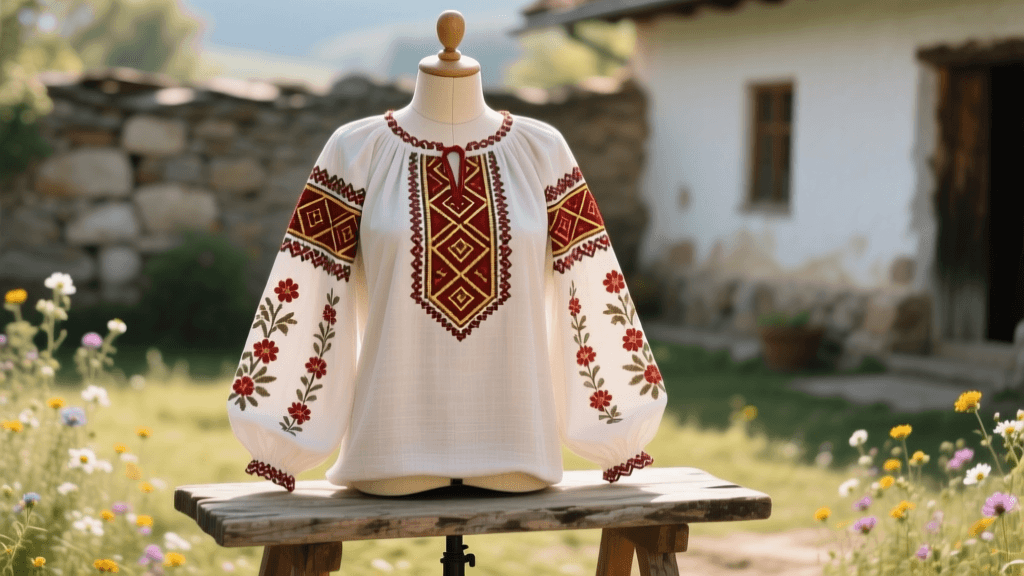
Before diving into regional distinctions, one must understand the strict structural anatomy that defines a true ie. Unlike standard European blouses, the ie is constructed from rectangular pieces of hand-woven linen, hemp, or cotton, gathered at the neck and cuffs. The embroidery is not merely decorative; it is a codified language of symbols, protective charms, and regional identifiers.
- Altița (The Shoulder): The most defining feature of the ie. This is a dense, rectangular block of embroidery located on the top of the sleeve. Historically, the altiță was believed to protect the wearer's vital energy centers.
- Încrețul (The Neck Gathering): A decorative, often square or rectangular stitched area just below the neckline where the fabric is gathered. It acts as a structural anchor for the heavy embroidery on the sleeves.
- Râurile (The Rivers): Vertical or diagonal bands of embroidery that flow down the sleeve from the altiță to the cuff. The number of 'rivers' (usually three or four) and their angle can instantly identify the wearer's specific village or sub-region.
- Puișorul (The Little Chicken): A small, isolated geometric motif often placed on the chest or back, serving as a talisman against the evil eye.
Natural Dyes and Sustainable Weaving in 2026
A major trend in the 2026 European folk dress revival is the strict return to historical, eco-friendly material sourcing. Contemporary artisan cooperatives in regions like Văratec and Marginea have abandoned synthetic threads, returning to the natural dyeing practices of the 19th century. Madder root (Rubia tinctorum) is used to achieve deep, colorfast reds, while woad and indigo provide the rich blues seen in Moldavian pieces. Black is traditionally derived from oak galls and iron mordants. When sourcing a newly woven ie in 2026, buyers should request a 'material passport' from the artisan, which documents the origin of the flax or hemp and the botanical sources of the dyes.
Regional Variations Across Romania
Romania's diverse topography and complex history have given rise to highly distinct regional styles. The National Museum of the Romanian Peasant in Bucharest categorizes these styles into several major ethnographic zones, each with unique color palettes and motifs.
Moldavia: Bold Geometrics and Voronet Blue
The Moldavian ie, particularly from the Suceava and Neamț counties, is renowned for its striking contrast. The most famous variant features 'Voronet Blue'—a vivid, azure shade inspired by the frescoes of the Painted Monasteries. The embroidery is heavily geometric, featuring coarnele berbecului (ram's horns) and romburi (diamonds) symbolizing fertility and agricultural abundance. The fabric is often a thicker hemp-linen blend, suited for the colder Carpathian winters.
Muntenia: Floral Elegance and Metallic Threads
In the southern plains of Muntenia (including Argeș and Teleorman), the ie takes on a lighter, more delicate appearance. The dominant motifs shift from strict geometry to stylized floral and vegetal patterns, such as the boboci de trandafir (rosebuds). A hallmark of the wealthy Muntenian blouses from the late 19th and early 20th centuries is the use of fir metalic (gold and silver metallic thread) and sequins, reflecting the region's historical trade wealth. In 2026, authentic antique Muntenian pieces with intact metallic threads are among the most expensive on the market.
Transylvania: Saxon Influences and Monochromatic Mastery
Transylvanian folk dress, particularly in Marginimea Sibiului, showcases heavy Saxon and Hungarian cultural cross-pollination. The blouses here often feature a tighter, more tailored fit with high collars and buttoned cuffs. The color palette is frequently monochromatic, relying on blackwork on white linen, or deep indigo blue on white. The embroidery is incredibly dense, sometimes covering the entire sleeve in a technique known as peste tot (everywhere).
Olt: The Blackwork Labyrinths
The Olt region (Vâlcea and Olt counties) is famous for its intricate, maze-like blackwork. The motifs are highly abstract, resembling circuitry or ancient labyrinths. The precision required to stitch an Olt ie is staggering, with some masterpieces requiring over 400 hours of continuous hand-stitching. These pieces are highly sought after by textile curators globally.
Sourcing Authentic Pieces vs. Modern Replicas in 2026
Navigating the 2026 market requires a discerning eye. The global popularity of the 'peasant blouse' silhouette means that machine-made copies from overseas manufacturers are ubiquitous. To build an authentic collection or integrate genuine heritage pieces into a modern wardrobe, buyers must understand current pricing and authentication markers.
Authentication Markers
Turn the blouse inside out. A genuine hand-stitched ie will show the reverse of the embroidery. While master artisans strive for a 'two-sided' stitch where the back is nearly as neat as the front, you will still see the distinct path of the thread, slight tension variations, and the knots where threads were tied off. Machine embroidery will show a continuous, uniform bobbin thread on the reverse, often with a synthetic sheen. Additionally, authentic vintage pieces will have hand-spun irregularities in the base fabric, visible when held up to the light.
2026 Pricing Guide
Due to the UNESCO recognition and the shrinking number of master embroiderers, the value of authentic ie blouses has appreciated significantly by 2026.
- Antique/Vintage (Pre-1960, Hand-spun, Natural Dyes): €450 to €2,500+. Prices peak for pristine Muntenian pieces with gold thread or perfectly preserved Moldavian hemp blouses.
- Contemporary Artisan (Newly woven, hand-stitched, natural dyes): €350 to €1,200. Commissioning a bespoke piece from a recognized cooperative in 2026 often involves a 6-to-9-month waiting list.
- Modern Semi-Handmade (Machine-woven fabric, partial hand-finishing): €120 to €250.
- Mass-Market Replica (Fully machine-made, synthetic fabrics): €30 to €80. These hold no cultural or collector value.
Comparison Table: Regional Styles & 2026 Sourcing Data
| Region | Dominant Colors | Signature Motif | 2026 Avg. Handmade Price | Best Sourcing Hub |
|---|---|---|---|---|
| Moldavia (Suceava) | Voronet Blue, Red, Black | Ram's Horns (Coarnele Berbecului) | €600 - €900 | Văratec Village Cooperatives |
| Muntenia (Argeș) | Red, Gold, Silver | Stylized Rosebuds (Boboci) | €800 - €1,500 | Curtea de Argeș Artisans |
| Transylvania (Sibiu) | Black on White, Indigo | Dense 'Peste Tot' Sleeve Cover | €500 - €850 | Marginimea Sibiului Markets |
| Olt (Vâlcea) | Black on White | Abstract Labyrinths | €700 - €1,200 | Horezu Ceramic & Textile Fairs |
Care and Preservation for Antique Textiles
Preserving European folk dress requires strict adherence to archival textile care. The Metropolitan Museum of Art Costume Institute recommends that antique cellulosic fibers (like linen and hemp) be stored in climate-controlled environments with a relative humidity of 45-55%. Never hang an antique ie by the shoulders; the weight of the heavy embroidery will distort and eventually tear the century-old fibers. Instead, store the blouse flat, padded with acid-free, unbuffered tissue paper to prevent creasing. If the piece features metallic threads (common in Muntenia), wrap it in unbleached muslin to prevent sulfur-induced tarnishing. For cleaning, avoid commercial detergents entirely; consult a professional textile conservator who specializes in European ethnographic garments to perform surface cleaning with neutral pH agents.
Conclusion
The Romanian ie is far more than a garment; it is a wearable archive of European history, botanical knowledge, and mathematical precision. As the 2026 market continues to reward authenticity and sustainable craftsmanship, understanding the nuanced differences between a Moldavian geometric masterpiece and a Muntenian floral treasure is essential. By sourcing directly from heritage cooperatives and respecting the archival needs of vintage pieces, collectors and enthusiasts play a vital role in keeping the profound legacy of European folk dress alive for future generations.