Historical Viking Smokkr Apron Dress Patterns 2026
The 2026 Renaissance of the Viking Smokkr
The landscape of historical European folk dress has undergone a massive, necessary transformation by 2026. Gone are the days of inaccurate, fantasy-driven costumes dominated by synthetic fabrics and ahistorical silhouettes. Today, the global heritage and reenactment communities demand meticulous archaeological reconstruction. At the forefront of this movement is the smokkr, widely known as the Viking apron dress or hangerock. As major European heritage festivals enforce strict evidence-based dress codes this year, understanding the authentic construction, textile sourcing, and historical context of the smokkr has never been more vital for textile enthusiasts and cultural historians alike.
Archaeological Foundations: Beyond the Fantasy
To draft an accurate pattern in 2026, we must first discard modern assumptions about tailoring. The Viking Age (roughly 793–1066 CE) relied on geometric, zero-waste cutting techniques dictated by the width of the warp-weighted loom. The most critical archaeological evidence for the smokkr comes from three primary sites: Birka (Sweden), Hedeby (modern-day Germany/Denmark), and Køstrup (Denmark).
According to extensive research documented by the National Museum of Denmark, the Køstrup find is particularly revolutionary. It revealed a pleated front panel on the apron dress, challenging the long-held belief that all Norse dresses were simple, flat tubes. Similarly, the Hedeby fragment shows evidence of tailoring darts and felted wool, indicating a more fitted silhouette in some regions. For a comprehensive overview of how these garments functioned in daily Norse life, the Hurstwic Norse Clothing Guide remains an indispensable resource for understanding the layering systems of the era.
Sourcing Authentic Textiles in 2026
The foundation of any accurate smokkr is the fabric. In 2026, the heritage textile market has matured beautifully, offering unprecedented access to historically accurate weaves. The most prized fabric for a high-status smokkr is the 2/2 diamond twill wool, while tabby (plain weave) and 2/2 twill were common for everyday wear.
Heritage Wool and Natural Dyes
Modern synthetic dyes are strictly prohibited in high-level authenticity circles. Instead, 2026 revivalists are turning to heritage sheep breeds such as the Norwegian Spælsau, Swedish Gotland, and Icelandic sheep. These breeds produce a dual-coated fleece that, when spun and woven, mimics the archaeological record perfectly.
- Woad (Isatis tinctoria): Used for achieving authentic, colorfast blues. A high-quality, naturally dyed woad wool runs approximately $65 to $85 per yard in 2026.
- Madder Root (Rubia tinctorum): Yields rich reds and earthy oranges. Madder-dyed diamond twill is often reserved for the upper echelons of reenactment due to its cost ($90 to $120 per yard).
- Weld and Tansy: Utilized for vibrant yellows and greens (when overdyed with woad).
When sourcing fabric this year, always request a burn test and a microscopic weave analysis from your weaver to ensure the thread count aligns with historical finds (typically 10-14 threads per centimeter for fine twills).
Drafting the Pattern: Construction Techniques
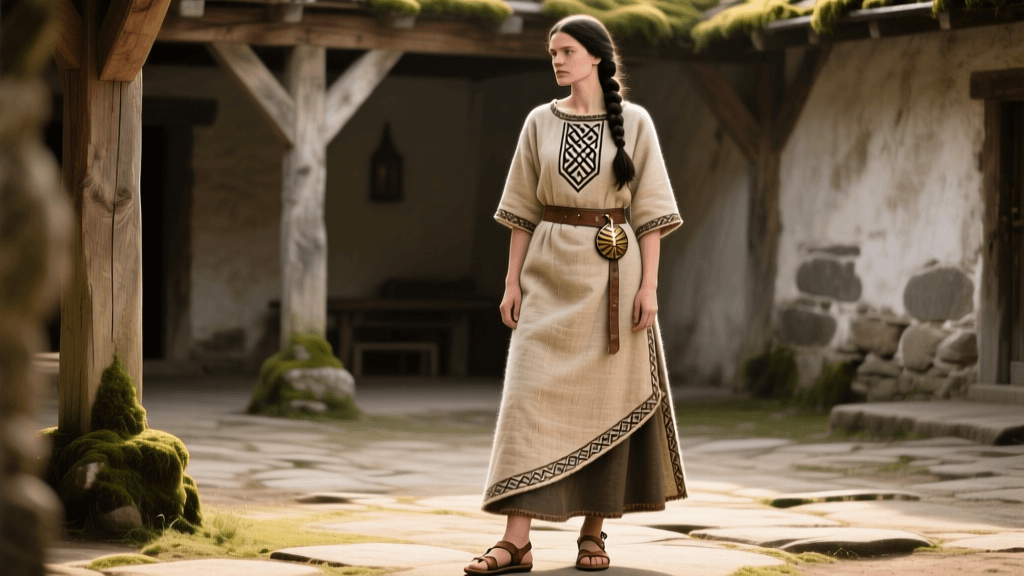
Constructing the smokkr requires a departure from modern fitted bodices. The garment is suspended from the shoulders by loops attached to oval brooches. Below is the standard methodology for drafting a historically plausible wrapped or pleated smokkr.
Measurements and Cutting
Historical looms generally produced fabric widths between 50 cm and 80 cm. To maintain authenticity, your pattern should respect these narrow widths, utilizing gussets and gores rather than wide, modern panels.
- The Main Body: Cut two main rectangular panels (front and back) measuring from the armpit to the mid-calf, plus 5 cm for hems. The width should be roughly half your body circumference plus ease.
- Side Gores: To allow for walking and sitting, insert triangular gores at the side seams starting from the waist down.
- The Køstrup Pleat (Optional): If recreating the Køstrup style, cut a narrower front panel and gather or knife-pleat the center 15 cm before attaching it to the flat side panels.
- Apron Loops: Cut four strips of wool or linen, 2 cm wide and 15 cm long. Fold and sew these into sturdy tubes. These will connect the dress to your tortoise brooches.
Historical Stitching
Machine sewing is entirely forbidden in strict authenticity. All seams must be sewn by hand using historically documented stitches. Use a waxed linen or wool thread. The primary seam technique is the running stitch for the initial join, followed by felling (folding the raw edges inward and securing them with an overcast or whip stitch) to prevent fraying. Hems are typically rolled and secured with a tight whip stitch.
Accessorizing: Oval Brooches and Bead Swags
The smokkr is held together by a pair of oval brooches, often colloquially called 'tortoise brooches' due to their domed, ornate shape. These brooches are not merely decorative; they are the structural anchor of the entire outfit. In 2026, artisan bronze casters are producing highly accurate replicas based on Petersen's and Jansson's typologies.
| Brooch Typology | Primary Region of Prevalence | Time Period | Distinguishing Features |
|---|---|---|---|
| Petersen Type 37 | Western Scandinavia, British Isles | Early to Mid 9th Century | Simpler geometric knotwork, smaller profile |
| Petersen Type 51 (JP 51) | Pan-Scandinavian, Iceland, Russia | Late 9th to 10th Century | Highly ornate, gripping beasts motif, large size |
| Jansson Type II | Eastern Baltic, Birka | 10th Century | Elaborate filigree, often silver or silver-washed |
Between the brooches, it is common to hang swags of glass and amber beads. Archaeological evidence from Birka graves shows that beads were often strung on linen or wool thread and hooked directly over the pins of the brooches. In 2026, authentic lampworked glass beads, replicating the mosaic and melon shapes of the Viking Age, are widely available from specialist artisans, though they remain a premium investment.
The Hiberno-Norse Intersection: Celtic Influences
While the smokkr is distinctly Norse, the European folk dress landscape is defined by cultural intersection. In regions like the Isle of Man, the Hebrides, and coastal Ireland, the Hiberno-Norse (Gall-Ghaedil) blended Scandinavian and Celtic textile traditions. A 2026 heritage wardrobe representing these areas might pair a woolen smokkr with a Celtic brat (a fringed, woven wool cloak) fastened at the shoulder with a cast bronze ring pin, rather than a traditional Norse penannular brooch. This blending of the structured Norse apron dress with the draped, heavily fringed Celtic cloak represents one of the most visually striking and historically accurate regional variations you can recreate today.
Underdresses and Layering: The Serk
The smokkr was never worn against the skin. It was layered over a serk (underdress or shift). While popular media often depicts these as white cotton, historical accuracy demands linen or hemp. The 2026 market has seen a surge in the availability of traditionally retted flax linen, which possesses a slightly uneven, slubby texture entirely unlike modern, chemically processed linens. The serk should feature long, fitted sleeves with a simple keyhole neckline, dyed in natural, undecorated tones or bleached using traditional wood ash and sunlight methods.
Conclusion: Embracing the Heritage Movement
Creating an authentic Viking smokkr in 2026 is an exercise in patience, historical empathy, and artisanal appreciation. By abandoning modern shortcuts in favor of narrow loom widths, natural dyes, and hand-finished seams, you are not merely sewing a garment; you are participating in a vital cultural revival. Whether you are preparing for the Moesgaard Viking Moot or simply expanding your knowledge of European folk dress, the smokkr remains a profound testament to the ingenuity and aesthetic brilliance of the Norse textile tradition.