Vietnamese Ao Dai Silk Dyeing And Embroidery Traditions
Origins and Evolution of the Áo Dài
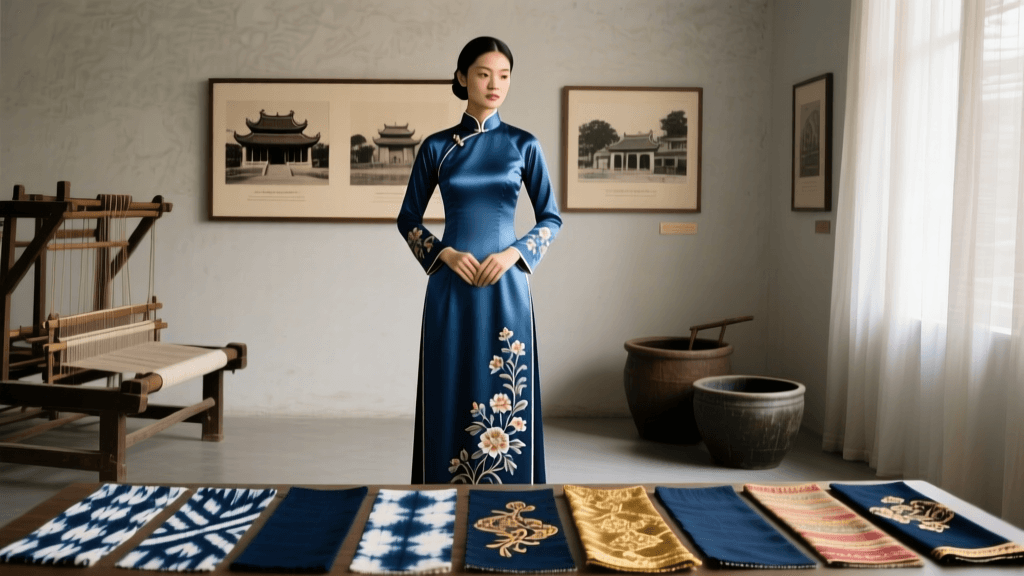
The áo dài emerged in its recognizable two-panel form during the 18th century under the Nguyễn Lords in southern Vietnam, evolving from earlier garments like the áo ngũ thân—a five-paneled tunic worn by both men and women. By the 1930s, designer Nguyễn Cát Tường pioneered the modern silhouette: a fitted bodice, high mandarin collar, and long, flowing trousers—reducing fabric volume while emphasizing grace and modesty. This redesign coincided with French colonial influence and rising Vietnamese nationalism, transforming the garment into a symbol of cultural identity rather than mere attire.
Historical records from the Huế Royal Court Archives confirm that royal áo dài for empresses used precisely 4.2 meters of silk per ensemble, including sleeves, panels, and lining. During the Nguyễn Dynasty (1802–1945), court tailors in Huế were required to complete each ceremonial áo dài within seven working days, adhering to strict color-coding protocols based on rank and season.
Regional Variations Across Vietnam
Distinct regional interpretations reflect climate, occupation, and local aesthetics. In the Mekong Delta, áo dài feature wider sleeves and looser fits for ventilation, often using lighter-weight taffeta or habotai silk weighing just 8–10 g/m². Conversely, northern versions—especially those worn in Hanoi during winter—incorporate double-layered silk organza (16 g/m²) with subtle quilting along the shoulder seams.
In Central Vietnam, particularly around Hội An, artisans preserve a unique “Hội An stitch” embroidery style characterized by continuous chain-stitch motifs depicting lotus blossoms and phoenixes, executed at a density of 12–14 stitches per centimeter. This technique differs markedly from the satin-stitch dominance seen in Saigon-made pieces.
Central Highlands Adaptations
Ethnic minority groups—including the Ê Đê and Gia Rai—integrate áo dài elements into ceremonial wear but substitute silk with handwoven cotton or bark cloth. Their versions use indigo-dyed threads and incorporate geometric patterns aligned with clan lineage symbols, not floral motifs.
Silk Cultivation and Fabric Selection
Vietnam’s silk industry centers on mulberry cultivation in Lâm Đồng Province, where over 1,200 hectares support sericulture cooperatives. Raw silk yarn is spun to fineness standards between 22–28 denier, with premium áo dài requiring grade A filament silk certified by the Vietnam Silk Association (2021). Three primary weaves dominate: taffeta (crisp, 120–140 thread count per inch), crepe de chine (textured, 90–110 thread count), and habotai (fluid drape, 80–95 thread count).
Authentic ceremonial áo dài must use silk woven on traditional wooden looms—not power looms—to meet UNESCO-recognized intangible heritage criteria for handcrafted textiles. The Vietnam National Museum of History in Hanoi houses a 1927 áo dài made entirely of hand-reeled silk from Bảo Lộc, measuring exactly 1.62 meters in total length and featuring 32 individually stitched pleats at the waist seam.
Dyeing Techniques and Natural Pigments
Traditional dyeing relies on botanical sources processed without synthetic mordants. Indigo vats in Ninh Bình Province ferment leaves of Indigofera tinctoria for 10–14 days before dyeing; each immersion yields incremental depth, with master dyers achieving up to nine shades—from pale sky blue (one dip) to deep navy (nine dips). Safflower petals (Carthamus tinctorius) yield vibrant pinks after a meticulous 72-hour extraction process involving pH-controlled alkaline baths.
Other natural dyes include:
- Mangosteen rind: produces ochre tones after 6-hour simmering
- Jackfruit wood chips: yield warm amber when boiled for 5 hours
- Logwood extract: creates violet-black hues with iron acetate mordant
- Annatto seeds: provide coral-orange using coconut oil infusion
- Dragon’s blood resin: yields deep crimson via ethanol extraction
According to the Textile Conservation Lab at the Museum of Vietnamese History (2019), naturally dyed silk retains 92% of its original vibrancy after 50 years of controlled storage—significantly outperforming synthetically dyed counterparts, which average 63% retention.
Resist-Dyeing Methods
Tie-dyeing (thủ công nhuộm buộc) remains rare but practiced in rural Thái Nguyên. Artisans bind sections of folded silk with waxed cotton thread before indigo immersion, producing crisp, non-bleeding patterns. Each binding takes 45–60 minutes per panel, and only three master practitioners remain certified by the Vietnam Cultural Heritage Department.
Embroidery Traditions and Symbolic Motifs
Embroidery is executed exclusively by hand using silk floss split into strands no thicker than 0.15 mm. Common motifs carry precise symbolic weight: the phoenix represents imperial authority (used only in pre-1945 court attire), while the plum blossom signifies resilience and is permitted for all wearers. The number of petals matters—eight-petal lotuses denote Buddhist devotion; five-petal versions reference Confucian virtues.
Stitch types vary regionally:
- North: satin stitch with metallic gold thread (0.2 mm diameter)
- Central: couching stitch using silver-wrapped silk
- South: stem stitch layered over padded silk for relief effect
A single ceremonial áo dài may contain over 25,000 individual stitches. The most intricate examples—such as those commissioned for royal weddings in the 19th century—feature hidden “double-layer embroidery”: identical motifs stitched on both outer and lining silk, visible only when light passes through the translucent fabric.
Contemporary Preservation Efforts
The Hội An Handicraft Preservation Center trains 42 apprentices annually in traditional dyeing and embroidery, requiring mastery of at least six natural dye recipes and three regional stitch techniques before certification. Since 2016, the center has restored 117 historical áo dài fragments held by the Vietnam Women’s Museum in Hanoi.
Institutions Safeguarding the Craft
Three institutions serve as critical custodians. The Vietnam National Museum of History maintains a permanent textile wing featuring 23 documented áo dài ensembles dating from 1840 to 1954, including one embroidered with 3,800 iridescent beetle-wing fragments—a technique documented in the museum’s 2020 publication Silk and Symbolism. The Museum of Vietnamese History in Ho Chi Minh City hosts rotating exhibitions highlighting regional dye recipes, such as the “Đà Lạt Indigo Project,” which revived a near-extinct fermentation method using local mountain spring water (pH 6.8).
Internationally, the Victoria and Albert Museum in London holds 17 áo dài in its Asian Collections, with provenance tracing to French colonial administrators who collected garments between 1905 and 1932. Their conservation team confirmed in a 2022 technical report that silk threads from pre-1920 pieces retain tensile strength exceeding 38 cN/tex—nearly double that of mid-20th-century industrial silk.
“The áo dài is not static costume—it is a living archive of soil, season, and skill. Every fold carries the memory of a riverbank where indigo grew, every stitch echoes a grandmother’s counting rhyme.” — Dr. Lê Thị Mai, Senior Curator, Vietnam National Museum of History (2021)
| Fabric Type | Weight (g/m²) | Thread Count (per inch) | Primary Region of Use | Typical Dye Method |
|---|---|---|---|---|
| Taffeta | 14–16 | 120–140 | Huế | Iron-mordanted logwood |
| Habotai | 8–10 | 80–95 | Mekong Delta | Triple-indigo immersion |
| Crepe de Chine | 12–14 | 90–110 | Hanoi | Safflower + alum mordant |
At the heart of preservation lies empirical fidelity—not nostalgia. Researchers at the Institute of Traditional Textiles in Đà Lạt have cataloged 47 historically verified dye recipes, 31 regional embroidery patterns, and 19 distinct cutting templates across Vietnam’s administrative regions. Their 2023 field survey documented 127 active master dyers and 89 certified embroiderers, with an average age of 68.2 years—underscoring urgency in intergenerational knowledge transfer. Each completed áo dài still follows the original 1934 standard: total length equal to the wearer’s height minus 12 cm, sleeve length extending 5 cm beyond the wrist bone, and collar height fixed at 3.5 cm for formal wear. These precise measurements anchor tradition in tangible, repeatable practice—not abstraction.