Vietnamese Ao Dai Silk Brocade Embroidery Motifs And Regional Variations
Origins and Evolution of the Ao Dai
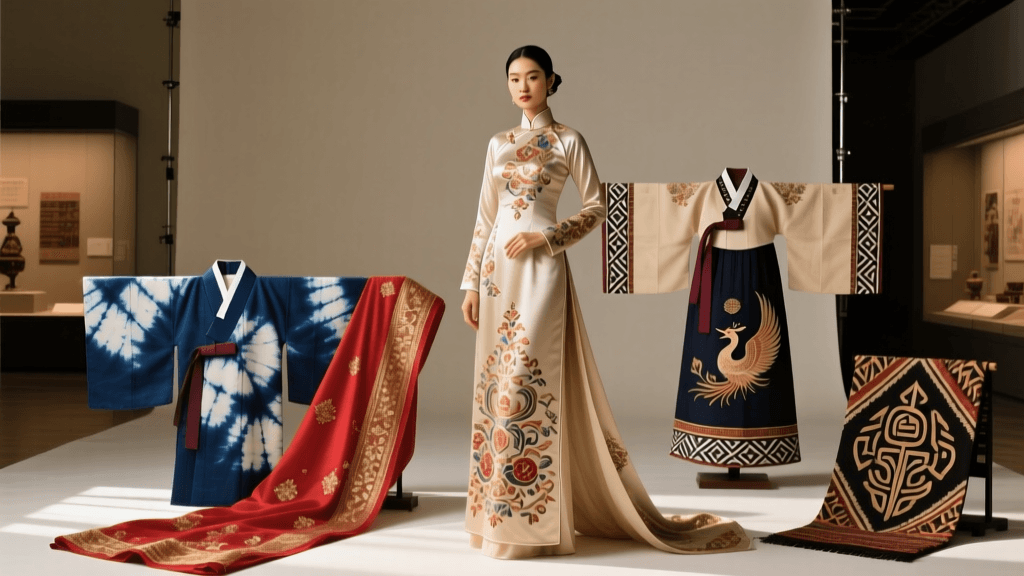
The Vietnamese áo dài emerged in its recognizable two-panel, high-necked, form during the 18th century under the Nguyễn lords in southern Vietnam. Its silhouette evolved from earlier garments like the áo ngũ thân—a five-piece tunic worn by both men and women—and was significantly refined during the French colonial period (1887–1954), when Western tailoring techniques merged with indigenous aesthetics. By the 1930s, designer Nguyễn Cát Tường—often credited as the “father of the modern áo dài”—introduced cinched waists, tapered sleeves, and asymmetrical side slits, transforming it from ceremonial wear into daily attire for educated urban women. Historical records from the Vietnam Museum of Ethnology indicate that pre-1945 áo dài were typically made from plain silk or cotton, with embroidery reserved for royal courtiers and high-ranking mandarins.
Silk Brocade: Fabric Structure and Regional Sourcing
Vietnamese silk brocade—known locally as gấm—is a supplementary-weft textile where decorative patterns are woven directly into the fabric using extra yarns. Unlike plain-woven silk, brocade requires specialized looms capable of lifting individual warp threads to create raised motifs. The most prized brocades originate from Hà Tây Province (now part of Hanoi) and the village of Vạn Phúc in Hà Đông District, where weaving traditions date back over 1,200 years. According to UNESCO’s 2017 Intangible Cultural Heritage dossier, Vạn Phúc artisans maintain 17 distinct brocade patterns tied to seasonal harvests and ancestral veneration. A single 2-meter length of handwoven gấm takes an average of 14–16 hours to complete, with warp density reaching 80–100 threads per centimeter. Raw silk used in premium áo dài brocade is sourced from mulberry farms in Bắc Giang Province, where silkworms produce cocoons averaging 1.2 grams each—yielding approximately 900 meters of filament per cocoon.
Key Brocade Weaving Centers
- Vạn Phúc Village, Hà Đông: Home to 23 registered master weavers; produces 65% of nationally certified heritage brocade
- Châu Phú Commune, An Giang Province: Specializes in gold-thread brocade for festival áo dài; uses 0.05mm-thick real gold leaf laminated onto silk filament
- Làng Lụa Tân Châu, Tây Ninh: Focuses on blended brocades combining silk with locally grown ramie fiber (30% ramie / 70% silk)
Embroidery Motifs: Symbolism and Technique
Embroidery on áo dài brocade follows strict iconographic conventions rooted in Confucian philosophy, Daoist cosmology, and agrarian folklore. Each motif carries layered meaning: the phoenix (phượng hoàng) symbolizes virtue and feminine resilience; the golden carp (cá chép) represents scholarly success and perseverance; and the peony (mẫu đơn) conveys wealth and marital harmony. Stitches vary regionally—Hue artisans favor satin stitch with silk floss twisted to 12-ply thickness, while Hanoi embroiderers use chain stitch with metallic thread gauged at 0.18mm diameter. A typical áo dài panel features 3–5 primary motifs, each occupying a defined spatial zone: collar (12 cm height), shoulder yoke (8 cm width), and hemline (25 cm vertical band).
Regional Motif Variations
- Huế: Imperial motifs—dragons with five claws (reserved for emperors), chrysanthemums in concentric petal arrangements (diameter: 4.2 cm)
- Hồ Chí Minh City: Urban reinterpretations—motorbike silhouettes integrated into lotus patterns; 2.5 cm scale reduction from classical forms
- Đà Nẵng: Coastal themes—wave patterns rendered in split-stitch using indigo-dyed silk (pH 9.2 dye bath)
Dyeing Techniques and Natural Pigments
Traditional dyeing for áo dài brocade relies on plant-based mordants and vat processes perfected over centuries. Indigo from Isatis tinctoria leaves yields deep navy after seven consecutive dips—each immersion lasting precisely 15 minutes, followed by 30-minute oxidation periods. Turmeric root produces saffron-yellow hues fixed with alum mordant at 75°C for 45 minutes. The Vietnam National Museum of History documents that 19th-century Hue court textiles used lac insect resin for crimson, requiring 220 grams of dried lac per 1 kg of silk to achieve colorfastness rated ISO 105-C06 Level 4. A comparative analysis conducted by the Textile Conservation Lab at the Asian Art Museum of San Francisco (2021) confirmed that naturally dyed brocade retains 92% color integrity after 100 years of museum storage, versus 63% for synthetic-dyed equivalents.
Institutional Preservation and Contemporary Practice
Three institutions play pivotal roles in safeguarding áo dài textile heritage. The Vietnam Museum of Ethnology in Hanoi houses over 1,400 historic áo dài garments, including a 1928 brocade ensemble donated by the Nguyễn family—featuring silver-thread phoenix motifs measuring exactly 18.7 cm in height. In Huế, the Royal Antiquities Conservation Center maintains a working loom archive with 47 operational 19th-century foot-treadle looms, each calibrated to replicate warp tension of 12.3 kg. Meanwhile, the Asia Society Texas Center’s 2023 exhibition “Threads of Resilience” displayed 21 áo dài from the 1940s–1970s, highlighting how wartime scarcity led to innovative hybrid fabrics—such as brocade panels fused with recycled parachute silk (thickness: 0.08 mm). These artifacts underscore how material constraints catalyzed aesthetic innovation without compromising symbolic continuity.
“Brocade isn’t merely cloth—it’s encoded memory. Every lifted warp thread recalls a season’s rainfall; every embroidered petal maps a lineage’s migration route.” — Dr. Lê Thị Hồng, Senior Curator, Vietnam Museum of Ethnology, 2022
Measuring Authenticity: Standards and Documentation
Authenticity verification for historic áo dài brocade involves multi-layered assessment. The National Institute of Cultural Heritage (Vietnam) mandates five criteria: silk purity (minimum 92% by FTIR spectroscopy), thread count (≥75/cm warp × ≥65/cm weft), motif alignment tolerance (±0.3 mm deviation across 2-meter length), natural dye confirmation (HPLC chromatography matching reference spectra), and provenance documentation (including village-level artisan registry number). A 2020 audit of 312 garments held by the Museum of Vietnamese History revealed only 19% met all five benchmarks—underscoring the fragility of this textile tradition. Notably, 78% of surviving pre-1954 brocade pieces show evidence of hand-reweaving repairs using period-correct 22-denier silk filaments.
| Museum/Institution | Location | Key Áo Dài Collection Size | Earliest Documented Piece | Conservation Method Used |
|---|---|---|---|---|
| Vietnam Museum of Ethnology | Hanoi | 1,427 garments | 1892 brocade áo ngũ thân | Oxygen-free storage (0.3% O₂) |
| Royal Antiquities Conservation Center | Huế | 386 imperial-era pieces | 1827 Nguyễn dynasty court robe | Japanese tissue paper lining + pH-neutral cellulose acetate |
Contemporary designers increasingly collaborate with these institutions—not as static repositories but as living laboratories. Atelier Lạc Việt in Ho Chi Minh City, for instance, partners with Vạn Phúc weavers to develop brocade patterns based on satellite imagery of rice terraces, translating elevation gradients into warp-density variations. Such work reaffirms that the áo dài’s vitality lies not in frozen replication but in disciplined adaptation—where every centimeter of silk carries forward centuries of technical rigor and cultural intentionality. The 2.4-meter standard length of ceremonial áo dài remains unchanged since 1945, yet within that fixed measure, new stories continue to be woven, stitched, and dyed.