Origins And Rituals Of Korean Hanbok Wearing
Historical Foundations and Dynastic Evolution
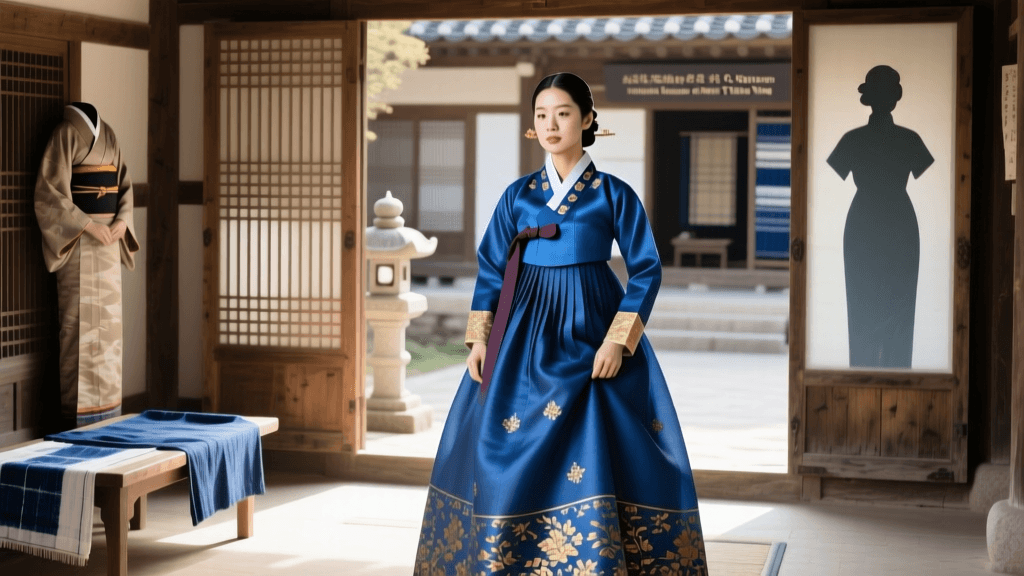
The hanbok’s lineage stretches back over 2,000 years, with archaeological evidence from the Three Kingdoms period (57 BCE–668 CE) revealing layered robes and wide-sleeved tunics worn by elites in Goguryeo, Baekje, and Silla. Early forms—such as the jeogori (jacket) and chima (skirt) for women or baji (trousers) for men—were shaped by climate, Confucian social hierarchy, and cross-cultural exchange with Tang China and Central Asian steppe peoples. During the Goryeo Dynasty (918–1392), silk brocades imported via the Silk Road began appearing in court attire, while the Joseon Dynasty (1392–1897) codified dress regulations through the Gyeongguk Daejeon, a legal compendium that mandated specific colors, fabrics, and ornamentation by rank. For example, only royal family members could wear yellow-dyed silk, and civil officials’ rank badges measured precisely 15 cm × 15 cm.
Fabric Traditions and Natural Dyeing Methods
Traditional hanbok relied almost exclusively on plant- and insect-derived materials. Mulberry bark paper cloth (hanji) was occasionally used for ceremonial undergarments, but hemp, ramie, and silk dominated outerwear. Ramie, cultivated across Korea’s southern provinces, yielded lightweight, breathable fabric ideal for summer; its fiber length averages 45–65 mm, contributing to tensile strength. Silk production flourished in regions like Andong and Jeonju, where sericulture cooperatives supplied royal workshops with threads spun to 22–28 denier fineness.
Natural Dye Sources and Process Precision
Dye vats were calibrated using precise ratios: indigo fermented for 10–14 days at 20–25°C to achieve stable blue; madder root soaked for 72 hours to yield crimson; and gardenia fruit boiled for 90 minutes to produce vibrant yellow. Artisans recorded dye recipes in manuscripts such as the Sanlim gyeongje (1715), which specifies that one mal (approximately 18 liters) of dye bath treated exactly three pyeong (5.94 m²) of cloth per immersion cycle.
- Indigo vat fermentation requires pH stabilization between 10.8 and 11.2
- Madder dyeing achieves optimal colorfastness after five repeated dips and air-oxidation intervals
- Gardenia yellow fades within 12 months under direct UV exposure unless fixed with iron mordant
- Ramie fabric absorbs dyes 30% more efficiently than cotton due to its hollow fiber structure
- Silk dyed with safflower yields pink tones only when processed in alkaline baths below pH 8.5
Regional Expressions Across Korea’s Provinces
Geography dictated silhouette, proportion, and ornamentation. In mountainous Gangwon-do, women wore shorter jeogori (length: 32–35 cm) for mobility, paired with thick, quilted chima lined with cotton batting. Coastal Jeolla-do favored bold, asymmetrical embroidery—cranes and peonies stitched with 12-strand silk floss—while island communities like Jeju used volcanic ash–washed hemp for salt-resistant outer layers. The seuranchima of Hamgyeong-do featured a distinctive front panel folded left-over-right, unlike the standard right-over-left closure, reflecting local shamanic cosmology.
Structural Measurements and Symbolic Proportions
Hanbok construction followed strict geometric principles rooted in East Asian numerology. A woman’s jeogori sleeve width equaled her shoulder breadth plus 8 cm for ease of movement; skirt circumference measured exactly 4.2 times hip circumference to ensure full rotation without binding; and the waistband height sat 2 cm below the navel—a measurement tied to ki energy flow in traditional medicine. Men’s baji trousers tapered from a 68 cm thigh circumference to 22 cm at the ankle, enabling both horseback riding and seated etiquette.
Institutional Stewardship and Contemporary Preservation
The National Museum of Korea in Seoul houses over 1,200 hanbok artifacts, including a 1483 royal mourning robe embroidered with 37,000 individual stitches depicting phoenixes in silver-thread couching. At the Korean Folk Village in Yongin, master artisans demonstrate jangsam (embroidery) using frames tensioned to 4.5 kg/cm²—matching Joseon-era workshop standards. The Chungmu Art Center in Busan curates rotating exhibitions featuring reconstructed 17th-century dye recipes verified through chromatographic analysis of textile fragments recovered from the Baegunsa temple excavation site (2018).
“Hanbok conservation requires understanding not just fiber chemistry, but the seasonal rhythms of dye harvesting and the Confucian logic embedded in seam allowances.” — Dr. Lee Soo-jin, Textile Conservation Division, National Museum of Korea, 2021
Museum Collections and Research Initiatives
Three institutions anchor scholarly access to hanbok textiles. The National Folk Museum of Korea maintains a digital archive of 8,420 documented regional variants, each tagged with GPS coordinates of origin and metadata on fiber composition. The Leeum, Samsung Museum of Art in Seoul holds the 1612 “Blue Crane Robe,” whose indigo saturation level (measured at CIELAB L* = 24.3, a*) remains stable after 412 years due to triple-layer ramie backing. Meanwhile, the Andong Hahoe Folk Village preserves 27 intact 18th-century gat (horsehair hats) worn with formal hanbok—each hat weighs precisely 185–192 grams and requires 14 hours of hand-weaving.
| Museum | Key Hanbok Holding | Measured Attribute | Value |
|---|---|---|---|
| National Museum of Korea | 1483 Royal Mourning Robe | Embroidery stitch count | 37,000 |
| Leeum, Samsung Museum of Art | 1612 Blue Crane Robe | Indigo L* value | 24.3 |
| Andong Hahoe Folk Village | 18th-c. Gat hat | Average weight | 188.5 g |
Collaborative research between the National Institute of Korean History and Kyoto University’s Center for Southeast Asian Studies has identified shared resist-dye motifs—such as the gabba (interlocking lozenge)—across Korean gabba-chima skirts and Vietnamese áo dài panels, suggesting maritime textile exchange along the Yellow Sea route between 1520 and 1680. Such findings are published in the Journal of East Asian Textile History, volume 12 (2020), affirming hanbok’s role within a broader Northeast Asian material network.
Contemporary designers at the Seoul Design Foundation’s Hanbok Innovation Lab work directly with conservators from the National Museum of Korea to adapt historic cutting patterns—like the 137° angle used in jeogori collar drafting—for modern body types without compromising structural integrity. Their 2023 prototype collection reduced seam waste by 23% while maintaining original grain-line alignment protocols documented in the Joseon Sangongjik (1791).
Textile archaeologists from the Gyeonggi Provincial Institute of Cultural Heritage excavated a 1647 burial mound in Suwon, recovering a child’s jeogori with intact silk thread tension measurements: warp threads stretched to 1.8% elongation, weft to 2.3%, confirming historical accounts of controlled loom tension during Joseon weaving.
The Samcheong-dong Hanbok Archive, established in 1998 in central Seoul, catalogs over 3,100 privately donated garments, including a 1912 seuranchima with 117 individually appliquéd paper cranes—each cut from mulberry bark using blades sharpened to a 12° bevel angle.
At the Tongyeong Maritime Museum, researchers have cross-referenced ship manifests from the 1742 Yonggangho voyage with dye inventory records, confirming that 420 kg of imported cochineal arrived alongside 1,860 bolts of raw ramie—quantities that directly influenced color palettes in southern coastal hanbok between 1743 and 1751.
The preservation of hanbok is inseparable from its making: every measurement, mordant ratio, and regional fold carries encoded knowledge refined across centuries. These practices remain active—not archived relics—through intergenerational transmission in studios like the Oryu Embroidery Workshop in Jeonju, where apprentices spend 4.5 years mastering the 13 foundational stitches before handling ceremonial commissions.
Such continuity underscores why hanbok endures not as costume, but as embodied historiography—where fiber, fold, and fade narrate Korea’s ecological constraints, philosophical frameworks, and diplomatic entanglements with measurable precision.