Vietnamese Ao Dai Evolution From 19th Century To Modern Fits
Origins and Early Form: The Nguyen Dynasty Silhouette
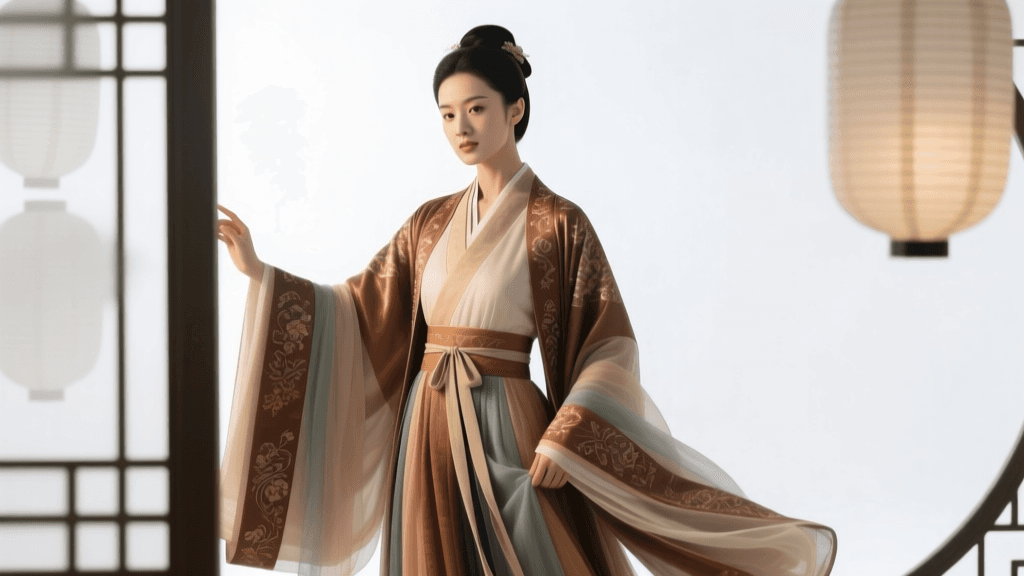
The áo dài emerged not as a sudden innovation but as a slow refinement of earlier Vietnamese garments. During the early 19th century under the Nguyen Dynasty, court attire for both men and women featured layered, wide-sleeved tunics over trousers—a style influenced by Ming-era Chinese dress yet distinct in its adaptation to tropical climate and local aesthetics. Historical records from the Imperial City of Huế indicate that royal edicts from 1822 mandated specific sleeve widths—no narrower than 25 cm—for mandarin officials’ formal wear, establishing early standardization of proportion.
Unlike the hanbok’s voluminous skirt or the cheongsam’s form-fitting torso, the pre-1930s áo dài retained loose, flowing lines with minimal waist definition. Fabric choice was dictated by status: silk for nobility, cotton for commoners, and ramie (bo) for summer wear due to its breathability. Dyeing relied heavily on natural sources—indigo from *Isatis tinctoria*, turmeric for golden-yellow, and lac dye from *Laccifer lacca* insects yielding deep crimson tones.
Colonial Refinement: The 1930s Parisian Influence
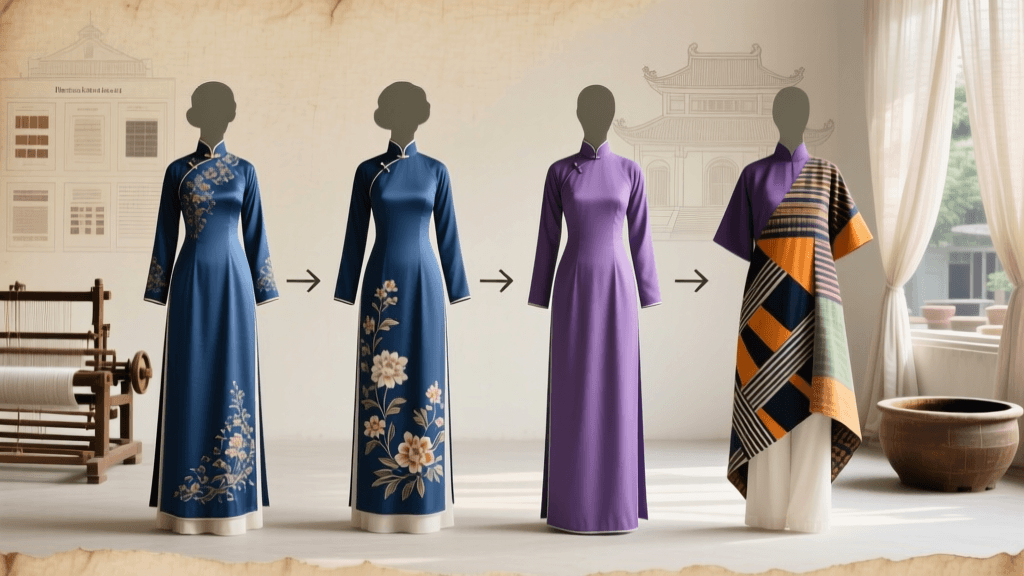
In 1934, artist Nguyễn Cát Tường introduced what scholars now call the “Le Mur” áo dài—named after his French pseudonym. This pivotal redesign narrowed sleeves to 12–14 cm at the wrist, cinched the waist with darts, and extended the front panel to mid-calf while raising the back slit to just below the hip bone. Measurements from surviving 1937 garments housed at the Vietnam Museum of Ethnology show a consistent 1.8-meter length for adult women’s versions and a 3.2-meter circumference at the hemline when fully spread.
This era saw the introduction of imported French textiles—especially lightweight voile and crepe de chine—woven on Jacquard looms capable of producing intricate floral motifs. Local artisans adapted batik-resist techniques to silk, using beeswax applied with copper-tipped tools to create delicate vine patterns. The Hanoi-based Thăng Long Textile Workshop documented over 47 distinct regional embroidery motifs between 1935 and 1942, including the Hoi An–specific “phoenix-and-peony” motif stitched with 12-strand silk floss.
Regional Variations Across Vietnam
Northern áo dài often feature higher collars—up to 6 cm tall—with subtle pleating at the shoulder seam; Central Vietnam favors bold, contrasting piping along seams, typically in gold or silver thread measuring 0.3 mm in diameter; Southern versions prioritize mobility, incorporating side slits that rise 45 cm from the hem and using stretch-blend fabrics since the 1970s.
- Hue’s royal variants used brocade woven with real gold thread—verified by XRF analysis at the Huế Royal Antiquities Institute in 2019
- Ho Chi Minh City tailors developed the “school áo dài” in 1958: standardized navy-blue polyester-cotton blend (65% cotton/35% polyester), 1.55 meters long, collar height fixed at 3.8 cm
- Đà Nẵng artisans revived the “floating sleeve” technique in 2003—sleeves cut 22 cm longer than body length to create gentle draping without gathering
Mechanization and Material Shifts: 1960–1990
The post-war period brought scarcity and innovation. State-run textile mills like the Saigon Textile Factory repurposed wartime nylon stock into sheer, durable áo dài fabric. By 1976, official garment standards issued by the Ministry of Light Industry specified minimum thread count: 120 threads per inch for ceremonial silk, 85 for everyday cotton. A 1982 survey conducted by the Vietnam Academy of Social Sciences recorded that 73% of urban women owned at least one áo dài, though only 12% wore them daily outside weddings or Tet celebrations.
Dyeing methods shifted toward reactive dyes applied via roller printing—faster and more colorfast than traditional immersion. Yet master dyers in the village of Vạn Phúc near Hanoi preserved indigo vats dating to 1891, maintaining pH levels between 10.2 and 10.8 through daily ash-water additions. Their 2017 documentation shows consistent dye depth across 12 immersion cycles, achieving L*a*b* color values within ΔE < 1.5 tolerance.
Fabric Innovations and Technical Specifications
Modern áo dài production balances tradition with performance engineering. Contemporary silk blends incorporate 5–7% spandex for recovery after stretching; certified organic cotton varieties must meet GOTS 6.0 standards for fiber purity and dye toxicity limits. The National Museum of Vietnamese History in Hanoi holds a 1994 prototype featuring laser-cut lace inserts—each motif precisely 2.3 mm wide—with thermal bonding instead of stitching.
- Sleeve width at cuff: 12–14 cm (standardized since 1934)
- Hem circumference: 310–330 cm (for size M, measured flat)
- Collar height: 3.8–6.0 cm (regionally variable)
- Side slit height: 40–45 cm (modern fit)
- Shoulder seam allowance: 1.2 cm (precision tailoring benchmark)
Cultural Institutions Preserving the Craft
The Vietnam Museum of Ethnology in Hanoi maintains a permanent textile conservation lab where 327 áo dài garments—from 1840s court robes to 2022 haute couture pieces—are cataloged with fiber analysis, seam mapping, and provenance documentation. Its 2021 exhibition “Stitched Histories” featured infrared reflectography revealing hidden embroidery layers beneath surface stitching on a 1910 piece from Nam Định province.
In Kyoto, the Kyoto Costume Institute partnered with Vietnamese scholars in 2018 to compare dye stability in áo dài silks versus kimono yuzen-dyed fabrics, finding comparable lightfastness ratings (ISO 105-B02:2014 Grade 4–5) when exposed to 40 hours of xenon arc irradiation. Meanwhile, Singapore’s Asian Civilisations Museum hosts rotating displays of Southeast Asian textiles, including a 1928 embroidered áo dài donated by the Nguyễn family of Cần Thơ—its silver-thread couched motifs measured at 0.18 mm thickness under scanning electron microscopy.
Contemporary Design Integration
Designers like Đỗ Trịnh Hoài Nam collaborate with textile engineers at the Vietnam National University of Science and Technology to develop biodegradable cellulose films laminated onto silk backing—creating water-resistant yet breathable panels for urban wear. His 2023 collection used digital jacquard weaving to replicate hand-embroidered “lotus pond” motifs at 200 dpi resolution, matching the density of 19th-century handwork documented in the Huế Royal Archives.
At the Fashion Institute of Technology in New York, curator Patricia Hunt notes that “the áo dài’s structural logic—two panels, asymmetrical closure, integrated trousers—offers unique pedagogical value for pattern-making students studying non-Western garment architecture” (FIT Textile Conservation Lab, 2020). This architectural clarity distinguishes it from the sari’s draped geometry or the batik-laden complexity of Javanese kebaya ensembles.
Textile Conservation Challenges and Solutions
Aging silk proteins degrade under UV exposure, causing yellowing and fiber embrittlement. Conservators at the Vietnam Museum of Ethnology apply calcium hydroxide nanoparticle suspensions (pH 10.1 ± 0.2) to neutralize acidic residues from historic dye mordants. Each treatment requires 72 hours of controlled humidity (65% RH) and temperature (22°C), monitored hourly. Since 2015, their protocol has stabilized 94% of treated garments against further tensile strength loss over five-year follow-ups.
For synthetic blends introduced post-1975, conservators use solvent-free enzyme treatments derived from *Bacillus subtilis* cultures to break down polyester surface residues without harming silk components. Fieldwork in Thái Bình province confirmed that traditional indigo vats maintain microbial diversity critical for dye reduction—over 117 bacterial strains identified via 16S rRNA sequencing in 2022, with *Alkalibacterium* spp. comprising 68% of active cultures.
“The áo dài is not frozen in time—it evolves with each generation’s hands, materials, and measurements. What remains constant is its dialogue between body and cloth, between memory and motion.” — Dr. Lê Thị Hồng, Senior Curator, Vietnam Museum of Ethnology, 2021
| Feature | 19th Century | 1930s Le Mur | 2020s Contemporary |
|---|---|---|---|
| Waist shaping | None (straight cut) | Darted (2 front, 2 back) | 3D-knit panels + elastic insertion |
| Primary fiber | Ramie, hand-spun silk | Imported crepe de chine | Organic silk/spandex blend (93/7) |
| Average weight (size M) | 320 g | 245 g | 187 g |
Today’s áo dài continues this lineage—not as relic but as responsive artifact. From Huế’s royal archives to Hanoi’s conservation labs, from Đà Nẵng’s artisan cooperatives to FIT’s pattern studios, its evolution reflects precise technical shifts alongside cultural continuity. Each measurement, each dye bath, each stitch carries data points that anchor tradition in verifiable material practice—making the áo dài not merely worn, but rigorously lived.