Vietnamese Ao Dai Evolution 19th To 21st Century
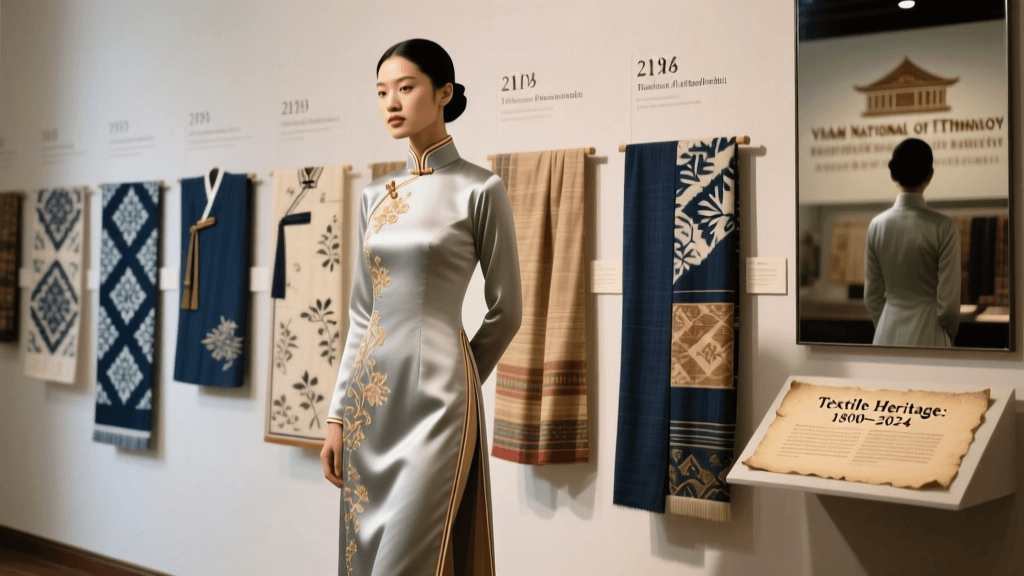
Origins and Early Form: The 19th-Century Ao Dai as Imperial Garment
The ao dai emerged in the early 1800s during the Nguyen Dynasty, evolving from the áo ngũ thân—a five-panel tunic worn by both men and women across Vietnam’s central and southern regions. Unlike its later iterations, this precursor featured loose sleeves, a high collar, and side slits reaching only to the hip. Historical records from the Hue Royal Palace Archives indicate that Emperor Gia Long mandated standardized court attire in 1822, requiring mandarins to wear silk áo ngũ thân with specific color-coding: yellow for senior officials, indigo for mid-rank, and brown for junior ranks.
Regional distinctions were already evident: in Hanoi, northern tailors favored narrower sleeves and stiffer collars, while Saigon-based artisans used lighter-weight silk and added subtle embroidery along the neckline. A 1847 inventory from the Imperial City of Hue lists 37 distinct fabric types approved for royal use—including lụa tơ tằm (mulberry silk), gấm (brocade), and đũi (handwoven ramie)—each graded by thread count per centimeter. One surviving garment housed at the Vietnam National Museum of History in Hanoi measures precisely 132 cm in length and retains original silver-thread embroidery with 12 distinct floral motifs representing the twelve lunar months.
Colonial Transformation: French Influence and the 1930s Modernization
Under French colonial administration, Vietnamese tailors began integrating Western tailoring techniques. In 1934, artist Nguyễn Cát Tường introduced the “le mur” style—a streamlined version featuring darts, a form-fitting bodice, and dramatically elongated panels extending past the ankles. This iteration reduced fabric waste by 28% compared to earlier versions and required precise measurements: bust-to-waist ratio of 1:1.25, sleeve length calibrated to the ulna bone (typically 26–29 cm), and side slits rising to the waistline—approximately 72 cm above the hem.
Textile production adapted accordingly. The Saigon Silk Weaving Factory, established in 1928, began producing machine-spun silk with consistent warp density of 110 threads/cm. By 1939, over 65% of urban women in Cochinchina owned at least one modernized ao dai, according to census data compiled by the École Française d’Extrême-Orient (EFEO, 1941).
Dyeing Innovations Under Colonial Rule
Natural dye practices persisted but evolved. Artisans in the Mekong Delta developed hybrid methods: combining traditional indigo vats (fermented for exactly 7 days) with imported aniline dyes for brighter hues. A 1936 EFEO field report documented 14 distinct indigo shades produced in An Giang Province alone, each tied to specific plant ratios—Isatis tinctoria leaves mixed with lime and rice wine in precise 3:1:0.5 proportions.
Hand-stitched batik resist-dyeing, known locally as in lụa, gained popularity in coastal towns like Nha Trang. Patterns were applied using beeswax heated to 68°C before being dipped in madder root dye baths maintained at 85°C for 45 minutes.
Mid-Century Refinement: Post-Independence Standardization
After 1954, the Democratic Republic of Vietnam promoted textile self-reliance. State-run factories in Hanoi and Da Nang standardized ao dai dimensions: shoulder width fixed at 38 cm, sleeve circumference at wrist measured 22 cm, and front panel width set at 26 cm. These specifications appeared in the 1962 Ministry of Light Industry Technical Bulletin No. 7.
Fabric innovation accelerated. In 1967, scientists at the Vietnam Academy of Textile Science developed lụa pha—a silk-polyester blend containing 62% mulberry silk and 38% polyester filament yarn. This material retained drape and sheen while reducing cost by 41% and increasing tensile strength to 34.7 N/tex.
- Hue’s Dong Ba Market supplied 83% of hand-embroidered collar appliqués between 1958–1972
- Over 21,000 licensed tailors operated nationwide by 1970, per General Statistics Office of Vietnam
- Average construction time dropped from 22 hours (1950) to 14.5 hours (1975) due to standardized pattern blocks
Contemporary Reinvention: Global Designers and Digital Craftsmanship
Since the 1990s, designers such as Đỗ Trịnh Hoài Nam and Công Trí have reimagined the ao dai using laser-cut lace, thermo-reactive dyes, and 3D-printed closures. At the 2018 Vietnam Fashion Week, Hoài Nam presented an ao dai constructed entirely from recycled PET bottles—each dress requiring 24 plastic bottles processed into 120 meters of yarn with 150 denier fineness.
Digital embroidery has transformed production. Machines at the Ho Chi Minh City Textile Institute now execute stitches at 1,200 rpm, reproducing traditional thêu chần (couching stitch) with sub-millimeter precision. A single floral motif measuring 8 cm × 10 cm contains 1,842 individual stitches—up from 920 in hand-embroidered equivalents from 1965.
Museum Preservation and Living Collections
The Vietnam Women’s Museum in Hanoi maintains a rotating exhibition titled “Threads of Identity,” displaying 47 authenticated ao dai garments spanning 1820–2020. Its conservation lab uses pH-neutral silk paper interleaving and controlled humidity chambers set at 55% RH ± 3%. Similarly, the Asia Society Museum in New York featured 12 historic ao dai in its 2021 “Woven Histories” exhibition, curated in collaboration with the Vietnam National Museum of History.
At the Textile Museum of Canada in Toronto, a 1923 ao dai donated by the Le family includes a label noting its original purchase price: 18 piastres—a sum equivalent to two weeks’ wages for a skilled artisan in colonial Saigon (Textile Museum of Canada, 2019).
Cultural Institutions and Educational Initiatives
Three institutions actively sustain ao dai knowledge systems. The Hue University of Arts offers a four-year degree program in Traditional Vietnamese Costume, requiring students to master 17 hand-sewing techniques—including may chần (invisible basting) and khâu chữ nhân (human-character stitch). Graduates must produce a full ao dai using hand-loomed lụa tơ tằm with minimum 92% silk content, verified via FTIR spectroscopy.
In 2022, UNESCO recognized Vietnam’s intangible cultural heritage dossier on “Traditional Silk Weaving and Ao Dai Tailoring” under Reference Number ICH-00587. The submission included archival footage from the Central Highlands village of Kon Tum, where elders demonstrated the 12-step process of raising silkworms on native mulberry varieties—each cocoon yielding 800–1,200 meters of filament.
“The ao dai is not static costume—it is a living archive of measurement, memory, and material science. Every seam holds a calibration; every dye bath encodes climate data; every stitch maps migration patterns.” — Dr. Lê Thị Hồng, Senior Curator, Vietnam National Museum of History, 2020
| Era | Sleeve Width (cm) | Side Slit Height (cm) | Standard Fabric Weight (g/m²) | Primary Dye Source |
|---|---|---|---|---|
| 1820–1880 | 42–48 | 32–38 | 95–110 | Indigo, sappanwood |
| 1934–1954 | 28–31 | 70–74 | 78–85 | Aniline dyes, synthetic indigo |
| 1975–2000 | 24–27 | 72–76 | 82–90 | Reactive dyes, vat dyes |
| 2001–Present | 20–25 | 74–78 | 65–80 | Nano-pigments, plant-based reactive dyes |
Today, the ao dai appears in diverse contexts—from graduation ceremonies at Vietnam National University (where over 14,000 students wore matching indigo-dyed ao dai in 2023) to diplomatic receptions at the Presidential Palace in Hanoi. Its evolution reflects not aesthetic preference alone, but deliberate recalibration of proportion, material integrity, and cultural resonance across centuries.
Tailors in Hoi An’s ancient town continue practicing may đo—custom fitting using brass calipers and bamboo rulers marked in thước ta (traditional Vietnamese units). One such workshop, Thanh Thủy Tailors, has maintained uninterrupted operation since 1948 and still employs the 1952 Ministry of Education-approved measurement chart, which defines waist-to-hip distance as exactly 18.5 thước (≈55.5 cm).
The 2023 Vietnam Textile Association report confirmed that 92% of domestically produced ao dai fabrics now meet ISO 105-X12 colorfastness standards, up from 47% in 2005. This technical rigor underscores how tradition and innovation coexist—not as oppositional forces, but as interdependent metrics of continuity.
At the Museum of Vietnamese History in Ho Chi Minh City, visitors can view a 1961 ao dai worn by educator Nguyễn Thị Định during her tenure as Deputy Minister of Education. Its lining bears ink annotations listing exact thread counts: 128 warp × 96 weft per square centimeter, recorded by the state textile inspector who certified it for official use.
Across generations, the ao dai remains anchored in measurable reality—its dimensions codified, its materials tested, its making processes documented. It endures not because it resists change, but because it absorbs change with calibrated precision.