Miao Traditional Dress: Guizhou Provincial Folk Garments And Silver
The Living Textile Archive of Guizhou
The Miao (Hmong) people of southwestern China possess one of the most complex and visually stunning sartorial traditions in Asia. Unlike the standardized silhouettes of Han Chinese historical dress, Miao traditional clothing is deeply provincial, serving as a wearable archive of clan history, regional identity, and spiritual belief. In Guizhou province alone, over 100 distinct regional variations of Miao folk dress exist, each defined by unique embroidery stitches, indigo-dyeing techniques, and silver ornamentation. For textile collectors, cultural travelers, and fashion historians, understanding the nuances of Guizhou's provincial Miao dress offers a masterclass in indigenous craftsmanship and regional folk art.
Anatomy of the Miao Folk Outfit
A complete Miao festival ensemble is a triumph of textile engineering and metallurgy. The outfit is generally composed of three core elements: the pleated skirt, the embroidered jacket, and the silver regalia.
The Baizhequn (Hundred-Pleat Skirt)
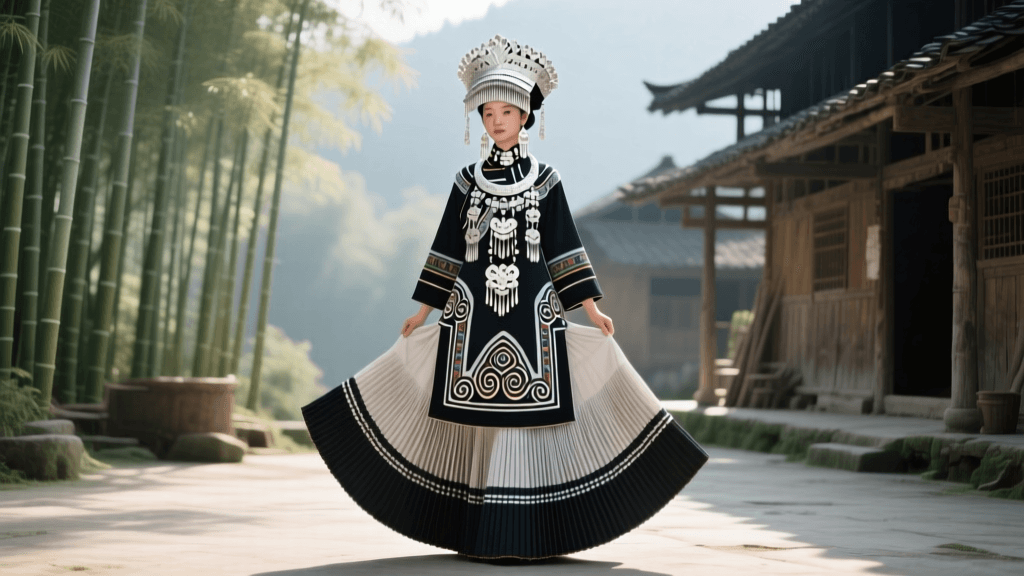
The baizhequn is a masterpiece of structural textile design. Crafted from hand-woven cotton or hemp, the fabric is repeatedly dipped in fermented indigo vats until it achieves a deep, metallic navy-blue hue. Artisans then fold the fabric into 500 to 1,000 microscopic pleats, using straw threads and natural resins to set the folds. The skirt is typically wrapped around the waist and secured with long, woven cotton ties rather than buttons or zippers. The stiffness of the indigo-dyed fabric allows the skirt to flare out dramatically during the rhythmic stepping of the Lusheng (bamboo pipe organ) dances.
The Xiangxiu Embroidered Jacket
Miao embroidery, or xiangxiu, is renowned for its raised, three-dimensional texture. The most prized technique is the double-needle locking stitch, which creates a dense, braided surface that is highly resistant to wear. Motifs are rarely purely decorative; they are mythological. The 'Butterfly Mother' (Mais Bangx Mais Lief), the mythical ancestor of the Miao people, is a ubiquitous motif, alongside water buffaloes, dragons, and birds. According to The Metropolitan Museum of Art, these garments function as historical texts for a culture that traditionally lacked a written script, encoding migration routes and clan lineages into the threads of the jacket's collar and sleeves.
Silver Craftsmanship and Headdresses
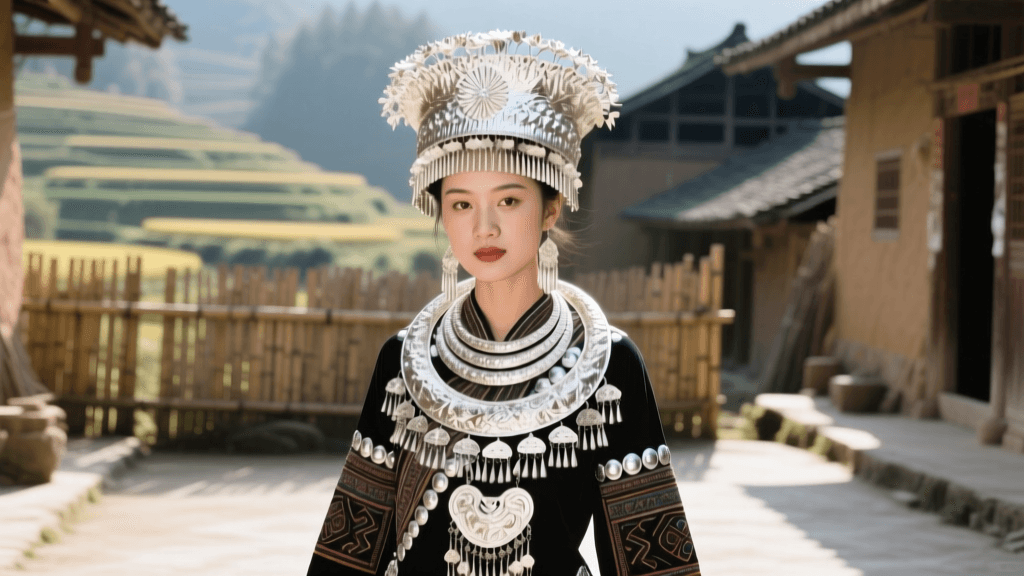
Silver represents wealth, spiritual protection, and social status in Miao culture. A full festival headdress can feature towering silver horns, hairpins, and dangling floral combs. The chest is adorned with heavy, multi-layered neck rings and intricate chest plates featuring repoussé dragons and phoenixes. Silversmithing is a male-dominated craft passed down through generations, requiring mastery of wire-drawing, filigree, and hammering.
Indigo Dyeing and Batik (Laran)
Before embroidery begins, the base fabric must be prepared. Miao batik (laran) utilizes a brass-tipped stylus to apply melted beeswax to raw cotton. The fabric is then submerged in vats of fermented indigo (derived from the Persicaria tinctoria plant). Once the desired depth of blue is achieved, the fabric is boiled to remove the wax, revealing intricate white geometric and floral patterns against the indigo background. The fermentation of the indigo vat is a closely guarded village secret, often requiring the addition of rice wine, wood ash, and specific herbs to maintain the dye's vitality.
Regional Variations Across the Province
Guizhou's mountainous terrain has historically isolated Miao communities, leading to hyper-localized fashion dialects. Below is a comparison of four major provincial variations.
| Region | Key Garment Feature | Dominant Motif | Avg. Silver Weight |
|---|---|---|---|
| Xijiang (Leishan) | Long pleated skirt, massive horned headdress | Water buffalo, dragons | 5 - 10 kg |
| Danzhai | Short pleated skirt, heavy wax-resist batik aprons | White pheasants, geometric spirals | 2 - 4 kg |
| Rongjiang | Trousers instead of skirts, apron-focused embroidery | Ancestral figures, river maps | 1 - 3 kg |
| Huishui | Multi-layered batik skirts, shoulder capes | Butterfly Mother, stars | 3 - 5 kg |
Actionable Guide: Sourcing, Sizing, and Wearing
For collectors, travelers, and designers looking to source authentic Miao provincial garments, navigating the markets of Guizhou requires specific knowledge regarding measurements, costs, and timing.
Measurements and Sizing Guide
Traditional Miao garments are remarkably adaptable, relying on wrapping and tying rather than tailored seams.
- Pleated Skirts: Usually one-size-fits-all. The waistband measures roughly 100-120 cm in total length, designed to wrap around the waist 1.5 times and tie securely. The length is universally modest, typically falling between 55 cm and 65 cm from the waist to the mid-calf.
- Jackets: Cropped and boxy. Expect a back length of 50-60 cm. The sleeves are often wide and straight, measuring 20-25 cm in width at the cuff, designed to be pushed up to the elbow to reveal heavily embroidered inner cuffs.
- Aprons: Worn over the skirt, front aprons typically measure 45 cm wide by 60 cm long, secured by woven ties that wrap to the back.
Cost Breakdown and Authenticity Checks
The market is flooded with machine-embroidered, chemically dyed tourist replicas. Authentic provincial folk dress commands a premium. As noted in cultural heritage reports by Sixth Tone, the revival of traditional craftsmanship has created a tiered market for authentic textiles.
- Authentic Silver Headdress: 15,000 - 40,000 RMB ($2,100 - $5,500 USD). Test: Real Miao silver is often an alloy of 60-80% silver mixed with copper for structural integrity. It should feel heavy, have a slightly muted luster (not blindingly white like plated brass), and emit a dull thud rather than a high-pitched ring when tapped.
- Hand-Embroidered Indigo Jacket: 1,500 - 4,500 RMB ($210 - $625 USD). Test: Inspect the reverse side of the embroidery. Hand-stitched locking loops will look nearly as neat on the back as the front. Machine embroidery will show a continuous, messy bobbin thread.
- Authentic Batik Skirt: 800 - 2,000 RMB ($110 - $280 USD). Test: Look for 'ice cracks'—fine, web-like lines of blue dye that seeped into micro-fractures in the beeswax. Chemically printed replicas lack these organic imperfections.
Timing Your Visit and Purchase
To witness these garments in their intended context and to find the best antique and newly crafted pieces, time your visit to coincide with regional festivals and market days.
- Sisters' Meals Festival (Mid-April, Lunar Calendar): Held primarily in the Taijiang and Kaili regions, this is the premier event for viewing elaborate silver regalia and courting garments. Local markets in the weeks leading up to the festival are flooded with high-quality silver and textiles.
- Lusheng Festival (Autumn, post-harvest): Celebrated across Danzhai and Leishan, this festival highlights the pleated skirts and heavy indigo garments designed for vigorous dancing.
- Kaili Weekend Market: The provincial capital's weekend markets remain the most reliable hub for sourcing vintage textiles, raw indigo, and commissioning silversmiths directly.
Preserving the Heritage
The survival of Miao provincial dress is inextricably linked to the economic empowerment of rural women. Organizations and cooperatives across Guizhou are now leveraging global interest in sustainable, slow fashion to preserve these techniques. By purchasing directly from village cooperatives in Xijiang or Danzhai, buyers ensure that the meticulous art of indigo fermentation and double-needle embroidery remains a viable livelihood. As documented by National Geographic, the integration of traditional Miao craftsmanship into contemporary ethical fashion markets is providing a vital lifeline to these ancient, mountain-bound communities, ensuring that the wearable archives of Guizhou continue to evolve rather than fade into museum displays.