The Ultimate Guide to Qun Kwa Chinese Wedding Jackets
The Heritage of the Qun Kwa (裙褂)
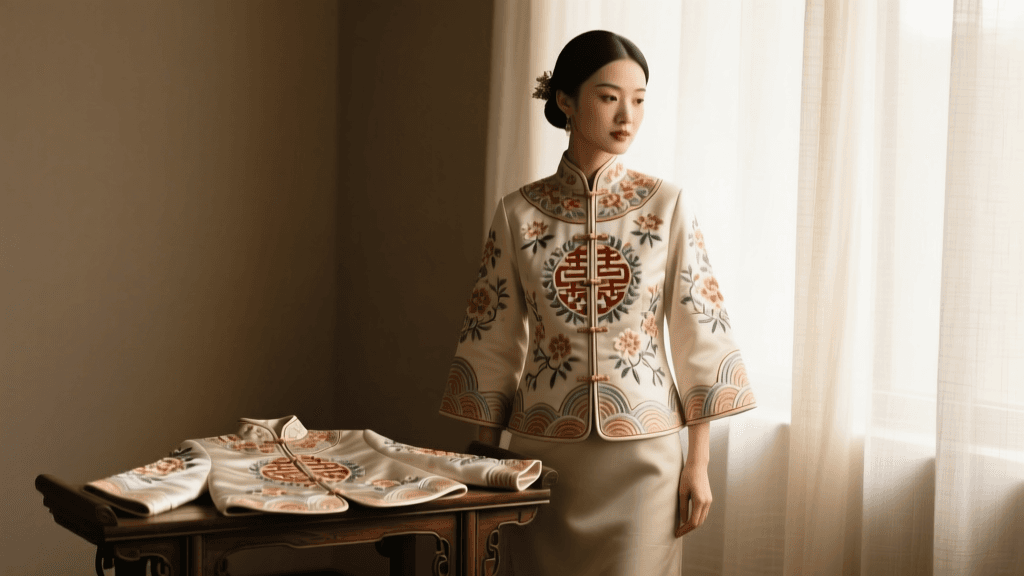
When exploring the rich tapestry of Asian wedding traditions, few garments command as much reverence and visual splendor as the Qun Kwa (裙褂), also widely known as the Long Feng Gua (龙凤褂). Originating in the Guangdong province of Southern China, this exquisite two-piece ceremonial attire has transcended its regional roots to become a staple in modern Chinese weddings worldwide. Unlike the flowing, robe-like silhouettes of the traditional Hanfu or the form-fitting elegance of the Shanghai qipao, the Qun Kwa is characterized by its structured, boxy jacket and straight, ankle-length skirt, entirely lavished in intricate metallic embroidery.
Historically, the Qun Kwa was a symbol of immense familial wealth and status. During the Qing Dynasty, the intricate embroidery techniques required to produce these garments were closely guarded secrets of the imperial courts before eventually making their way into the hands of master artisans in Guangzhou and Chaozhou. Today, the Qun Kwa remains a vital component of the traditional Chinese tea ceremony, serving as a bridge between ancestral heritage and contemporary matrimonial celebrations.
Decoding the Dragon and Phoenix (Long Feng) Motif
The most iconic iteration of this garment is the Long Feng Gua, which translates directly to the "Dragon and Phoenix Jacket." In traditional Chinese cosmology, the dragon represents the groom, embodying yang energy, power, and success. Conversely, the phoenix represents the bride, symbolizing yin energy, grace, and virtue. When depicted together, the dragon and phoenix represent the ultimate harmony of yin and yang, a perfect marital union blessed by the heavens.
However, the dragon and phoenix are rarely alone. Master embroiderers weave a secondary lexicon of auspicious symbols into the negative space of the garment:
- Bats (蝠): The Chinese word for bat sounds identical to the word for "good fortune." Five bats often surround a central motif to represent the "Five Blessings" of longevity, wealth, health, virtue, and a peaceful death.
- Peonies (牡丹): Known as the "king of flowers," peonies symbolize honor, wealth, and feminine beauty.
- Pomegranates (石榴): Bursting with seeds, pomegranates are a discreet but powerful wish for the couple to have many children and a flourishing family tree.
- Lotus (莲花): Rising unsullied from muddy waters, the lotus represents purity, spiritual awakening, and a harmonious marriage.
"A mother's love is woven into every stitch of the Kwa, a silent blessing for her daughter's new journey into womanhood and marriage."
— Traditional Cantonese Proverb
The Craftsmanship: Yue Embroidery and the Maternal Tradition
The creation of a genuine Qun Kwa relies heavily on Yue Embroidery (Guangdong Embroidery), one of the four major styles of Chinese needlework. According to the Victoria and Albert Museum, Chinese embroidery is distinguished by its use of brilliantly colored silk threads and complex stitching techniques that create a raised, three-dimensional effect. In the context of the Qun Kwa, artisans use gold and silver threads wrapped around a silk core, employing the "pad stitch" to make the dragons and phoenixes appear as though they are leaping off the red silk base.
Historically, a bride's mother would begin embroidering her daughter's Kwa the day the daughter was born. This painstaking process could take years, serving as a physical manifestation of maternal love and a dowry of immense value. While modern brides rarely sew their own garments, the tradition of passing down heirloom Kwas from mother to daughter remains a deeply emotional cornerstone of Southern Chinese wedding culture.
The Five Grades of Kwa: A Buyer’s Comparison Chart
When shopping for a Qun Kwa, buyers are often confused by the pricing disparities. The value of a Kwa is not determined by the brand, but by the embroidery density—the percentage of the red silk base that is covered by gold and silver thread. The Metropolitan Museum of Art notes that the mastery of Chinese textiles is often judged by the density and complexity of the weave and surface ornamentation. Below is the industry-standard grading system used by master tailors and bridal boutiques.
| Grade Name | Embroidery Density | Visual Characteristics | Price Tier & Best For |
|---|---|---|---|
| Xiao Wu Fu (小五福) | ~30% | Red silk is highly visible; motifs are spaced out. | Budget-Friendly. Ideal for rentals or secondary outfits. |
| Zhong Wu Fu (中五福) | ~50% | Balanced ratio of red silk to metallic thread. | Mid-Range. A popular choice for modern brides on a budget. |
| Da Wu Fu (大五福) | ~70% | Rich metallic sheen; red silk is mostly obscured. | Premium. Excellent for high-quality photography and heirlooms. |
| Gua Huang (褂皇) | ~95-100% | No red silk visible; entirely covered in gold/silver. | Luxury/Heirloom. Custom orders only; massive investment. |
| Xiu He Fu (秀禾服) | Varies (Usually <30%) | Looser fit, multi-colored threads (not just gold/silver). | Accessible. Popular for pre-wedding shoots and tea ceremonies. |
Practical Guide: Renting vs. Buying Your Wedding Kwa
Cost Breakdown and Timing
Deciding whether to rent or buy your Long Feng Gua depends on your budget, your desire for an heirloom, and the grade of embroidery you covet. A genuine, hand-embroidered Gua Huang can take up to a year to complete by a single master artisan and can cost upwards of $20,000 to $50,000 USD. Conversely, machine-embroidered replicas or lower-grade hand-stitched options are much more accessible.
- Renting: Expect to pay between $200 and $800 USD for a 3-day rental package. This is highly recommended for brides who want the visual impact of a Da Wu Fu or Gua Huang without the exorbitant upfront cost. Timing: Secure your rental 3 to 4 months before the wedding to ensure your size and preferred grade are available.
- Buying (Hand-Embroidered): A custom Da Wu Fu starts around $3,000 USD, while a true Gua Huang starts at $15,000 USD. Timing: You must place your order 8 to 12 months in advance to allow artisans adequate time for hand-stitching.
- Buying (Machine-Embroidered): Ranging from $300 to $1,000 USD, these are mass-produced but visually striking from a distance. Timing: Can be purchased off-the-rack 1 to 2 months prior to the wedding.
Essential Measurements for a Custom Kwa
Unlike Western wedding gowns that corset and contour to the body, the Qun Kwa is designed with a structured, modest, and slightly boxy silhouette. It is meant to drape elegantly rather than cling. If you are ordering a custom piece or having a rental tailored, provide your tailor with the following precise measurements:
- Shoulder Width: Crucial for the structured drop-shoulder look of the jacket.
- Bust & Upper Bust: Measured over the undergarments you plan to wear on the day.
- Waist: Measured at the natural waistline where the skirt will sit.
- Hips: The widest part of the lower body, ensuring the straight skirt allows for sitting during the tea ceremony.
- Sleeve Length: Traditionally, sleeves should end just above the wrist bone to allow heavy gold bangles to be visible.
- Jacket Length: Usually ends just below the hip bone.
- Skirt Length: Measured from the natural waist to the floor, factoring in the exact heel height of your wedding shoes.
Styling and Modern Accessories
Styling the Qun Kwa requires an understanding of traditional aesthetics balanced with modern comfort. Because the neckline of the jacket is typically a stiff mandarin collar, brides should avoid long, dangling earrings that clash with the collar's structure. Instead, opt for traditional jade or gold stud earrings.
The most vital accessories for a Qun Kwa are the Long Feng Bangles (龙凤镯). These heavy, intricately carved 24k gold bangles are traditionally gifted by the groom's parents during the betrothal ceremony (Guo Da Li). Brides often stack multiple bangles on both wrists, creating a stunning visual and auditory display of family wealth and blessing. To complement the red and gold of the dress, hair is traditionally styled in a sleek, low bun adorned with a golden hairpin or a modern floral crown featuring red roses and gold leaf accents.
Preserving the Craft for Future Generations
As fast fashion and machine embroidery flood the bridal market, the survival of authentic, hand-stitched Yue Embroidery relies on conscious consumerism and institutional preservation. Organizations and institutions like the China Silk Museum work tirelessly to archive historical textiles and support the master artisans who keep these ancient techniques alive. By understanding the grading system, respecting the symbolism, and investing in authentic craftsmanship, modern brides do more than just wear a beautiful dress; they become active participants in the preservation of Asian textile heritage.