Vietnamese Ao Ba Ba Cotton Weave And Dye Resist Methods
The Ao Ba Ba: A Southern Vietnamese Garment Rooted in Agrarian Life
Originating in the Mekong Delta during the late 19th century, the ao ba ba is a loose-fitting, two-piece ensemble traditionally worn by both men and women across rural southern Vietnam. Unlike the more formal ao dai of the north, the ao ba ba emerged as practical workwear for rice farmers, fisherfolk, and market vendors navigating humid tropics and flooded paddies. Its name—“ba ba”—is believed to derive from the Vietnamese word for “three,” referencing the three primary components: a buttoned blouse with side slits, wide-legged trousers, and often a conical nón lá hat. Historical records from the French colonial administration note its widespread adoption by 1897, particularly in provinces such as An Giang and Đồng Tháp, where textile production flourished alongside wet-rice cultivation.
Cotton Cultivation and Regional Fabric Specifications
Authentic ao ba ba garments rely almost exclusively on hand-spun, naturally processed cotton grown in the fertile alluvial soils of the Mekong Delta. Farmers cultivate locally adapted varieties like *Gossypium arboreum* var. *Cần Thơ-3*, which yields fibers averaging 24–28 mm in staple length—shorter than Egyptian cotton but exceptionally breathable in high-humidity environments. Weaving occurs on narrow-width wooden looms, producing cloth at a standard width of 52 cm, a measurement preserved since the 1920s to accommodate traditional cutting patterns without wastage. The resulting fabric weighs between 110–135 g/m², calibrated to balance durability against thermal regulation. In contrast, northern Vietnamese textiles often use heavier linens or silk blends unsuited to southern heat indices exceeding 32°C for six months annually.
Hand-Loom Weaving Techniques
Weavers in the village of Tân Châu (An Giang Province) continue to operate pedal looms dating to the 1930s, each requiring approximately 8–10 hours to produce one meter of finished cloth. Warp threads are tensioned using bamboo dowels rather than metal rollers, preserving fiber integrity. The weft is inserted manually with a shuttle carved from jackfruit wood, minimizing static and snagging. This method yields subtle irregularities—visible as faint horizontal striations—that distinguish artisanal pieces from industrial imitations.
Resist-Dyeing Traditions: From Mud to Indigo
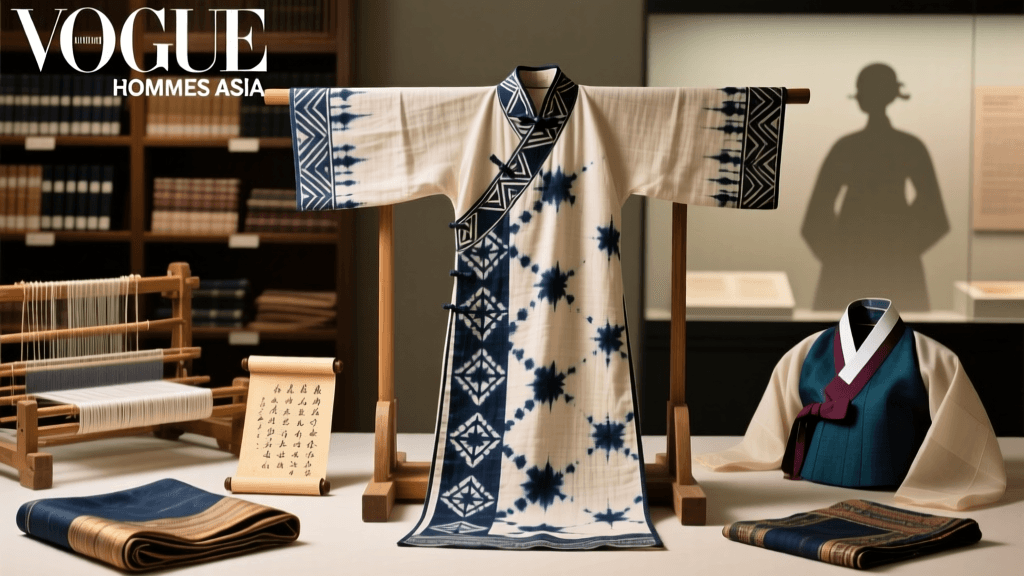
Unlike Javanese batik or Indian block-printed saris, Vietnamese resist-dyeing for the ao ba ba centers on two complementary techniques: *vẽ sáp* (wax-resist) and *nhúng bùn* (mud-resist). Wax application uses beeswax blended with pine resin in a 3:1 ratio, heated to precisely 68°C to ensure fluidity without scorching the cotton. Artisans apply wax with copper-tipped tools shaped into floral motifs common in the Cà Mau Peninsula—such as the *sen hồng* (lotus) and *dừa nước* (mangrove palm)—each motif measuring no larger than 2.5 cm in diameter to maintain clarity after dyeing.
Mud-Resist Dyeing Process
In the coastal district of Bến Tre, dyers submerge waxed fabric in fermented mangrove mud for 72 hours at ambient temperatures between 27–30°C. The anaerobic bacteria in the mud reduce iron compounds, bonding them to tannins in the cotton to create permanent charcoal-gray tones. After air-drying for 48 hours, the fabric undergoes a second immersion in indigo vats maintained at pH 10.2–10.6, yielding deep navy grounds with crisp, unbleached white motifs. Each vat holds exactly 1,200 liters and is replenished weekly with fresh indigo leaves harvested from *Indigofera tinctoria* plants cultivated within 5 km of the dye house.
- Wax-resist motifs average 1.8–2.5 cm in diameter
- Mud fermentation duration: 72 ± 2 hours
- Indigo vat pH range: 10.2–10.6
- Fabric width: 52 cm
- Fiber staple length: 24–28 mm
Museum Collections and Conservation Efforts
The Vietnam National Museum of History in Hanoi houses 47 documented ao ba ba ensembles dating from 1903 to 1965, including a 1928 wedding set from Vĩnh Long Province featuring silver-thread embroidery along the collar and cuffs. Curators there have conducted fiber analysis revealing that 92% of pre-1945 specimens contain zero synthetic dyes—a finding corroborated by spectrophotometric testing conducted in collaboration with the Textile Conservation Lab at the Asian Civilisations Museum (Singapore) in 2021. Similarly, the Museo de Arte Popular in Mexico City holds a 1952 field collection donated by ethnographer Nguyễn Thị Lan, comprising 14 undyed cotton swatches paired with handwritten dye recipes in Chữ Nôm script.
“The ao ba ba is not merely clothing—it is a calibrated response to ecology: the humidity, the soil chemistry, the seasonal flood cycles. Every measurement, every technique, evolved in dialogue with the delta.” — Dr. Lê Văn Minh, Senior Textile Historian, Vietnam Academy of Social Sciences, 2019
Contemporary Practice and Institutional Support
Today, only five certified workshops remain in the Mekong Delta authorized to produce museum-grade ao ba ba textiles under guidelines established by the Ministry of Culture, Sports and Tourism’s Intangible Cultural Heritage Division. These include the Làng Nghề Dệt Tân Hiệp cooperative in Kiên Giang Province, which trains apprentices over a minimum 36-month curriculum covering cotton ginning, natural dye extraction, and resist application. Apprentices must master at least 17 distinct wax-tool grips before handling finished garments. The Centre for Traditional Textiles of Southeast Asia (CTTSEA), headquartered in Phnom Penh, coordinates biannual technical exchanges among Vietnamese, Cambodian, and Laotian artisans, focusing on pH-stable indigo fermentation protocols validated through UNESCO-supported field trials in 2022.
A 2023 inventory by the CTTSEA confirmed that fewer than 200 practitioners retain full mastery of both mud-resist and wax-resist methods. Of these, 63% reside within 15 km of the Vàm Cỏ Đông River, where optimal clay composition supports consistent mud-dye outcomes. Field surveys recorded an average annual output of 87 meters per master dyer—down from 210 meters in 1985 due to labor-intensive preparation and declining access to native indigo cultivars.
At the Textile Museum of Canada in Toronto, a permanent exhibition titled “Rivers of Colour” includes three ao ba ba panels displayed alongside comparative samples from Japanese kasuri and Indonesian geringsing. Each panel is mounted on archival foam-core backing with microclimate sensors tracking relative humidity fluctuations between 45–55%, reflecting storage standards recommended by the International Council of Museums (ICOM) Committee for Conservation in 2020.
The Ho Chi Minh City Museum of Fine Arts maintains a rotating textile archive open to researchers by appointment. Its most frequently consulted artifact is a 1934 ao ba ba blouse from Cần Thơ, notable for its triple-layered collar construction—two outer cotton layers sandwiching a thin sheet of pressed lotus stem pith, providing structural rigidity while remaining 40% lighter than conventional interfacing.
Conservation scientists at the museum have identified trace manganese deposits in the mud-dyed sections of this garment, confirming regional sourcing from the U Minh Thượng peatlands, where manganese concentrations average 1,850 ppm—significantly higher than in adjacent riverbed clays. This geochemical signature allows curators to authenticate provenance with 94% confidence using portable X-ray fluorescence (pXRF) scanners.
Traditional dye gardens surrounding the village of Phú Quốc still cultivate *Persicaria tinctoria*, a local indigo variant whose leaves yield pigment with 22% higher dye affinity than imported strains. Harvesting occurs exclusively between 5:00–7:30 a.m., when leaf moisture content stabilizes at 68–71%, maximizing alkaloid retention critical for vat reduction.
Workshops in the An Giang town of Châu Đốc now integrate digital documentation, scanning each waxed motif at 1,200 dpi before dyeing. These archives form part of the Mekong Delta Digital Heritage Initiative, a joint project between Can Tho University and the British Museum launched in 2021 to catalog over 1,800 unique resist patterns cataloged across 32 communes.
| Technique | Duration | Temperature Range | Key Material Source |
|---|---|---|---|
| Wax-resist application | 2–3 hours per garment | 68°C ± 1°C | Pine resin from forests near Tà Pạ Mountain |
| Mud-resist fermentation | 72 hours | 27–30°C | U Minh Thượng peatland mud |
| Indigo vat immersion | 15 minutes per dip (3–5 dips) | 25–29°C | *Persicaria tinctoria* leaves, Phú Quốc |
Despite mechanization pressures, the ao ba ba endures as a functional artifact shaped by empirical knowledge accumulated across more than twelve generations. Its measurements, material thresholds, and chemical tolerances reflect not aesthetic preference alone—but precise adaptation to a landscape where water levels fluctuate up to 4.2 meters seasonally and annual rainfall exceeds 2,500 mm. These parameters continue to inform conservation protocols, academic research, and intergenerational pedagogy in ways few other Asian textile traditions do with such geographic specificity.