Authentic Banarasi Silk Saree Online Shopping Guide 2026
The Evolution of Banarasi Silk E-Commerce in 2026
The landscape of traditional Indian textile shopping has undergone a massive transformation by 2026. While walking through the labyrinthine alleys of Varanasi’s Visheshwarganj market remains a pilgrimage for textile connoisseurs, the digital marketplace has become the primary avenue for global buyers to acquire authentic Banarasi silk sarees. Today’s e-commerce platforms offer high-definition macro photography, virtual draping tools, and direct-to-consumer (D2C) channels that connect rural weaver cooperatives directly with international buyers. However, this digital boom has also led to a proliferation of powerloom replicas and synthetic blends masquerading as handloom heritage pieces. Navigating online marketplaces requires a keen eye, an understanding of traditional weaving terminology, and a strict adherence to authenticity verification protocols.
Decoding Authenticity: GI Tags and the Silk Mark
When shopping for a Banarasi saree online in 2026, your first line of defense is the Geographical Indication (GI) tag. According to the Geographical Indications Registry of India, the term "Banarasi" is legally protected. Only sarees and brocades woven in six specific districts of Uttar Pradesh—Varanasi, Azamgarh, Jaunpur, Bhadohi, Mirzapur, and Chandauli—can be legitimately sold as Banarasi. Reputable online sellers will provide a scannable GI certificate or a holographic GI tag number in their product listings. If a marketplace vendor cannot provide verifiable GI documentation, the garment is likely a mass-produced imitation from a powerloom hub outside the protected region.
The Silk Mark and Handloom Mark
Beyond geographical origin, the fiber content must be verified. The Ministry of Textiles oversees the Silk Mark and Handloom Mark initiatives, which are critical for online buyers. The Silk Mark guarantees that the fabric is 100% pure natural silk, while the Handloom Mark certifies that the garment was woven on a traditional handloom rather than a mechanized powerloom. In 2026, top-tier online platforms integrate blockchain-backed QR codes that display the entire supply chain, from the sericulture farms producing the mulberry silk to the specific artisan family who wove the final piece.
Understanding the Weaves: What to Look for in Macro Photos
To shop confidently online, you must know how to analyze the macro photographs provided by the seller. The beauty of a Banarasi saree lies in its intricate motifs, and the technique used to create them dictates both the price and the drape.
- Kadhwa (Jangla) Weave: This is the most labor-intensive and expensive technique. In Kadhwa, each motif is woven individually, meaning there are no loose threads on the reverse side of the fabric. When zooming in on product photos, the back of a Kadhwa saree should look almost as neat as the front. This technique ensures the saree is incredibly durable and heavy.
- Cutwork (Fekua) Weave: A more affordable alternative, Cutwork involves weaving the motifs continuously across the width of the fabric and then cutting the loose silk threads on the reverse side later. If the seller provides a photo of the reverse side and you see long, floating threads or a mesh-like netting attached to the back, it is a Cutwork piece.
- Tanchoi: Originating from Persian influences, Tanchoi involves weaving with multiple silk threads without the use of heavy zari (metallic thread). It results in a soft, satin-like finish with subtle, self-patterned motifs. It is highly prized for its lightweight drape and elegant sheen.
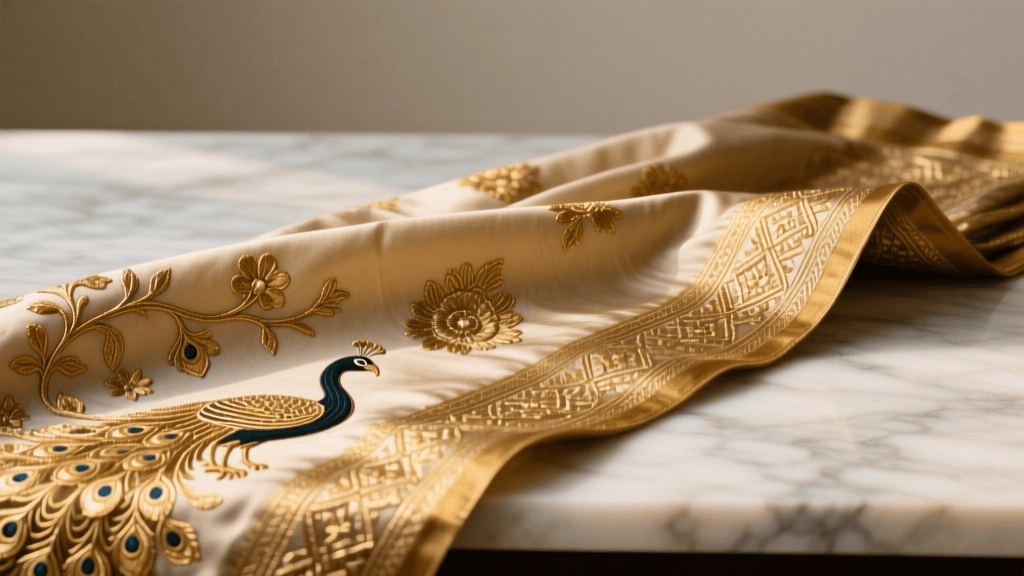
- Butidar: Characterized by an all-over pattern of small, intricate floral motifs (butis) woven with gold and silver zari. A genuine handloom Butidar will show slight, natural irregularities in the motif alignment, which is a hallmark of human craftsmanship.
2026 Market Price Guide: Budgeting for Your Banarasi
Pricing for authentic handloom Banarasi sarees has adjusted in 2026 to reflect the rising costs of pure silk yarn, precious metal zari, and fair-trade wages for artisan communities. If a website offers a "Pure Katan Silk Kadhwa" saree for under $150 USD, it is almost certainly a powerloom synthetic blend. Below is a realistic pricing matrix for the current market.
| Silk Type & Weave | Estimated 2026 Price (USD) | Best Use Case |
|---|---|---|
| Pure Katan Silk (Cutwork) | $250 - $450 | Festive wear, daytime weddings |
| Pure Katan Silk (Kadhwa) | $600 - $1,500+ | Bridal wear, heirloom investment |
| Organza (Kora Silk) with Zari | $300 - $600 | Summer weddings, formal evening events |
| Tussar Silk (Ghicha) | $180 - $350 | Corporate events, casual elegant draping |
| Pure Georgette (Cutwork) | $200 - $400 | Receptions, parties, travel-friendly wear |
Red Flags: Spotting Powerloom Fakes on Marketplaces
As AI-generated product descriptions and stolen photography become more prevalent on global e-commerce sites, buyers must be vigilant. Watch out for these critical red flags when browsing online marketplaces:
- The "Art Silk" Deception: "Art Silk" is a marketing term for artificial silk (rayon, viscose, or polyester). It is not silk. If the description says "Art Silk," "Blend Silk," or "Silk Touch," you are buying synthetic fibers.
- Flawless Symmetry: Handloom weaving is a human endeavor. If the motifs are mathematically perfect, with zero tension variations or microscopic misalignments, the fabric was likely woven on a computerized Jacquard powerloom.
- Missing Reverse-Side Imagery: Authentic sellers are proud of their weave structure and will always include photos of the reverse side of the pallu (the decorative end of the saree). If a listing only shows the front, request reverse-side photos before purchasing.
- Unrealistic Dispatch Times: A genuine Kadhwa Banarasi saree takes anywhere from 15 days to six months to weave. If a vendor claims to have 500 identical pieces in stock ready for next-day shipping, they are selling factory-made powerloom inventory.
Top Trusted Online Channels for 2026
To ensure authenticity, prioritize your shopping through verified channels. Government-run emporiums (such as state-level handloom cooperatives) offer guaranteed authenticity, though their digital interfaces may be less modern. Curated D2C heritage brands that partner directly with Varanasi weaving clusters are currently the gold standard for international buyers, offering excellent customer service, DHL shipping, and detailed artisan profiles. Additionally, many master weavers now operate verified WhatsApp and Instagram storefronts, allowing for live video calls where you can inspect the saree's drape and sheen in natural sunlight before commissioning a purchase.
Post-Purchase Verification and Care
Once your Banarasi saree arrives, perform a tactile and visual inspection. Pure silk has a distinct, slightly coarse texture and warms to the touch, whereas synthetic slides coolly through the fingers. Many premium sellers now include a small swatch of the warp and weft threads; you can perform a burn test on this swatch. Pure silk will burn slowly, smell like burnt hair, and leave a crushable ash, while polyester will melt into a hard plastic bead. For long-term preservation, always store your Banarasi silk wrapped in unbleached muslin cloth to allow the natural fibers to breathe, and avoid hanging the garment, as the heavy zari work can distort the silk yarns over time. Dry clean only, and ensure the cleaner specializes in handling delicate metallic zari threads to prevent tarnishing.