Mastering Kimono Fabrics: Nishijin, Yuzen & Chirimen
The Foundation of Elegance: Understanding Kimono Silk
The world of traditional Japanese clothing is inextricably linked to the mastery of its textiles. Unlike Western tailoring, which relies on complex, curved cutting patterns to shape fabric to the human body, the kimono is a triumph of geometric simplicity and textile artistry. The garment's beauty is derived almost entirely from the fabric itself—its drape, its texture, and the intricate methods used to weave and dye it. To truly appreciate Japanese dress, one must understand the raw materials and the centuries-old craftsmanship that transform silk threads into wearable art.
At the core of this tradition is the 'tanmono', a standard bolt of kimono fabric. A traditional tanmono measures approximately 36 centimeters (14 inches) in width and 12 meters (13 yards) in length. This specific, narrow width dictates the straight-line cutting pattern of the kimono, ensuring that the entire bolt is used with virtually zero fabric waste. When evaluating vintage or contemporary kimono, understanding the specific weave and dyeing technique of the tanmono is essential for determining the garment's formality, value, and care requirements.
Nishijin-ori: The Brocade of Kyoto
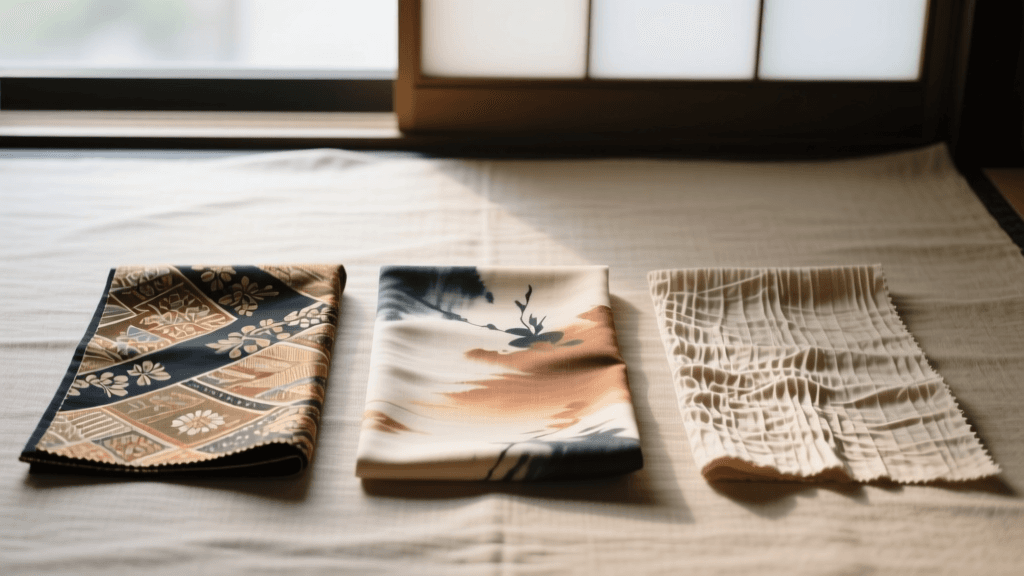
Nishijin-ori is not a single fabric, but rather a designation for the luxurious, multi-colored brocade weaving produced in the Nishijin district of Kyoto. Recognized by the Japan Traditional Crafts Association as a premier national craft, Nishijin weaving dates back over a millennium. The technique involves dyeing the silk threads before they are woven, allowing artisans to create complex, tapestry-like patterns that are identical on both sides of the fabric, or deliberately contrasting for visual depth.
Modern Nishijin-ori often utilizes Jacquard looms, a technology introduced from France in the late 19th century and perfected by Kyoto artisans to handle delicate silk and metallic threads. Authentic Nishijin obi (the sash worn with a kimono) are heavily structured and can incorporate 'kinran' (gold leaf threads) or 'ginran' (silver leaf threads).
Actionable Buyer's Tip: When purchasing a vintage Nishijin-ori obi, inspect the reverse side. Authentic, high-quality pieces will show a distinct, albeit muted, mirror image of the pattern with neatly tied-off threads. Machine-made synthetic brocades often have a flat, uniform backing with loose, unclipped threads floating across the back. Expect to pay between $500 and $5,000+ USD for an authentic, hand-finished Nishijin fukuro obi.
Yuzen Dyeing: Painting on Silk
While Nishijin relies on the loom, Yuzen relies on the brush. Yuzen is a resist-dyeing technique that allows for the creation of highly detailed, pictorial designs on silk, effectively turning the kimono into a canvas. As documented by the Metropolitan Museum of Art's Heilbrunn Timeline of Art History, Japanese textile artists developed sophisticated resist methods to achieve vibrant, multi-colored patterns that would otherwise bleed together on absorbent silk.
The hallmark of traditional Yuzen is 'itome-nori', a rice-paste resist applied through a metal cone to create ultra-fine, thread-like white outlines around design elements. There are two primary regional styles:
- Kyo-Yuzen (Kyoto): Characterized by opulent, stylized designs, heavy use of gold leaf, and a pastel color palette. It is the standard for highly formal garments like the 'furisode' (long-sleeved kimono for unmarried women).
- Kaga-Yuzen (Kanazawa): Known for its realistic, nature-inspired motifs, such as leaves with insect bites or wilting edges. It utilizes a distinct five-color palette (kaga-gosai) and rarely employs gold leaf, favoring a more subdued, elegant aesthetic.
Tango Chirimen: The Crepe Silk Standard
If you touch a standard, everyday silk kimono, you are likely feeling Tango chirimen. Originating from the Tango peninsula in Kyoto Prefecture, chirimen is a crepe silk characterized by its distinctive bumpy texture, known as 'shibo'. This texture is achieved by using untwisted threads for the warp, but tightly twisting the weft threads (up to 3,000 twists per meter) in alternating directions. When the fabric is woven and subsequently washed, the tension in the weft threads causes the silk to shrink and buckle, creating the microscopic pebbled surface.
This shibo texture is not merely aesthetic; it makes the silk highly resistant to wrinkling, gives it a beautiful, matte drape, and allows it to take on deep, rich colors during the dyeing process. Tango chirimen is the workhorse of the kimono world, serving as the base fabric for the vast majority of dyed, patterned kimono worn by women today.
Oshima Tsumugi: The Pongee Masterpiece
Tsumugi refers to pongee, a fabric woven from spun silk noil (the short fibers left over after combing). Unlike the glossy, continuous filament silk used in chirimen, tsumugi has a matte, cotton-like finish and a rustic, nubby texture. The undisputed king of this textile is Amami Oshima tsumugi, produced in the Amami islands of Kagoshima Prefecture.
Oshima tsumugi is famous for its 'kasuri' (ikat) patterns and its unique mud-dyeing process. Artisans dye the silk threads using a decoction of the native 'teh-chi' tree bark, which contains high levels of tannin. The threads are then submerged in iron-rich mud from the island's rice paddies. The chemical reaction between the tannin and the iron creates a deep, lustrous, and colorfast black. A single bolt of authentic Oshima tsumugi can take up to a year to produce and easily commands prices ranging from $2,000 to over $15,000 USD due to the staggering labor intensity.
Comparison Chart: Kimono Fabric Types
| Fabric Type | Primary Technique | Best Used For | Est. Price Range (USD) | Care Level |
|---|---|---|---|---|
| Nishijin-ori | Brocade Weaving | Formal Obi, Haori | $500 - $5,000+ | High (Specialist Dry Clean) |
| Kyo-Yuzen | Resist Dyeing | Furisode, Tomesode | $1,000 - $10,000+ | High (Avoid Water/Stains) |
| Tango Chirimen | Crepe Weaving | Everyday Silk Kimono | $200 - $1,500 | Moderate (Wrinkle Resistant) |
| Oshima Tsumugi | Mud-Dyed Ikat | Casual/Streetwear Kimono | $2,000 - $15,000 | Moderate (Highly Colorfast) |
Actionable Guide: Sourcing, Tailoring, and Caring
Whether you are a collector, a practitioner of traditional arts, or a fashion enthusiast, handling kimono fabrics requires specific knowledge. The Tokyo National Museum frequently exhibits historical textiles, highlighting the importance of proper environmental controls for silk preservation. Here is how you can apply museum-level care to your own collection.
Sizing and Tailoring Constraints
Because kimono are cut from standard 36cm wide tanmono, the maximum wingspan (the distance from the center of the back to the tip of the sleeve) is strictly limited. When sourcing a vintage kimono, measure the 'yuki' (center back to wrist). If your required yuki exceeds 75cm, you will struggle to find vintage garments that fit, as historical Japanese demographics were smaller. In such cases, you must commission a modern kimono using wider, custom-woven fabric bolts, which significantly increases the cost and production time (often 3 to 6 months).
Professional Cleaning: Maru-Arai
Never attempt to wash a silk kimono at home. Water spots on chirimen or yuzen-dyed silk can permanently ruin the garment by causing the dye to bleed or the shibo texture to flatten. Instead, utilize a professional 'maru-arai' (whole washing) service. This specialized dry-cleaning process involves disassembling the kimono into its flat rectangular panels, washing them, and restitching them. Expect to pay between 5,000 and 12,000 JPY ($35 to $85 USD) per garment. This process should only be done every few years, or immediately if a stain occurs.
Storage Best Practices
Silk is a protein fiber, making it highly susceptible to moisture, light, and pests.
- Folding: Always fold kimono along their original seam lines. Store them flat; hanging a heavy silk kimono on a hanger for long periods will distort the shoulder seams and stretch the delicate fibers.
- Wrapping: Wrap each garment in 'tatou' paper, a specialized, acid-free Japanese paper that allows the silk to breathe while protecting it from dust and light. Never use plastic garment bags, which trap humidity and promote mold growth.
- Pest Control: Use natural camphor or specialized kimono mothballs (shounou). Place the repellent in the corners of the storage drawer, never directly touching the silk, as chemical reactions can cause localized discoloration.
By understanding the profound craftsmanship behind Nishijin brocades, Yuzen paintings, and Chirimen crepes, you not only preserve a garment but also become a custodian of Japan's rich textile heritage.