Vanuatuan Tapa Dyeing With Mangrove Bark And Ritual Application
Vanuatuan Tapa: A Living Archive Woven in Bark and Ritual
In the archipelago of Vanuatu—comprising over 80 islands scattered across 1,300 kilometres of South Pacific ocean—tapa cloth is not merely textile but a chronicle of kinship, cosmology, and ecological knowledge. Unlike Hawaiian kapa or Samoan siapo, Vanuatuan tapa (known locally as *naghol* on Pentecost Island or *kakae* in parts of Ambrym) is distinguished by its exclusive reliance on mangrove bark, particularly from the red mangrove (*Rhizophora stylosa*) and, less commonly, the grey mangrove (*Avicennia marina*). This botanical specificity anchors the practice to intertidal zones where ritual harvesting occurs only during lunar phases aligned with ancestral calendars. The bark is stripped in strips measuring precisely 15–20 cm wide and 1.2–1.8 metres long—a dimension dictated by the average arm span of adult women, who remain the primary practitioners across most islands.
Mangrove Harvesting Protocols and Seasonal Timing
Harvesting begins at dawn during the waning moon, when sap flow is minimal and fibre integrity is highest. Practitioners from the village of Loltong on Espiritu Santo observe a three-day preparation period before entering the mangrove swamps, including fasting and consultation with elders. According to field documentation by the Vanuatu Cultural Centre (VCC) in 2019, bark collection is restricted to designated groves near the Nokuku River estuary, where soil salinity levels between 18–22 ppt sustain optimal tannin concentration. Each harvested strip yields approximately 40–60 grams of usable inner bark after scraping and soaking.
Processing Stages: From Bark to Beaten Cloth
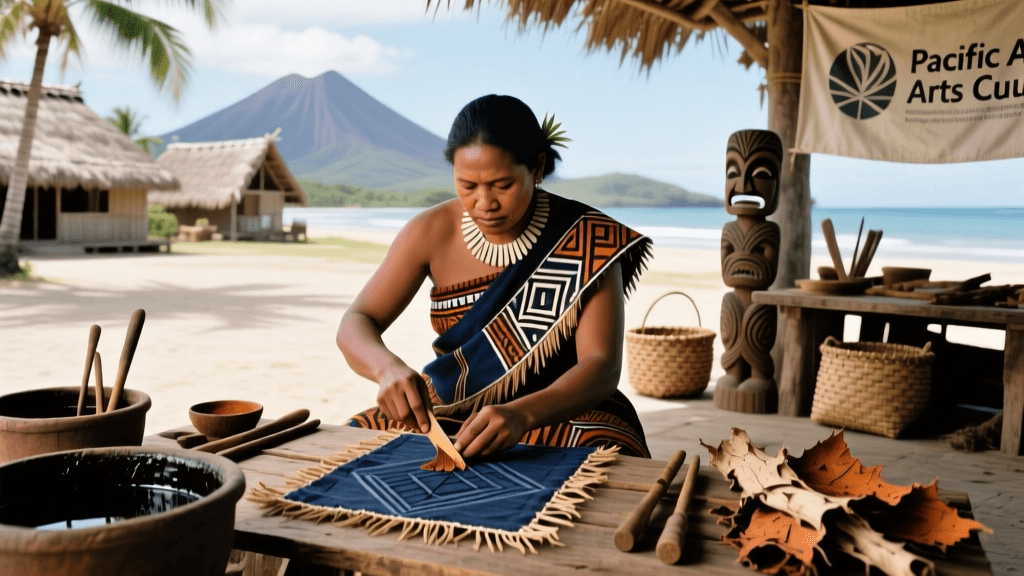
The inner bark undergoes fermentation in freshwater pits for 7–10 days, followed by thorough rinsing in tidal channels to leach excess tannins. It is then laid flat on smooth coral slabs and beaten with wooden mallets (*tutu*) carved from ironwood (*Intsia bijuga*), each weighing between 1.3–1.7 kg. Beating continues for up to 12 hours per sheet, expanding the fibre matrix to reach final dimensions of 1.5 × 2.3 metres—large enough to wrap an adult male during initiation rites on Malekula Island.
Ritual Application in Life-Cycle Ceremonies
Tapa functions as sacred interface between human and spiritual realms. At the annual *Naghol* land-diving ceremony on Pentecost Island, men wear freshly dyed tapa loincloths stained with mangrove tannin and charcoal ash mixtures. These garments are worn for exactly 47 minutes—the duration of the first dive—and discarded immediately afterward into the sea, signifying irreversible transition into manhood. Similarly, in funeral rites on Ambrym, widows drape themselves in black-dyed tapa measuring 2.1 × 3.4 metres, symbolising the “shadow of absence” that must be ritually lifted after 11 months.
Colour Symbolism and Natural Dye Chemistry
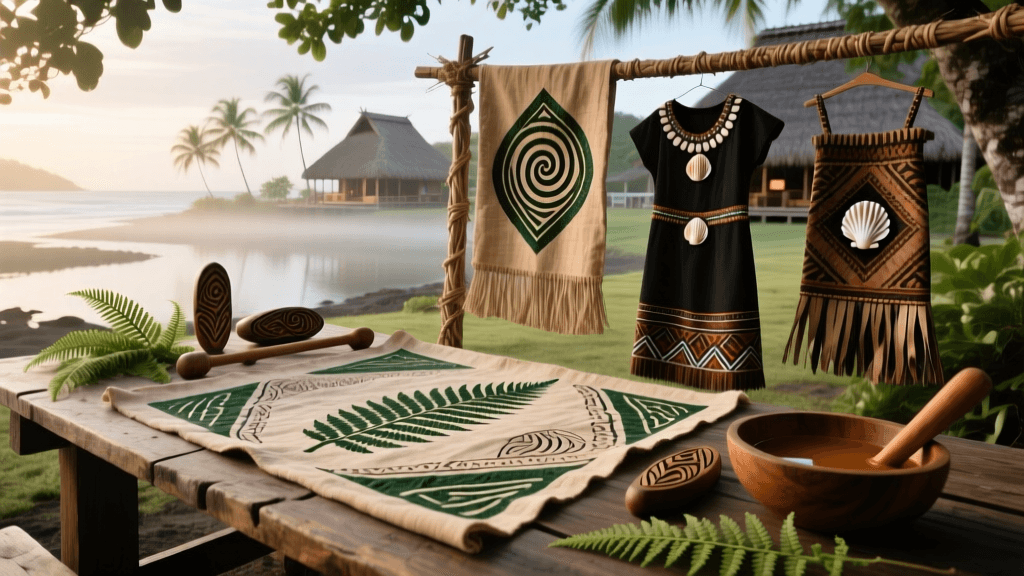
Vanuatuan tapa employs no synthetic pigments. Mangrove bark alone produces rich russet-browns; when combined with crushed turmeric rhizomes (*Curcuma longa*) and fermented coconut water, it yields ochres ranging from pale gold (light exposure <2 hours) to deep amber (fermentation ≥96 hours). Iron-rich mud from the Vila River delta, applied with finger-stippling techniques, creates permanent black motifs representing ancestral pathways. A 2021 pigment analysis conducted by the University of the South Pacific’s Institute of Applied Science confirmed that tannin concentrations in *Rhizophora stylosa* bark average 12.7% dry weight—significantly higher than in *Broussonetia papyrifera*, used elsewhere in Polynesia.
Institutional Safeguarding and Contemporary Practice
The Vanuatu Cultural Centre’s Fieldworkers’ Programme has documented over 312 distinct tapa motifs across 17 islands since 1994, assigning each motif a unique alphanumeric code (e.g., AMB-447-BL for a specific “crocodile spine” design from Ambrym’s north coast). In partnership with the National Museum of Vanuatu in Port Vila, the VCC maintains a climate-controlled archive housing 89 original tapa sheets, all stored at 22°C ± 1°C and 55% relative humidity. Since 2017, the centre has trained 43 master practitioners—including six women from the island of Gaua—to lead intergenerational workshops in schools across Torba Province.
Ethical Sourcing and Ecological Monitoring
To prevent overharvesting, the VCC enforces a rotational harvesting system: only one of every five mangrove stands may be accessed annually, verified through GPS-tagged surveys. Satellite mapping by the Secretariat of the Pacific Community (SPC) in 2022 recorded a 9.3% increase in monitored mangrove coverage since 2015—attributed directly to community-led conservation tied to tapa production. Each practitioner must report harvest volumes quarterly; data shows average annual extraction remains below 2.4 tonnes island-wide, well within sustainable thresholds modelled by the Pacific Islands Forum Fisheries Agency.
Material Specifications Across Key Islands
| Island | Bark Species Used | Average Sheet Size (m) | Dye Fixation Time (hrs) | Ritual Context |
|---|---|---|---|---|
| Pentecost | Rhizophora stylosa | 1.5 × 2.3 | 47 | Land-diving initiation |
| Ambrym | Avicennia marina + R. stylosa | 2.1 × 3.4 | 112 | Funerary wrapping |
| Malekula | Rhizophora stylosa | 1.8 × 2.6 | 72 | Chiefly investiture |
Transmission Through Embodied Knowledge
Learning tapa-making occurs not through written instruction but via tactile repetition and oral recitation. Apprentices spend 18–24 months mastering the rhythm of beating—initially striking at 68 beats per minute, progressing to 112 bpm for fine-textured ceremonial cloths. Elders from the village of Melsisi on Pentecost recount that the sound of the *tutu* must match the cadence of the local *tam tam* drum used in harvest chants. As noted in the VCC’s 2020 ethnographic report, “the cloth remembers the hand that made it”—a principle reflected in strict protocols prohibiting left-handed individuals from handling newly beaten sheets until they have undergone purification rites involving saltwater immersion.
- Each mature mangrove tree yields only 3–5 harvestable bark strips per year without compromising regeneration.
- Vanuatu’s national tapa inventory includes 2,147 documented designs, with 68% originating from islands north of the 16°S latitude line.
- The longest continuous tapa-making lineage documented by the National Museum of Vanuatu spans 7 generations—from Mwewa of Loltong (b. 1903) to her great-great-granddaughter Lian Kalo (b. 2001).
- During the 2023 *Naghol* season, 412 tapa loincloths were produced across Pentecost Island, all adhering to traditional dye recipes verified by VCC chemists.
- Fieldwork conducted by the University of New Caledonia’s Pacific Heritage Unit (2021) recorded 12 distinct verbal formulae used during mangrove stripping, each invoking specific reef spirits associated with particular tidal zones.
At the Tanna Cultural Centre in Lenakel, rotating exhibitions feature tapa alongside audio recordings of bark-scraping rhythms and infrared images showing tannin migration through fibres during fermentation. These displays reinforce that Vanuatuan tapa is neither static artifact nor decorative craft—it is a kinetic system binding botany, timekeeping, social law, and spiritual geography. When a woman in South West Bay on Malekula bends to rinse bark in brackish water, she does not manipulate raw material; she fulfils a covenant older than written history, measured not in years but in tidal cycles, lunar returns, and the precise weight of a wooden mallet resting in her palm.
“The mangrove does not give its bark to everyone. It gives only to those who know the names of its roots, the songs of its crabs, and the silence between waves.” — Elder Nalau Tari, Ambrym Island, cited in Vanuatu Cultural Centre, Rooted Rhythms: Mangrove Knowledge Systems, 2018
Such statements are not metaphor but operational truth. In 2022, the VCC collaborated with UNESCO’s Intangible Cultural Heritage Section to develop a digital geotagging platform linking tapa motifs to their exact points of origin, hydrological conditions, and associated oral narratives. Over 1,200 coordinates now anchor this living archive—not as data points, but as waypoints along a continuum where cloth, coastline, and consciousness remain inseparable. At the Korman Art Gallery in Port Vila, contemporary artists like Jules Kalsakau reinterpret tapa motifs using laser-cut mangrove wood panels, yet insist each installation includes a vial of actual bark extract—proof that innovation honours, rather than replaces, the biochemical memory held in every gram of tannin.
The persistence of Vanuatuan tapa defies simplification as “traditional dress.” It is governance enacted through fibre, pedagogy encoded in beat frequency, and theology rendered visible in the gradient of brown achieved when mangrove tannin meets seawater pH. No single institution owns this knowledge—though the Vanuatu Cultural Centre, the National Museum of Vanuatu, and the Tanna Cultural Centre steward its transmission—but it resides, as always, in the hands that peel, soak, beat, and wrap, guided by protocols calibrated over millennia to the pulse of the Pacific.