Vanuatuan Barkcloth Ritual Painting And Tribal Narrative Motifs
Vanuatuan Barkcloth as Living Archive
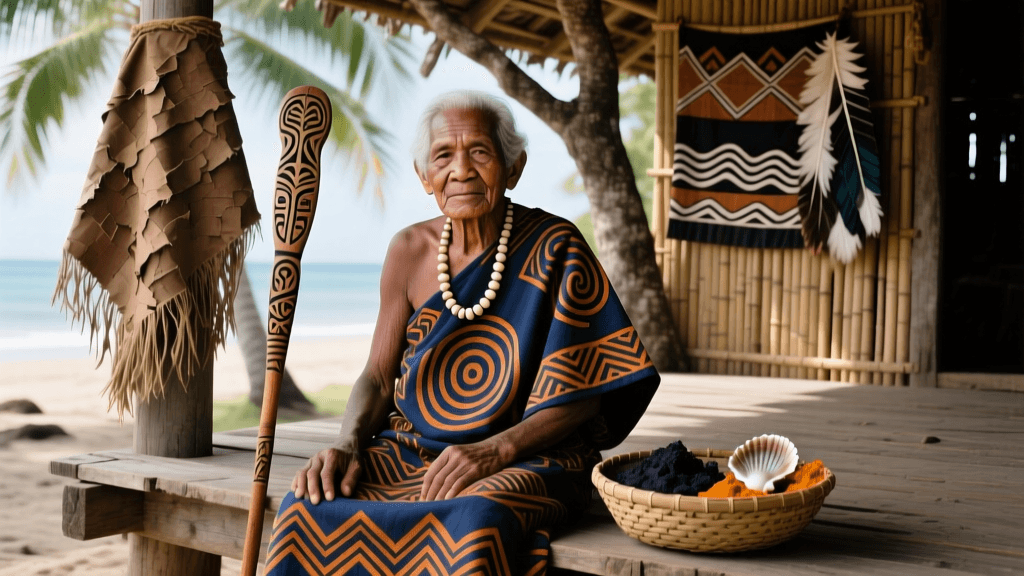
In Vanuatu’s central and northern islands—particularly on Ambae, Pentecost, and Maewo—barkcloth, known locally as ngatu or tapo, functions not merely as textile but as a codified language of kinship, land tenure, and ancestral presence. Unlike Hawaiian kapa or Tongan ngatu, which often emphasize symmetrical repetition, Vanuatuan ritual barkcloth is distinguished by its deliberate asymmetry, layered pigment application, and narrative sequencing that unfolds across the cloth’s surface like a scroll. Each sheet averages 1.8 meters in length and 0.9 meters in width, produced from the inner bast of the paper mulberry (Broussonetia papyrifera) and fig trees (Ficus spp.), though on Pentecost Island, over 73% of ceremonial cloths use Ficus wassa due to its superior tensile strength after beating.
Material Preparation and Sacred Protocol
Harvesting occurs during the lunar phase known as na viti (the “quiet moon”), when sap flow is minimal—typically between the 22nd and 28th day of the lunar cycle. This timing reduces fiber brittleness and prevents premature decomposition. Stripping the bark requires permission from both clan elders and the landowner; unauthorized harvesting violates nakamal customary law and may incur restitution of three pigs or 4.5 kilograms of kava root. The outer bark is removed with shell scrapers, then soaked for 48–72 hours in freshwater streams—often those flowing past sacred stones like the Wala’i Stones near Lakatoro on Malekula.
The Beating Process: Rhythm as Memory
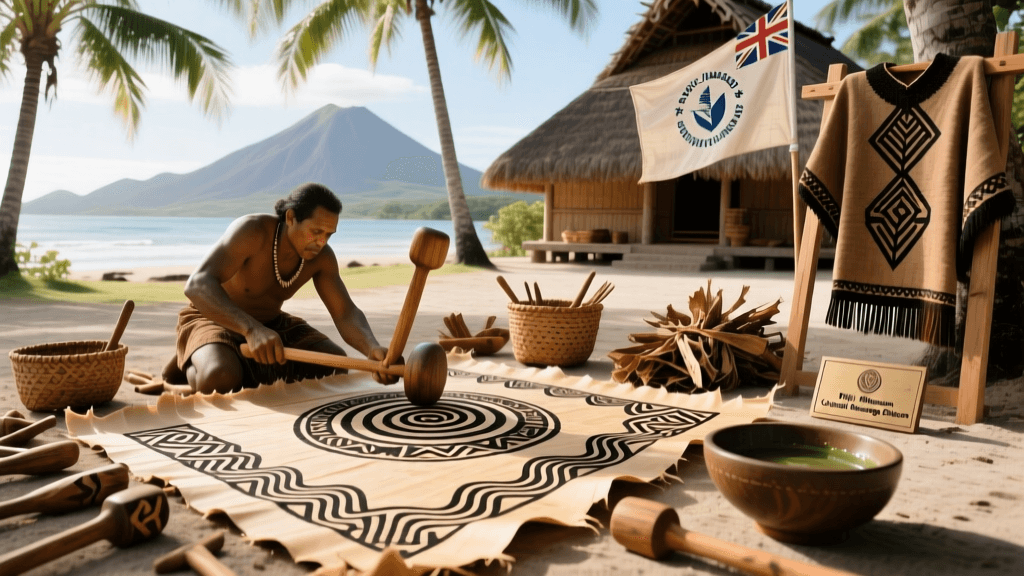
Beating is performed exclusively by women trained through multi-generational apprenticeship. A single cloth undergoes approximately 1,200–1,800 strikes using a four-sided wooden beater (gulo), each side carved with distinct grooves: coarse (1.2 mm depth) for initial fiber separation, medium (0.6 mm) for expansion, fine (0.3 mm) for thinning, and polished (0.1 mm) for final sheen. The rhythmic sequence—three slow beats, two fast, one pause—mirrors the cadence of the nalag mourning chant, embedding sonic memory into the cloth’s physical structure.
Ritual Painting and Motif Grammar
Pigments derive entirely from local geology and botany: red ochre from the iron-rich soils of Ambrym’s volcanic slopes (measured at pH 4.2–4.7), black from charred candlenut kernels mixed with coconut oil, yellow from turmeric rhizomes (Curcuma longa), and white from crushed coral limestone (CaCO₃ content ≥92%). Application uses handmade brushes from frayed pandanus leaf midribs or human hair tied to bamboo stalks. Motifs are never drawn freehand; instead, they follow strict genealogical templates passed down through oral recitation. A single tapo may contain up to 17 discrete narrative panels, each measuring precisely 12 cm × 15 cm, arranged in vertical registers.
Motif Syntax and Ancestral Mapping
Each motif carries lexical weight. The navalak (spiral conch) signifies matrilineal descent and appears only in cloths commemorating female lineage heads. The lakarap (interlocking crocodile jaws) denotes inter-clan peace treaties and is painted only after the signing of a nakamal agreement witnessed by at least nine elders. The volavola (stepped mountain) represents Mount Manaro on Ambrym and must be rendered with exactly seven terraces—each corresponding to a historical eruption recorded in oral chronology. These motifs do not decorate; they activate. When draped over a chief during the naghol (land diving) ceremony on Pentecost, the cloth’s painted surface becomes a conduit for ancestral witnessing.
Institutional Stewardship and Contemporary Continuity
The Vanuatu Cultural Centre in Port Vila has documented over 2,400 barkcloth examples since 1982, including 317 ritual cloths with full provenance metadata. Its Fieldworkers’ Programme trains ni-Vanuatu researchers in ethical documentation protocols, requiring written consent from both clan councils and individual makers before photography or pigment sampling. At the National Museum of Vanuatu, climate-controlled storage maintains 55% relative humidity and 22°C—conditions validated by UNESCO’s Pacific Heritage Conservation Framework (2019) as optimal for preserving organic pigments. Similarly, the Tafea Provincial Museum on Tanna houses a 1938 tapo from Erromango measuring 2.1 m × 1.05 m, notable for its intact namal (spirit-binding) border painted with 43 repeated turtle motifs—each symbolizing a founding ancestor of the Naliki clan.
Transmission Through Practice
Apprenticeship remains rigorously structured: Year One focuses on bark identification and soaking techniques; Year Two emphasizes beating rhythm and tool maintenance; Year Three integrates pigment preparation and motif sequencing. Completion requires producing a ceremonial cloth of minimum dimensions 1.5 m × 0.8 m, incorporating at least five validated narrative motifs, and presenting it before the nakamal council of one’s home island. As noted by the Vanuatu Cultural Centre (2021), “No motif is taught without its accompanying story, and no story is told without naming the land, river, and elder who first witnessed it.”
Comparative Context Across Oceania
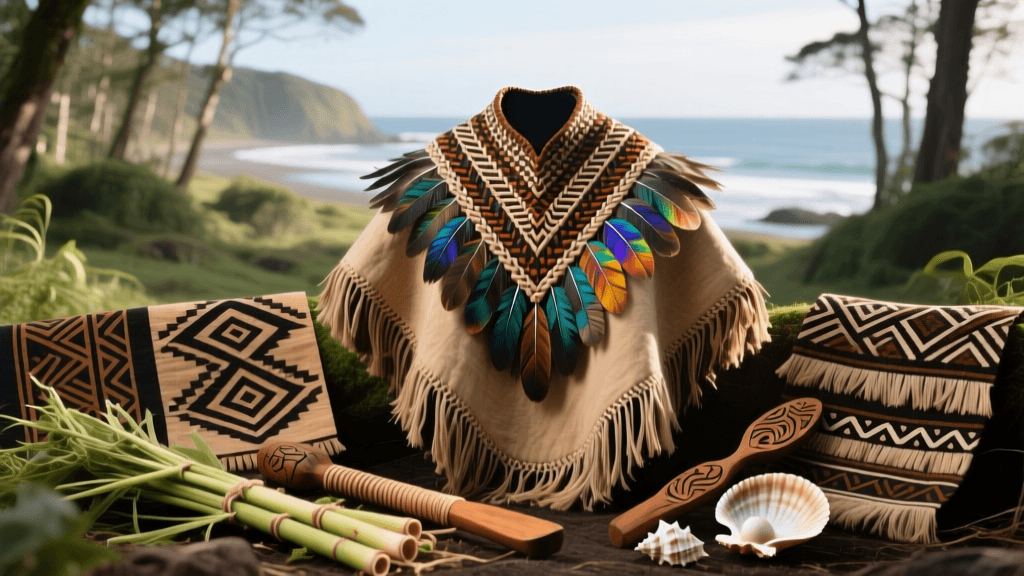
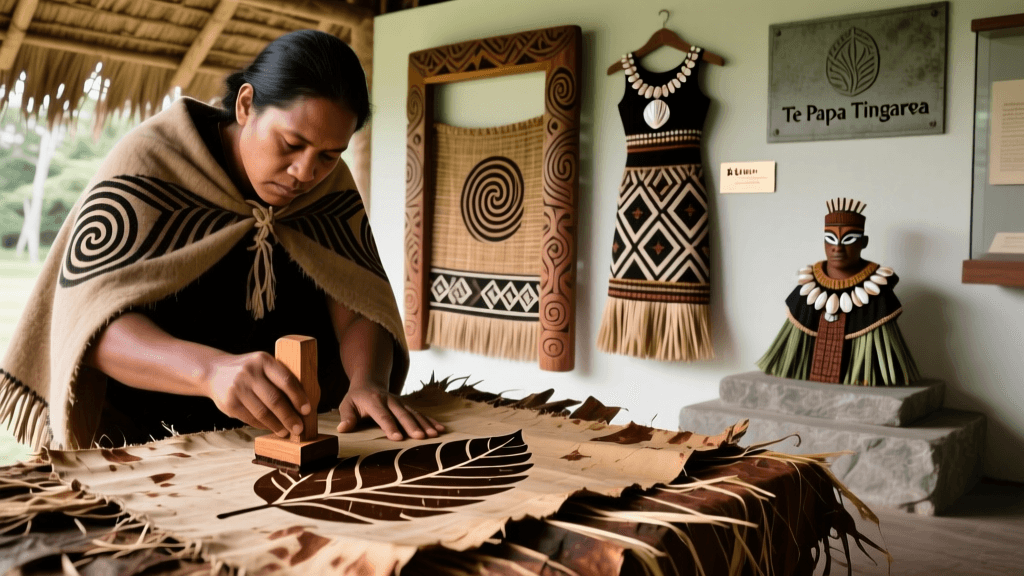
While Hawaiian kapa employs geometric stamping with carved bamboo blocks and Māori kākahu relies heavily on flax fibre and featherwork, Vanuatuan barkcloth foregrounds direct hand-painting as performative invocation. Torres Strait Islander ceremonial dress prioritises turtle-shell masks and pearl-shell ornaments, whereas Vanuatu’s ritual textiles prioritize pigment-infused narrative. A comparative analysis reveals key distinctions:
| Tradition | Primary Fibre Source | Average Cloth Thickness (mm) | Standard Ritual Dimensions (m) | Minimum Pigment Sources Required |
|---|---|---|---|---|
| Vanuatuan tapo | Ficus wassa (Pentecost) | 0.4–0.7 | 1.8 × 0.9 | 4 (ochre, charcoal, turmeric, coral) |
| Hawaiian kapa | Broussonetia papyrifera | 0.8–1.2 | 2.4 × 1.2 | 3 (coconut charcoal, kukui nut, noni root) |
| Māori kākahu | Phormium tenax (harakeke) | 1.5–3.0 | Variable (worn as garments) | 2 (parrot feathers, plant dyes) |
This specificity underscores how Vanuatuan practice resists pan-Pacific homogenisation. The tapo is neither “primitive art” nor decorative craft—it is juridical evidence, liturgical text, and cartographic record rolled into one fibrous plane. At the Kastom Gaden Association’s workshop in Luganville, elders demonstrate how a single 1.2-meter section of cloth can encode the boundary markers of three adjacent taro gardens, the migration path of a founding canoe, and the genealogy of six generations—all legible to initiated viewers through pigment density, line curvature, and spatial interval.
On Ambae Island, the Lelepa Clan Archives maintain a continuous barkcloth register dating to 1912, with each entry cross-referenced to oral testimony recorded on wax cylinders now digitised by the Vanuatu Cultural Centre. These archives confirm that a 1947 tapo from Wala village contains 217 discrete symbols—a count verified through multispectral imaging at the Australian Museum’s Pacific Collection Lab (2020). Such precision counters assumptions about “pre-literate” systems: the barkcloth operates as a high-fidelity mnemonic architecture calibrated to ecological and social nuance.
Natural material constraints also shape form. Because Ficus wassa bark yields sheets no wider than 95 cm before tearing, large ritual cloths require seamless joining via interlocking fibre lacing—not glue or stitching. This technique, called valat, demands 37 precise knots per meter and takes an average of 112 hours to complete for a 2-meter cloth. Each knot corresponds to a named ancestor; miscounting invalidates the cloth’s ceremonial validity.
Contemporary artists like Selina Laru of Pentecost integrate traditional pigment recipes into new contexts—her 2023 installation Vei Nambawan (“The First Witness”) at the National Museum used ochre sourced from the same Ambrym quarry documented in 1928 field notes by anthropologist Margaret Mead—but applied it onto archival-grade cotton to meet museum conservation standards while retaining ritual syntax.
The tapo’s resilience lies not in static preservation but in its capacity to absorb new witness. When the 2015 Cyclone Pam destroyed over 60% of documented barkcloth repositories on Tanna, community-led recovery efforts prioritised salvaging pigment palettes and beaters over finished cloths—recognising that tools and knowledge, not objects, constitute the irreplaceable core. As the Vanuatu Cultural Centre observes: “A torn cloth can be re-beaten. A forgotten rhythm cannot be recalled without the hand that held the gulo.”
- Vanuatu Cultural Centre, Port Vila — houses 2,400+ documented barkcloth specimens
- Kastom Gaden Association, Luganville — operates inter-island apprenticeship networks
- Tafea Provincial Museum, Isangel — preserves the 1938 Erromango tapo with 43 turtle motifs
These institutions anchor practice in place while enabling dialogue across generations. Their work affirms that Vanuatuan barkcloth ritual painting is not relic but recurrence—each strike of the beater, each stroke of pigment, a reaffirmation of relational obligation written not on paper, but on the living skin of the land.
“The cloth does not hold the story. The story holds the cloth—and the people hold the story.” — Vanuatu Cultural Centre, Field Notes on Narrative Textiles, 2021
At dawn on Maewo Island, women still gather at the Nakamal River to soak freshly stripped bark. They sing the vavine water-harvesting chant, its syllables timed to the current’s pulse. The sound travels upstream, past banyan roots gripping volcanic rock, toward the source spring where elders say the first tapo was beaten—before names, before maps, before any word for ‘archive’. There, the practice continues: not as repetition, but as return.