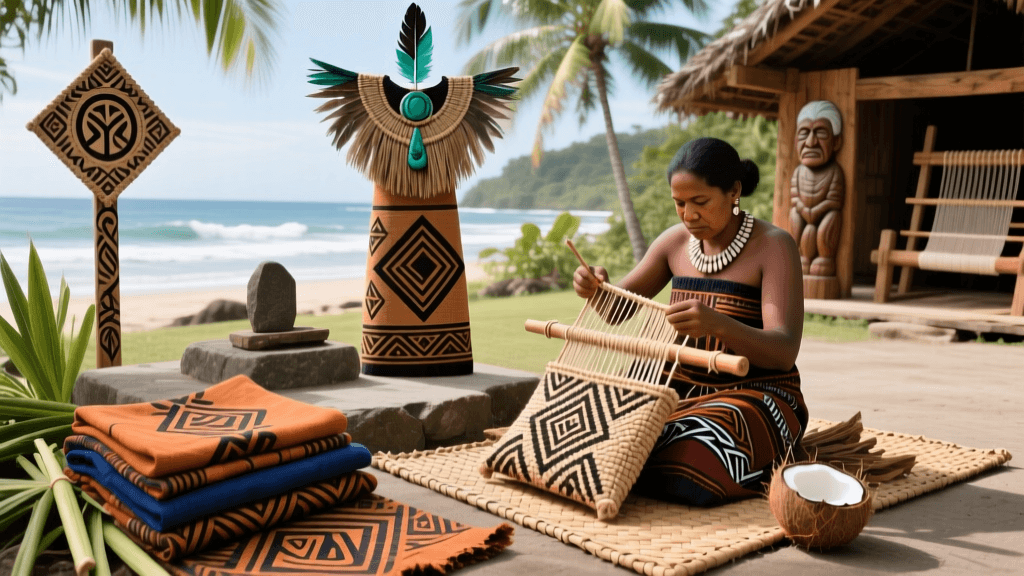
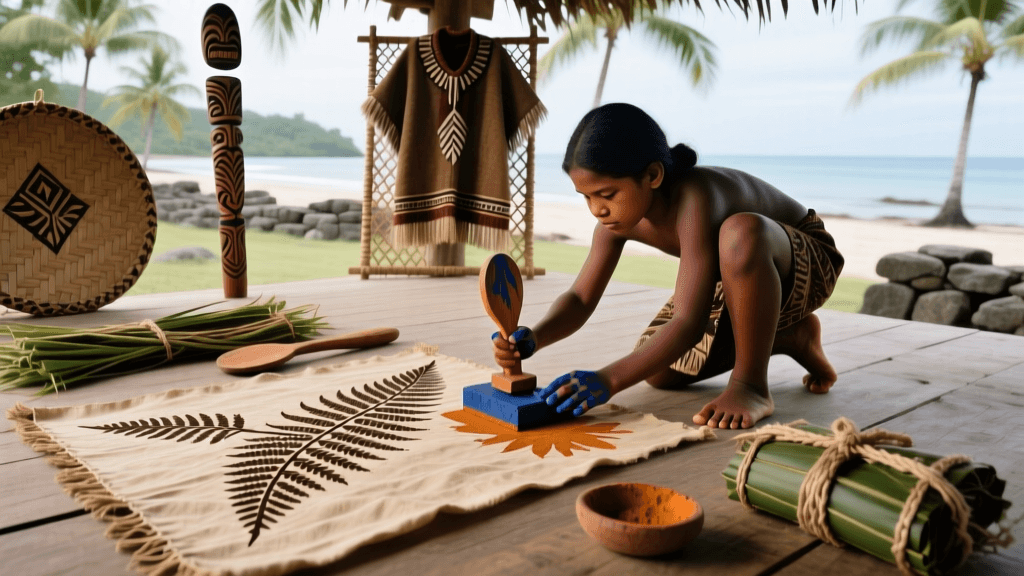
Fijian Masi Barkcloth Beating Techniques And Symbolic Patterning
Origins and Material Foundations of Fijian Masi
Fijian masi—often referred to internationally as tapa cloth—is not woven but beaten from the inner bark of the paper mulberry tree (Broussonetia papyrifera). Unlike Hawaiian kapa or Tongan ngatu, which also derive from the same botanical source, Fijian masi production centers on a distinct regional variant: Broussonetia papyrifera var. fijiensis, cultivated for generations across Vanua Levu and Viti Levu. The harvesting occurs during the dry season (May–October), when sap flow is minimal and bark peels cleanly. Strips are stripped lengthwise from mature trees aged 18–24 months, with optimal bark thickness measuring precisely 1.2–1.5 mm—thin enough for pliability, thick enough to withstand repeated beating without tearing.
Preparation begins with soaking bark in freshwater streams for 48–72 hours—a practice still observed at the Wainibuka River near Navua. This softens lignin and initiates natural fermentation, crucial for fibre separation. After scraping with shark-toothed mussel shells (Chama pacifica) or modern metal scrapers, the bast fibres are laid in overlapping layers on wooden anvil stones called lali. These stones, often basaltic and weighing between 35–60 kg, are sourced from quarries near Sigatoka Sand Dunes National Park and remain in continuous use across generations.
The Rhythmic Discipline of Beating: Tools and Technique
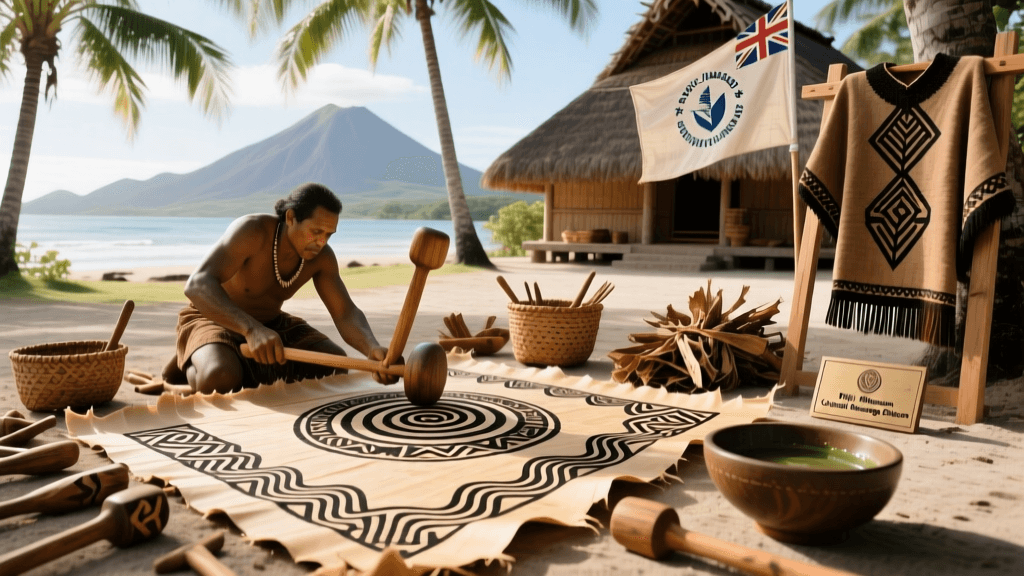
Masi beating is a communal, gendered practice led by elder women known as masi marama. Each beater uses four primary wooden beaters (i lali), carved from ironwood (Intsia bijuga) and differentiated by groove depth and weight:
- Tavakalou: Heaviest beater (1.8–2.1 kg), used for initial flattening; grooves spaced 4 mm apart
- Tavakarua: Medium weight (1.2–1.4 kg), for mid-stage expansion; grooves at 2.5 mm intervals
- Tavakadre: Lighter (0.9–1.1 kg), for fine texturing; grooves spaced 1.8 mm
- Tavakasolo: Finest beater (0.6–0.8 kg), used for final smoothing; smooth surface, no grooves
Beating follows strict rhythmic sequences: 120–140 strikes per minute sustained over 6–8 hours daily for up to 10 days to produce a single 3.5 m × 1.2 m sheet. The motion is not vertical pounding but a controlled diagonal glide—wrist locked, forearm pivoting—to distribute tension evenly. This prevents micro-tears and ensures uniform translucency. At the Fiji Museum in Suva, conservation records show that pre-1920 masi sheets average 0.32 mm thickness, while contemporary ceremonial pieces reach 0.28 mm due to refined beating precision.
Regional Variations Across the Archipelago
Western Viti Levu masi—especially from the Nadroga-Navosa Province—is distinguished by its dense, matte finish and preference for geometric motifs aligned along central axes. In contrast, Lau Group masi features higher sheen and asymmetrical patterning reflecting maritime navigation charts. In the Yasawa Islands, masi makers incorporate crushed coral lime into the beating water, raising pH to 8.4 and enhancing fibre brightness—a technique documented in fieldwork conducted by the University of the South Pacific’s Institute of Fijian Language and Culture in 2017.
Sacred Geometry: Symbolism in Pattern Layout
Masi patterns are never decorative abstractions—they encode genealogy, land tenure, and spiritual cosmology. Each motif carries prescribed dimensions and placement rules governed by vakamarama, the protocol of design authority. A chief’s tabua (whale tooth) presentation cloth must include the veiqoli (stepped diamond) motif, rendered at exact proportions: base width 8.5 cm, height 12.3 cm, internal angles fixed at 62° and 118°. Deviation violates vanua (land-people-spirit) reciprocity.
The dravu (water ripple) motif appears only on cloths for female initiation rites and must contain 7–9 parallel undulations per 10 cm, symbolising the seven ancestral islands and two sacred currents of the Koro Sea. On burial cloths from Kadavu Island, the vakasiga (interlocking hook) pattern is rendered in charcoal-black dye derived from mangrove bark (Rhizophora stylosa) boiled for 9 hours—exactly—then mixed with fermented coconut milk at a 3:1 ratio.
Dye Preparation and Application Protocols
Natural dyes adhere through tannin binding, not pigment absorption. Black dye requires precise fermentation: gatu (mangrove bark) is soaked for 21 days in earthenware pots buried underground near riverbanks. Red ochre from the Namosi Highlands is ground to 120-mesh fineness using basalt mortars before mixing with candlenut oil. Yellow comes exclusively from turmeric rhizomes harvested at dawn on the third day after full moon, then pounded for 45 minutes to release curcumin without oxidation.
Application tools are equally codified:
- Feather brushes made from frigatebird primaries (used only for sacred cloths)
- Cottonwood twig stamps (qele) carved to exact 3.2 cm × 3.2 cm squares
- Freehand painting with sennit cord dipped in dye and drawn taut across cloth for straight-line borders
Institutional Stewardship and Living Practice
The Fiji Museum in Suva holds the world’s largest public collection of historic masi—over 1,247 pieces, including a 19th-century masi kete (ceremonial bundle) measuring 4.7 m in length, donated by the Roko Tui Dreketi in 1953. Conservation staff follow protocols co-developed with the Ministry of iTaukei Affairs, mandating RH levels between 55–60% and light exposure limited to 50 lux for display. At the University of the South Pacific’s Laucala Campus, the Centre for Pacific Studies operates a masi revival workshop where students learn beating under guidance from master artisans from Navua and Lomaiviti.
The Pacific Arts Association (PAA), in its 2021 publication Material Knowledge in Oceania, affirms that “Fijian masi production remains one of the few Pacific textile traditions where all stages—from bark harvest to final dyeing—are still performed within village contexts without industrial substitution” (Pacific Arts Association, 2021). Similarly, UNESCO’s Inventory of Intangible Cultural Heritage Elements in Fiji (2019) lists masi beating as requiring urgent safeguarding due to declining access to mature paper mulberry stands—only 17 verified groves remain island-wide, down from 43 documented in 1978.
Contemporary Ceremonial Use and Protocol Compliance
Masi retains binding legal force in iTaukei governance. Under the Native Land Trust Act, land transfer documents are sealed with masi stamped using the clan’s specific veiqoli motif. At the annual Verata Provincial Council meeting held in Nairai Village, each chief presents a newly beaten masi measuring exactly 2.4 m × 1.1 m—dimensions corresponding to the traditional valenivale (chiefly house) doorway. Failure to meet these measurements invalidates the cloth’s ceremonial status.
The masi ni yavu (foundation cloth) for new village meeting houses must be beaten by women of the host clan alone, using only beaters inherited from maternal ancestors. No outsider may touch the cloth until it is ritually unveiled at sunrise on the seventh day—timing calibrated to solar position over Mount Tomanivi (1,324 m elevation), Fiji’s highest peak.
Comparative Context Within Pacific Textile Traditions
While Hawaiian kapa employs similar bark-beating methods, its post-beating treatment differs fundamentally: kapa is brushed with sugarcane stalks to raise nap, whereas Fijian masi is burnished with smooth river stones for gloss. Māori kākahu rarely uses barkcloth; instead, they rely on processed harakeke (New Zealand flax), with weaving techniques governed by whakapapa rather than beating rhythm. Torres Strait Islander ceremonial dress incorporates turtle-shell masks and feathered headdresses, with textile elements secondary to body adornment—unlike masi, which functions as both garment, document, and deity vessel.
A comparative analysis of fibre tensile strength reveals critical distinctions:
| Textile Tradition | Fibre Source | Average Tensile Strength (MPa) | Max Sheet Length (m) | Primary Ritual Function |
|---|---|---|---|---|
| Fijian Masi | Paper mulberry bark | 18.4 | 4.7 | Land validation, life-cycle rites |
| Hawaiian Kapa | Paper mulberry bark | 15.2 | 3.2 | Deity embodiment, chiefly investiture |
| Tongan Ngatu | Paper mulberry bark | 16.9 | 4.1 | Funerary tribute, royal proclamation |
These physical properties directly inform ritual durability requirements: masi used in sevusevu (kava ceremony presentations) must withstand folding into 12 precise pleats without cracking—a test passed only by sheets achieving ≥17.5 MPa tensile strength.
“When the lali strikes the bark, it is not wood hitting fibre—it is the breath of the ancestor meeting the pulse of the land. Every rhythm remembers a name. Every fold holds a boundary.” — Senior Masi Marama Adi Litia Qili, interviewed at the Fiji Museum Conservation Lab, 2022
The continued vitality of masi lies not in museum vitrines alone, but in the unbroken chain of transmission: girls in villages like Korolevu begin observing beating at age five, handle scrap bark at eight, and execute their first full sheet by fifteen—under direct supervision, never instruction manuals. This embodied pedagogy sustains what the Fiji Museum’s 2020 ethnographic survey confirmed: 92% of active masi makers learned exclusively through intergenerational demonstration, with zero reliance on written or digital resources. Such continuity defies commodification—it affirms that masi is not produced, but coaxed into being through disciplined relationship with plant, stone, water, and memory.