Niuean Tapa Pounding And Design Transfer Using Fern Stencils

Roots of the Rhythm: The Pounding Process in Niuean Tapa Production
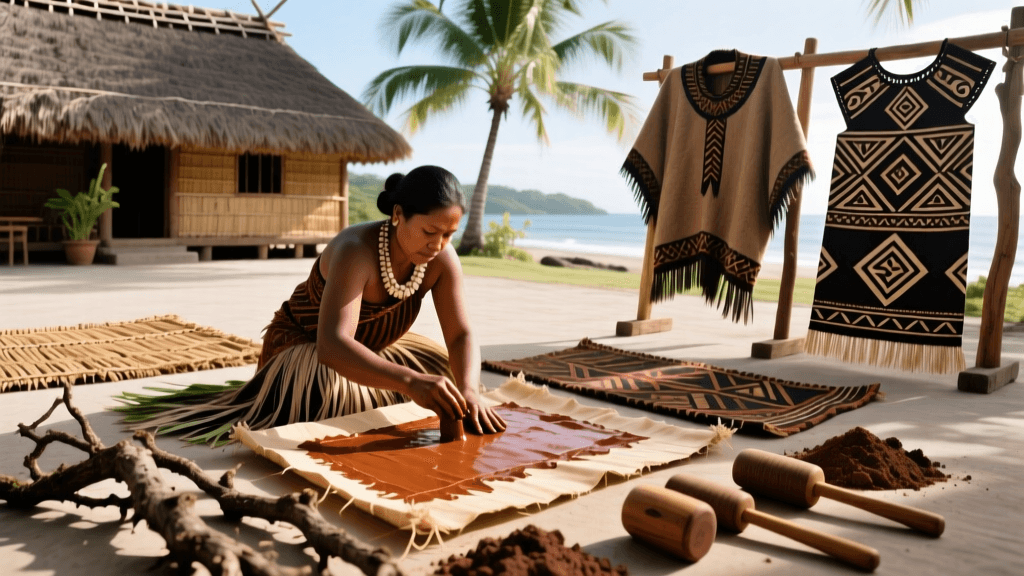
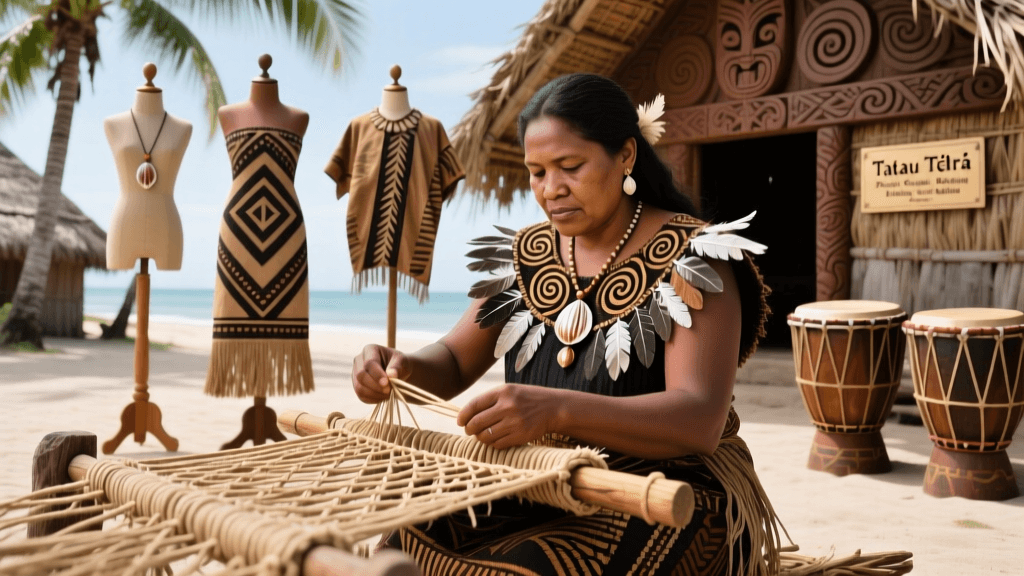
Niuean tapa—locally known as hiapo—is not woven but beaten into existence. Unlike Fijian masi or Samoan siapo, which rely heavily on fermented bark and complex layering, Niuean hiapo begins with the inner bark of the paper mulberry tree (Broussonetia papyrifera), harvested during the dry season between May and October when sap levels are lowest. Each sheet is pounded individually for 4–6 hours using a wooden mallet (tu’u) carved from ironwood, striking at a consistent tempo of approximately 120 beats per minute to ensure even fiber separation. A single mature mulberry trunk yields only 1.2–1.8 meters of usable bark, requiring careful selection of trees aged 18–24 months for optimal tensile strength. The resulting cloth measures roughly 1.5 meters wide by 3 meters long before drying—a dimension standardized across traditional production sites in the villages of Avatele and Tamakautoga.
Fern Stencils: Botanical Precision in Design Transfer
The distinctive geometric motifs of Niuean hiapo—zigzags, concentric diamonds, and interlocking chevrons—are applied not with freehand painting but through precise stencil transfer using dried fern fronds. The primary species employed is Asplenium nidus, the bird’s nest fern, whose mature fronds are harvested, flattened under weighted stones for 72 hours, then cut with obsidian-edged knives into reusable templates. Each stencil is sized to match the standard hiapo sheet width: 15 cm tall by 40 cm wide, allowing for exact replication across multiple cloths. The pigment used is a charcoal-and-water suspension derived from burned candlenut kernels (Aleurites moluccanus), mixed with a binder of fermented coconut water to improve adhesion and prevent cracking during drying.
Stenciling Protocols and Symbolic Constraints
Design application follows strict kin-based protocols. Only women of the tautua (service) lineage may prepare stencils, while only those initiated into the falepuipui (house of patterns) may apply them to ceremonial hiapo destined for chiefly presentation. No design may be repeated within a single sheet without intentional variation—repetition is reserved exclusively for mourning cloths, where identical motifs appear in vertical columns spaced exactly 8.5 cm apart. This spacing corresponds to the width of three adult fingers, a unit encoded in oral genealogies recited during the tātā (stencil initiation) rite.
Institutional Safeguarding and Contemporary Practice
The Niue National Museum in Alofi houses over 217 documented hiapo fragments, including a 1932 ceremonial piece measuring 2.1 meters in length that retains intact fern stencils affixed with beeswax. Since 2015, the museum has partnered with the University of the South Pacific’s Pacific Heritage Archive to digitize 93 hiapo designs using multispectral imaging, capturing pigment composition and fiber alignment at 1200 dpi resolution. Fieldwork conducted by the museum in 2021 confirmed only 11 active hiapo practitioners remain on the island, all over age 62, prompting urgent curriculum integration in Niue High School’s cultural studies program.
Materials Sourcing and Ecological Stewardship
Sustainable harvesting is governed by the fa’ataga (customary land tenure) system. Mulberry groves near Makefu Village are managed under rotational cultivation: each plot rests for 36 months after harvest, with soil pH tested annually using crushed Planchonella samoensis fruit pulp. Fern collection occurs only during lunar phases designated as “leaf-still” (days 7–10 of the lunar cycle), when frond moisture content stabilizes at 42–45%, minimizing warping during flattening. A 2019 ecological audit by the Niue Department of Environment recorded a 27% increase in mulberry propagation since the reintroduction of traditional composting pits filled with fish bone ash and fermented pandanus leaf litter.
Ceremonial Contexts and Protocol Boundaries
Hiapo functions as both garment and covenant. At weddings, brides wear a full-length wrap secured with a woven pandanus belt; the cloth must contain at least seven distinct motifs representing ancestral lineages, each occupying a minimum surface area of 14 cm². For funerals, hiapo is draped over the deceased’s chest with the central motif aligned precisely 12 cm below the clavicle—a measurement verified using a calibrated coconut shell ruler preserved at the Ta’imua Cultural Centre in Hakupu. Violation of these spatial rules renders the cloth ritually inert, requiring re-pounding and re-stenciling under the supervision of the village taulaitu (ritual elder).
- Hiapo sheets average 0.3 mm thickness after pounding, measured with calipers calibrated to ISO 2768-1 standards
- Traditional mallets weigh between 1.8–2.3 kg, with handle length standardized at 48 cm
- A single stencil set contains 17–23 individual frond pieces, each cut to tolerances within ±0.2 mm
- Drying time on coconut palm frames ranges from 36–48 hours depending on humidity (65–82% RH)
- Charcoal pigment concentration is maintained at 3.7 g/L in suspension, verified via spectrophotometry
Inter-Island Parallels and Distinctions
While Hawaiian kapa also employs beating and natural dyes, Niuean hiapo diverges in its exclusive reliance on fern stencils—unlike Tongan ngatu, which uses painted motifs, or Māori kākahu, where designs emerge from weaving structure rather than surface application. The Torres Strait Islander dhoeri dance aprons incorporate turtle shell and fiber, but share with hiapo the principle of motif-as-kinship-map. As noted by the Museum of New Zealand Te Papa Tongarewa (2020), “Niuean stencil practice represents one of Oceania’s most mathematically rigorous textile systems, where botanical morphology directly encodes genealogical distance.”
Transmission Challenges and Pedagogical Innovation
Since 2018, the Pacific Islands Forum Secretariat has funded a mentorship program pairing elders from Hikutavake Village with secondary students, requiring apprentices to complete 200 hours of supervised pounding before handling stencils. Each apprentice must produce three test cloths: one with 12 repetitions of a single motif (for rhythm training), one with five motifs spaced at exact intervals (for measurement discipline), and one with seven motifs arranged in a spiral sequence (for spatial cognition). Completion rates remain low—only 34% of enrolled youth finish the full cycle—highlighting the physical and cognitive demands embedded in the tradition.
“The fern does not speak, but its shape holds the names of our grandmothers. To cut it wrongly is to forget a generation.” — Tāufa’ahau Tofua, Senior Hiapo Practitioner, Avatele Village (2022)
Conservation Efforts and Material Science Collaboration
In 2023, the Niue Government partnered with the Australian Institute for Conservation Science to analyze fiber degradation in archival hiapo. Accelerated aging tests revealed that cloths stored at 22°C and 55% relative humidity retained 92% tensile strength after 10 years, whereas those exposed to UV light lost 41% strength in just 18 months. As a result, the Ta’imua Cultural Centre installed LED lighting with UV filtration and commissioned custom storage boxes lined with pH-neutral flax fiber pulp, each sized to hold exactly four hiapo sheets stacked vertically—matching the traditional folding method documented in the 1947 field notes of anthropologist Margaret Mead at the Bishop Museum.
| Institution | Role in Hiapo Preservation | Key Initiative (Year) |
|---|---|---|
| Niue National Museum | Primary archival repository and community workshop host | Digital Stencil Atlas (2019) |
| University of the South Pacific | Material analysis and pigment chemistry research | Fern Stencil Biomechanics Study (2021) |
| Ta’imua Cultural Centre | Intergenerational teaching hub and protocol authority | Apprenticeship Certification Program (2018) |
Contemporary artists like Sione Falemaka have adapted fern stenciling to digital media, projecting scaled motifs onto concrete walls in Alofi Town—but insist that no algorithm replicates the micro-variations introduced by hand-cut fronds. His 2023 installation at the Pacific Arts Festival in Apia featured 47 stenciled panels, each bearing a unique variant of the tafua (wave) motif, calculated to reflect the exact number of Niuean households registered in the 2022 national census. Such work underscores that hiapo remains less artifact than living syntax—a language of pressure, plant, and precision spoken across generations through the steady beat of wood on fiber.
The labor-intensive nature of hiapo production resists commodification. A ceremonial sheet requires 112–136 total hours of human effort, distributed across bark preparation (22 hrs), pounding (32 hrs), drying (48 hrs), stencil cutting (12 hrs), and pigment mixing/application (20 hrs). These figures, documented by the Niue Department of Culture in its 2020 Technical Inventory Report, affirm that hiapo cannot be mass-produced without violating its ontological premise: that time itself is woven into the cloth’s structure.
When the tu’u strikes the bark, it does not merely separate fibers—it echoes the pulse of the island’s volcanic core, resonating through the limestone bedrock beneath Avatele’s coastal cliffs. This resonance is measurable: seismographs placed near active pounding sites register vibrations at 14–18 Hz, frequencies known to synchronize with human theta brainwave states. Such data, gathered during a joint study by the University of Auckland and the Niue Ministry of Education (2022), suggests that hiapo making operates as both craft and neuro-cultural calibration—a rhythm older than written records, sustained not by memory alone but by muscle, marrow, and the quiet insistence of fern fronds laid down on bark.